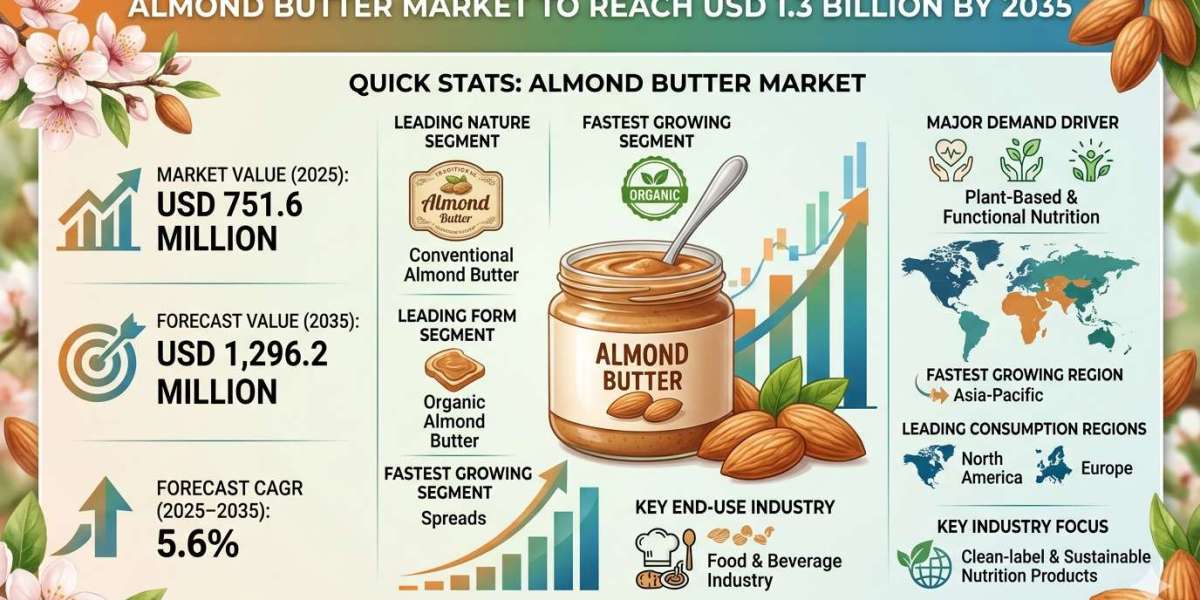

The global almond butter market is projected to grow from USD 751.6 million in 2025 to USD 1,296.2 million by 2035, registering a compound annual growth rate (CAGR) of 5.6% during the forecast period. Market expansion is being fueled by increasing consumer preference for plant-based protein products, growing awareness regarding healthy fats and nutritional wellness, and rising adoption of almond butter across vegan, keto, paleo, and clean-label dietary lifestyles.
The almond butter industry is evolving from a premium nut-based spread category into a broader functional nutrition and wellness ecosystem supported by product innovation, sustainable almond sourcing, and expansion into sports nutrition, dairy alternatives, and personalized health-focused food applications.
Rich in protein, vitamins, minerals, antioxidants, and heart-healthy fats, almond butter is increasingly being positioned as a nutrient-dense alternative to traditional spreads and processed snack ingredients across both household and foodservice sectors.
Quick Stats: Almond Butter Market
• Market Value (2025): USD 751.6 Million
• Forecast Value (2035): USD 1,296.2 Million
• Forecast CAGR (2025–2035): 5.6%
• Leading Nature Segment: Conventional Almond Butter
• Fastest Growing Segment: Organic Almond Butter
• Leading Form Segment: Spreads
• Fastest Growing Form Segment: Liquid Almond Butter
• Key End-use Industry: Food & Beverage Industry
• Major Demand Driver: Plant-Based & Functional Nutrition
• Fastest Growing Region: Asia-Pacific
• Leading Consumption Regions: North America and Europe
• Key Industry Focus: Clean-label & Sustainable Nutrition Products
The almond butter market is transitioning from a niche premium spread segment toward a highly diversified plant-based nutrition ecosystem supported by functional ingredient innovation, AI-driven personalization trends, and sustainable food manufacturing systems.
Manufacturers are increasingly focusing on clean-label ingredients, protein fortification, probiotic and adaptogen integration, and environmentally sustainable sourcing practices to strengthen consumer engagement and long-term market competitiveness.
Market Share Across Plant-Based & Functional Nutrition Ecosystem
• Plant-Based Protein Foods Market: ~5–7% share
• Healthy Spreads Industry: ~8–10% share
• Functional Snack Ingredients Market: ~4–6% share
• Nut-Based Food Products Industry: ~6–8% share
• Clean-label Functional Foods Segment: ~5–7% share
These figures highlight almond butter’s growing strategic importance within the global wellness nutrition, healthy snacking, and plant-based food ecosystems.
Key Growth Drivers
Rising Consumer Preference for Plant-Based Nutrition
Growing adoption of vegan, keto, paleo, and flexitarian dietary lifestyles is significantly accelerating demand for almond butter as a clean-label, protein-rich food alternative.
Increasing Awareness Regarding Healthy Fats & Functional Foods
Consumers are increasingly prioritizing nutrient-dense foods containing healthy fats, antioxidants, vitamins, and minerals, supporting broader almond butter adoption across health-conscious demographics.
Expansion of Organic & Clean-label Food Products
The growing preference for organic, non-GMO, additive-free, and minimally processed foods is driving strong demand for premium almond butter formulations globally.
Growth in Sports Nutrition & Functional Snacking
Increasing integration of almond butter into smoothies, protein snacks, breakfast products, meal replacements, and sports nutrition formulations is supporting long-term market expansion.
Technological Advancements & Product Innovation
The almond butter market is witnessing rapid transformation through advanced food-processing technologies and functional ingredient innovation systems:
• AI-driven product personalization technologies
• Blockchain-enabled ingredient traceability systems
• Precision roasting and grinding technologies
• Functional protein fortification systems
• Probiotic and adaptogen ingredient integration
• Sustainable regenerative almond farming technologies
Manufacturers are increasingly integrating digital quality monitoring, AI-assisted demand forecasting, and precision food-processing systems to improve consistency, scalability, and product differentiation.
Product Innovation Trends
Manufacturers are expanding innovation pipelines with:
• Organic and non-GMO almond butter
• Protein-enriched almond butter formulations
• Sugar-free and keto-friendly variants
• Probiotic-infused almond butter
• Superfood-enhanced formulations featuring chia, matcha, and collagen
• Liquid almond butter for beverages and desserts
• Sustainable biodegradable packaging systems
These innovations are strengthening almond butter’s commercial relevance across retail, foodservice, sports nutrition, and functional wellness applications.
Pricing & Market Stability
The almond butter market continues to maintain strong long-term investment potential despite almond supply volatility and premium raw-material costs:
• Organic almond butter: Premium pricing supported by clean-label positioning
• Functional fortified formulations: Higher-value commercialization opportunities
• Sustainable sourcing systems: Improving supply-chain resilience
• AI-assisted production optimization: Enhancing manufacturing efficiency
• Liquid almond butter applications: Expanding industrial-scale demand
Improved product accessibility, expanding online retail ecosystems, and increasing consumer focus on wellness nutrition are supporting long-term market scalability and profitability.
? Get Access to the Report Sample: https://www.futuremarketinsights.com/reports/sample/rep-gb-14448
Regional Outlook
North America remains the largest almond butter market due to strong health-conscious consumer behavior, widespread plant-based diet adoption, and established retail and e-commerce infrastructure.
Europe continues to witness stable market growth supported by increasing demand for organic food products, sustainable nutrition solutions, and plant-based dietary lifestyles across Germany, France, Italy, and the United Kingdom.
Asia-Pacific is projected to witness the fastest expansion driven by urbanization, rising disposable incomes, growing middle-class populations, and increasing awareness regarding preventive healthcare and healthy eating habits across China, India, Japan, and South Korea.
Japan continues to experience rising almond butter adoption due to increasing demand for nutrient-rich foods, functional nutrition products, and premium health-oriented food applications.
South Korea is witnessing strong growth supported by expanding café culture, growing bakery innovation, and increasing demand for plant-based functional food ingredients.
Competitive Landscape & Market Structure
The global almond butter market maintains a moderately fragmented competitive structure supported by premium nut-butter brands, specialty organic food companies, and plant-based nutrition innovators.
Leading Companies Include:
• Justin’s, LLC
• Barney Butter
• Blue Diamond Growers
• MaraNatha
• Once Again Nut Butter
• Artisana Organics
• Wild Friends Foods
• Nutty Novelties
• Big Spoon Roasters
Manufacturers are increasingly investing in sustainable almond sourcing, clean-label ingredient innovation, advanced flavour development, and eco-friendly packaging systems to strengthen market positioning.
Key Company Initiatives
Justin’s, LLC
Expanded premium organic and non-GMO almond butter product portfolios emphasizing sustainability-focused sourcing practices.
Barney Butter
Strengthened allergen-free almond butter production systems targeting clean-label and specialty dietary consumers.
Blue Diamond Growers
Developed high-protein and low-sugar almond butter formulations for sports nutrition and wellness-focused consumers.
MaraNatha
Expanded organic almond butter offerings supported by clean-label positioning and premium retail distribution.
Once Again Nut Butter
Enhanced fair-trade and sustainably sourced almond butter production targeting ethical consumer segments.
Future Outlook
The almond butter market is expected to witness sustained long-term growth supported by:
• Expansion of plant-based and functional nutrition ecosystems
• Increasing adoption of clean-label food products
• Rising demand for protein-rich healthy spreads
• Growth in sports nutrition and meal replacement categories
• Advancements in AI-driven personalized nutrition
• Expansion of sustainable and regenerative almond farming
• Increasing integration into dairy alternatives and functional beverages
As consumers increasingly prioritize wellness-focused diets, sustainable food systems, and nutrient-dense snacking solutions, almond butter is expected to evolve into a critical component of next-generation functional nutrition ecosystems.
About the Market
The almond butter market represents a rapidly expanding segment within the global plant-based nutrition, healthy spreads, and functional food industries. Its growing role in sports nutrition, wellness foods, meal replacements, dairy alternatives, and healthy snacking positions it as a strategically important category across retail, foodservice, and functional ingredient ecosystems.
About Future Market Insights (FMI)
Future Market Insights (FMI) is a leading provider of market intelligence and consulting services, serving clients across more than 150 countries. Headquartered in Newark, with delivery centers in Pune and offices in the UK and UAE, FMI delivers actionable insights across industries including healthcare, nutraceuticals, food ingredients, chemicals, packaging, and advanced manufacturing.
An ESOMAR-certified research organization, FMI provides data-driven consulting and syndicated market research reports to Fortune 1000 companies, institutional investors, and emerging enterprises worldwide.
See Full Report View: https://www.futuremarketinsights.com/reports/almond-butter-market