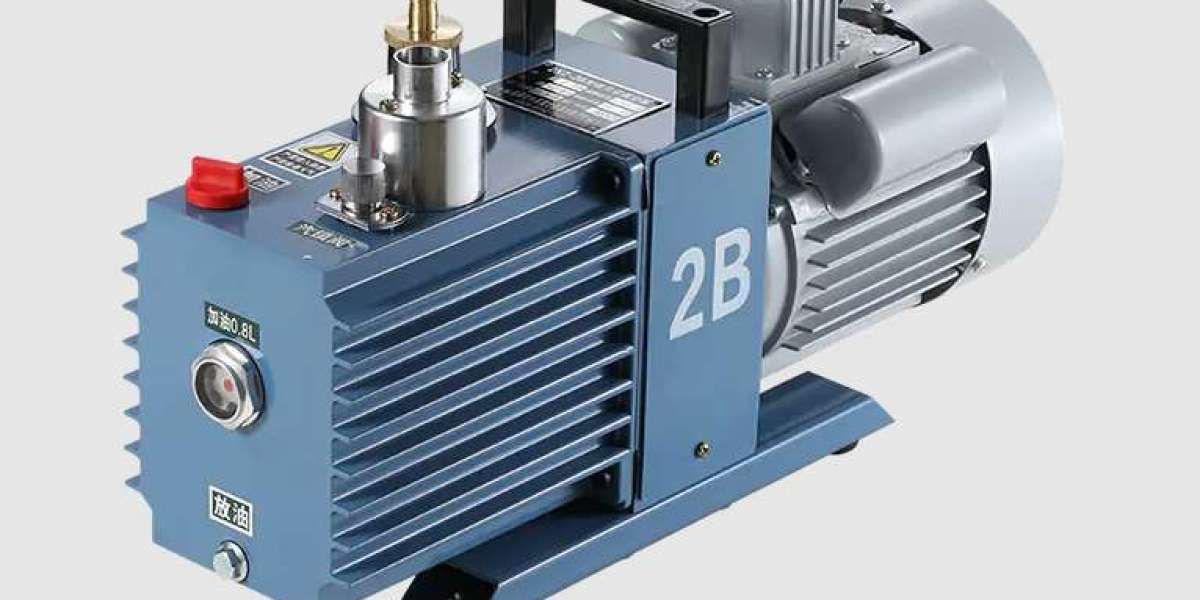

An Oil-Lubricated Rotary Vane Vacuum Pump is widely used in industrial production where stable vacuum generation supports manufacturing efficiency. Packaging facilities, electronics assembly plants, food processing lines, laboratories, plastic molding workshops, and printing operations often rely on vacuum systems during daily production. Although the pump operates behind the scenes, it plays an important role in moving air away from enclosed spaces so different industrial processes can proceed under controlled conditions.
The operating principle of an Oil-Lubricated Rotary Vane Vacuum Pump is both practical and carefully engineered. Inside the pump, a rotor turns within a cylindrical chamber while several sliding vanes move outward because of centrifugal force. Small chambers form between the vanes and the pump housing. As the rotor continues rotating, these chambers expand and contract, drawing air into the pump before compressing and discharging it through the outlet. Lubricating oil supports sealing, reduces friction between moving parts, and contributes to smooth mechanical operation throughout the pumping cycle.
Material selection influences the durability of an Oil-Lubricated Rotary Vane Vacuum Pump. Cast iron housings provide structural stability, while precision-machined rotors help maintain accurate movement inside the chamber. Carbon vanes are commonly selected because they combine wear resistance with stable sliding performance. Shaft seals, bearings, and internal gaskets are manufactured according to precise dimensions so each component fits together securely during assembly.
Different production environments require different pump capacities. Small models fit laboratory instruments, packaging machines, and analytical equipment. Larger units supply vacuum for centralized production systems, industrial forming equipment, woodworking machinery, and pneumatic conveying applications. Manufacturers also provide different motor options, connection sizes, and installation configurations to simplify integration into existing production lines.
Manufacturing accuracy directly affects operating consistency. During production, machined components undergo dimensional inspection before assembly begins. Rotors, pump chambers, shafts, bearings, and vanes are carefully matched according to engineering specifications. Assembly technicians verify clearances between moving parts before completed pumps enter performance testing. Vacuum level, motor operation, sealing performance, and overall mechanical function are evaluated before packaging.
Selecting an Oil-Lubricated Rotary Vane Vacuum Pump involves evaluating structural design, manufacturing precision, application compatibility, and customization capability together. Careful engineering, organized production, and thorough testing allow these pumps to serve industrial users seeking dependable vacuum generation for a broad range of manufacturing processes.