
Market Overview and Growth Outlook
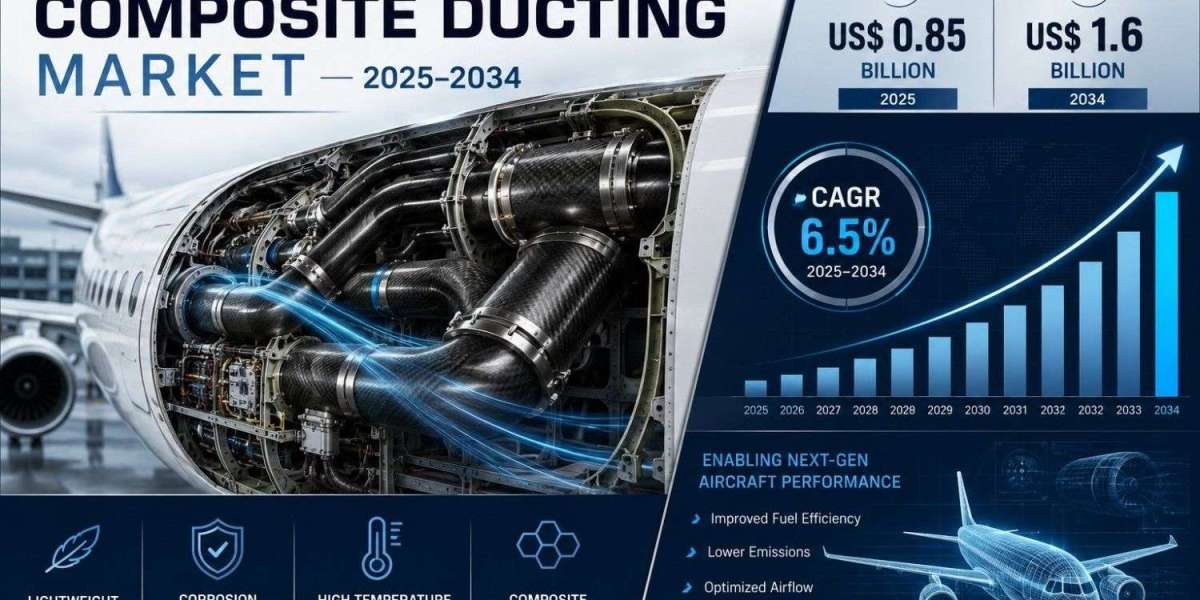
The Aerospace Composite Ducting Market forecast points to an increase from US$ 0.85 billion in 2025 to US$ 1.6 billion by 2034. This growth reflects the rising importance of composite duct assemblies in air distribution systems, avionics cooling, environmental control systems, engine bleed air systems, and other onboard applications.
The Aerospace Composite Ducting Market is expected to grow at a CAGR of 6.5% during 2025–2034. The growth trajectory is supported by rising aircraft production, increasing deliveries of fuel-efficient commercial aircraft, and growing demand for lightweight aerospace components that improve operational efficiency and reduce emissions.
Request a free sample report:
https://www.stratviewresearch.com/Request-Sample/aerospace-and-defense-composite-ducting-market#form
The latest Aerospace Composite Ducting Market forecast highlights a durable shift in aerospace system design. Manufacturers are increasingly adopting composite ducting because it offers strength-to-weight advantages, corrosion resistance, design flexibility, thermal resistance, and lower maintenance requirements compared with traditional aluminum or steel ducting.
Market Segmentation Analysis
The Aerospace Composite Ducting Market is segmented by Aircraft Type (Commercial Aircraft, Regional Aircraft, General Aviation, Military Aircraft, Helicopter, UAV, and Spacecraft), by Pressure Type (Low-Pressure Ducting and High-Pressure Ducting), by Reinforcement Type (Glass Fiber Composites, Carbon Fiber Composites, and Other Composites), by Matrix Type (Epoxy Composites, Phenolic Composites, Other Thermoset Composites, and Thermoplastic Composites), by Application Type (ECS, APU, Avionic Ventilation, and Other Applications), and by Region (North America [The USA, Canada, and Mexico], Europe [Germany, France, The UK, Russia, and Rest of Europe], Asia-Pacific [Japan, China, India, and Rest of Asia-Pacific], and Rest of the World [Brazil, Argentina, and Others]).
Commercial Aircraft are expected to remain the dominant and fastest-growing category. Their leadership is supported by rising global air travel demand, aircraft production growth, fleet expansion, strong order backlogs, and airline focus on lightweight structures that improve fuel efficiency and operational performance.
Glass Fiber Composites remain the dominant reinforcement type because of broad aircraft system use, proven performance, availability, and compatibility with aerospace design requirements. Carbon Fiber Composites are expected to register the highest growth as manufacturers pursue more advanced, lightweight, and high-performance materials.
Epoxy Composites are likely to dominate by Matrix Type, while Thermoplastic Composites are expected to register the highest growth trajectory. Low-Pressure Ducting remains dominant because it is widely used in environmental control systems, cabin air distribution, ventilation, and cooling applications.
High-Pressure Ducting is projected to witness the fastest growth as advanced engine systems and next-generation aircraft platforms require stronger thermal and air management capabilities. ECS remains the dominant and fastest-growing application because of its central role in environmental control and air distribution.
Regional Market Insights
North America dominates the Aerospace Composite Ducting Market and is anticipated to maintain its position through the forecast period. Market strength is supported by major aircraft manufacturers, advanced aerospace infrastructure, continuous investment in next-generation aircraft technologies, and extensive commercial and defense aviation activities.
Asia-Pacific is likely to emerge as the fastest-growing regional market. Its growth is supported by rapid aviation industry expansion, rising passenger traffic, increasing aircraft procurement, aerospace manufacturing investments, airport infrastructure development, indigenous aircraft programs, and expanding low-cost airline fleets.
Emerging Trends Shaping the Aerospace Composite Ducting Market
The market is increasingly shaped by demand for ducting systems that reduce aircraft weight while improving airflow management. Composite duct assemblies support aircraft efficiency and are gaining importance as OEMs focus on performance and maintenance advantages.
Another trend is the adoption of advanced manufacturing processes. Resin transfer molding, additive manufacturing, and integrated duct assembly designs are enabling efficient production and complex lightweight duct geometries suited to modern aerospace platforms.
The expansion of next-generation aircraft systems is increasing demand for ducting solutions that can withstand challenging pressure and thermal conditions. This trend is particularly relevant for High-Pressure Ducting and Thermoplastic Composites, both of which are expected to register faster growth.
Key Growth Drivers of the Market
• Aircraft production growth increases demand for duct systems across commercial, military, general aviation, helicopter, UAV, and spacecraft platforms.
• Fuel-efficient aircraft deliveries support composite ducting adoption because lighter duct assemblies help improve aircraft operational performance.
• Lightweighting priorities are shifting demand from metallic ducting to advanced composite ducting with better strength-to-weight characteristics.
• Advanced manufacturing processes are improving duct production efficiency and supporting complex geometries required by modern aircraft systems.
• More-electric aircraft architectures are increasing demand for ducting solutions that perform under challenging thermal and pressure conditions.
Competitive Landscape
Top Companies in the Market
AIM Aerospace
Arrowhead Products Corporation
ITT Corporation
Parker-Hannifin Corporation
Senior Aerospace
Stelia Aerospace
Triumph Group
Conclusion and Strategic Outlook
The Aerospace Composite Ducting Market is forecast to grow at a CAGR of 6.5% during 2025–2034, reaching US$ 1.6 billion by 2034. Growth is supported by lightweight component demand, advanced composite adoption, commercial aircraft production, and high-performance air management requirements.
The long-term outlook remains positive as North America leads, Asia-Pacific grows fastest, and commercial aircraft continue to anchor demand. As aircraft systems become more performance-driven, composite ducting will remain an important component of aerospace efficiency and lifecycle cost strategies.
FAQs – Aerospace Composite Ducting Market
What is the Aerospace Composite Ducting Market forecast?
The Aerospace Composite Ducting Market is forecast to reach US$ 1.6 billion by 2034. It was valued at US$ 0.85 billion in 2025, reflecting steady expansion over the forecast period.
What CAGR is expected in the Aerospace Composite Ducting Market?
The Aerospace Composite Ducting Market is projected to grow at a CAGR of 6.5% during 2025–2034. This growth is linked to wider composite ducting adoption across aircraft and spacecraft systems.
What are the main Aerospace Composite Ducting Market growth drivers?
Main drivers include rising aircraft production, fuel-efficient aircraft deliveries, lightweighting initiatives, advanced composite materials, and improved manufacturing processes. These drivers support demand across ECS, APU, Avionic Ventilation, and other applications.
Which region is fastest-growing in the Aerospace Composite Ducting Market?
Asia-Pacific is expected to grow at the fastest rate during the forecast period. Growth is supported by aviation expansion, rising passenger traffic, aircraft procurement, and aerospace manufacturing investments.
What risks or challenges should stakeholders consider?
Stakeholders should consider platform-specific performance requirements, pressure and thermal operating conditions, and material selection needs. The Aerospace Composite Ducting Market outlook remains positive where suppliers align with aircraft efficiency and system integration priorities.