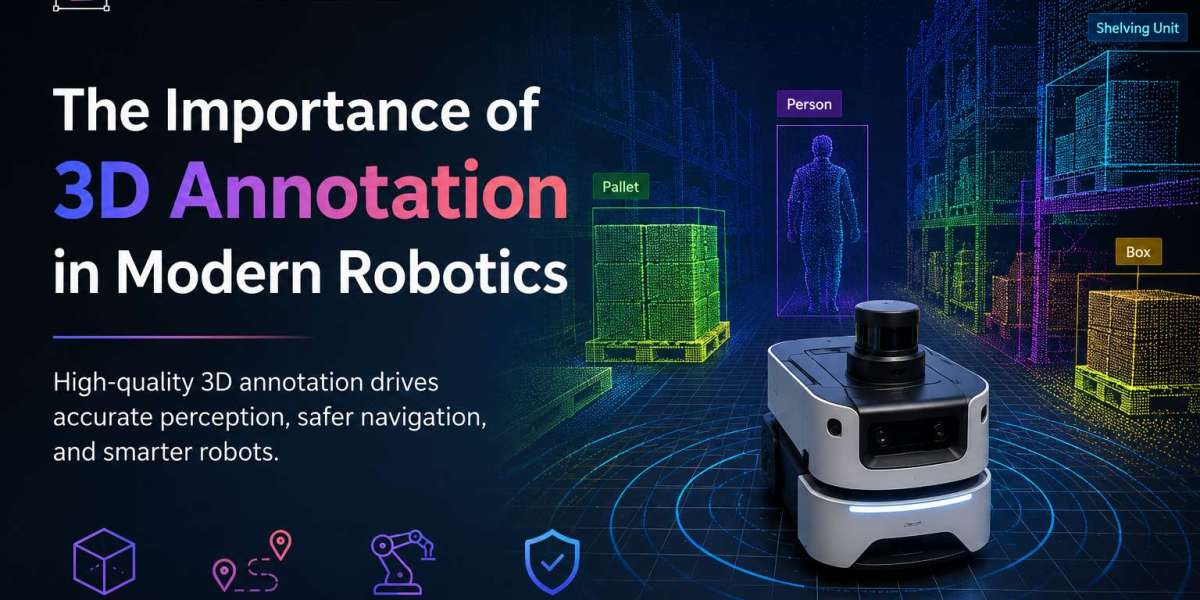

The Importance of 3D Annotation in Modern Robotics
As robotics continues to evolve from industrial automation into intelligent, autonomous systems, the demand for high-quality training data has never been greater. From warehouse robots and autonomous mobile robots (AMRs) to humanoid assistants and agricultural machines, today's robots rely on advanced perception systems to understand and interact with the physical world.
At the heart of these perception systems lies 3D annotation—the process of labeling three-dimensional sensor data such as LiDAR point clouds, RGB-D images, stereo vision outputs, and 3D meshes. Unlike traditional 2D image labeling, 3D annotation enables robots to perceive depth, distance, object orientation, and spatial relationships with remarkable accuracy.
For organizations building intelligent robotic systems, investing in high-quality robotics data annotation services is essential. Accurate robot training data empowers robots to navigate complex environments, manipulate objects safely, and make reliable decisions in real-world scenarios.
What Is 3D Annotation?
3D annotation is the process of assigning labels to objects and environments represented in three-dimensional space. Instead of simply identifying objects within flat images, annotators define their precise location, shape, orientation, and movement using volumetric data.
Common annotation techniques include:
3D bounding boxes
Cuboid annotation
Point cloud segmentation
Semantic segmentation
Instance segmentation
Object tracking across time
Keypoint annotation
Pose estimation
These annotations provide AI models with detailed spatial context, allowing robots to perceive environments much like humans do.
Why Modern Robotics Depends on 3D Annotation
Robots no longer operate in highly controlled environments. They must work alongside people, navigate changing surroundings, and perform increasingly sophisticated tasks.
To achieve this, robots require a deep understanding of:
Object dimensions
Relative positioning
Surface geometry
Distance estimation
Motion prediction
Environmental context
Without accurately labeled 3D datasets, perception models struggle to interpret sensor inputs correctly, leading to poor navigation, failed object manipulation, and unsafe operations.
High-quality robot training data bridges this gap by teaching AI systems how real-world environments are structured.
How 3D Annotation Improves Robot Perception
Accurate Object Localization
One of the biggest advantages of 3D annotation is precise localization.
Robots must know:
Where an object is
How far away it is
Its orientation
Whether it is moving
Its size and dimensions
For example, a warehouse robot cannot simply identify a pallet—it must determine whether it is reachable, estimate its exact position, and calculate a safe approach path.
3D bounding boxes provide this crucial information.
Better Navigation in Dynamic Environments
Autonomous robots constantly encounter changing environments.
Examples include:
Moving workers
Forklifts
Shelves
Doors
Stairs
Temporary obstacles
3D point cloud annotation enables robots to build highly accurate environmental maps while distinguishing between permanent structures and dynamic objects.
This dramatically improves:
Path planning
Collision avoidance
Localization
Simultaneous Localization and Mapping (SLAM)
Autonomous navigation
Improved Object Manipulation
Robotic arms require much more than object detection.
They must estimate:
Grasp points
Object orientation
Surface geometry
Depth
Rotation
High-quality 3D segmentation helps robots determine how to safely grasp fragile, irregular, or partially hidden objects.
This is especially important for:
Manufacturing
Warehouse automation
Surgical robotics
Service robots
Agricultural harvesting
Supporting Multi-Sensor Fusion
Modern robots rarely rely on a single sensor.
Instead, they combine information from:
LiDAR
RGB cameras
Depth cameras
Stereo cameras
Thermal sensors
IMUs
Sensor fusion creates a more complete representation of the environment.
However, this requires synchronized annotations across multiple sensor streams.
Professional robotics data annotation services ensure that labels remain spatially and temporally aligned across all modalities, significantly improving perception model performance.
Enabling Safer Human-Robot Collaboration
Collaborative robots (cobots) increasingly share workspaces with humans.
To operate safely, robots must recognize:
Human body posture
Hand positions
Walking direction
Workspace occupancy
Unexpected movements
3D keypoint annotation and pose estimation datasets help AI models understand human motion in real time.
This enables robots to:
Slow down near people
Maintain safe distances
Predict movement
Avoid collisions
Respond intelligently to human actions
Safety-critical robotics applications depend heavily on accurately annotated 3D datasets.
Applications of 3D Annotation in Robotics
3D annotation plays a critical role across numerous robotics domains.
Warehouse Robotics
Autonomous warehouse robots rely on annotated point clouds for:
Shelf detection
Inventory identification
Bin picking
Forklift avoidance
Navigation
Autonomous Mobile Robots (AMRs)
AMRs use 3D annotations for:
Obstacle detection
Route planning
Localization
Dynamic mapping
Industrial Robotics
Manufacturing robots require accurate 3D labels for:
Assembly
Welding
Pick-and-place operations
Quality inspection
Humanoid Robots
Humanoid robots need detailed annotations to understand:
Furniture
Doors
Household objects
Human gestures
Indoor environments
Agricultural Robotics
Farm robots benefit from annotated datasets for:
Crop identification
Fruit localization
Plant segmentation
Terrain mapping
Healthcare Robotics
Medical robots use 3D annotation for:
Surgical navigation
Instrument tracking
Anatomical segmentation
Patient monitoring
Challenges in 3D Annotation
Although highly valuable, 3D annotation is considerably more complex than traditional image labeling.
Common challenges include:
Massive Data Volumes
LiDAR scans and point clouds often contain millions of individual points.
Managing these datasets requires specialized annotation platforms and experienced teams.
Occlusions
Objects are frequently hidden behind other objects, requiring annotators to infer complete shapes from partial observations.
Temporal Consistency
Robotics datasets often include long video sequences.
Maintaining consistent object identities across hundreds of frames is essential for robust tracking models.
Sensor Noise
Outdoor environments introduce challenges such as:
Rain
Fog
Dust
Reflections
Low-light conditions
Annotators must accurately distinguish meaningful structures from sensor artifacts.
Annotation Accuracy
Even small labeling errors can negatively impact robot perception.
Incorrect object orientation or inaccurate cuboids may cause:
Failed grasp attempts
Navigation errors
Unsafe robot behavior
Rigorous quality assurance is therefore essential throughout the annotation workflow.
Best Practices for High-Quality Robot Training Data
Organizations developing robotic AI systems should adopt several best practices to maximize annotation quality.
These include:
Defining detailed annotation guidelines
Using experienced robotics annotators
Maintaining consistent labeling standards
Implementing multi-stage quality assurance
Validating annotations with automated tools
Leveraging human-in-the-loop review processes
Supporting multimodal sensor alignment
Continuously updating datasets with new edge cases
These practices produce reliable robot training data that improves model accuracy and generalization across real-world environments.
Why Choose Professional Robotics Data Annotation Services?
Building large-scale robotics datasets internally can be expensive, time-consuming, and difficult to scale.
Dedicated robotics data annotation services provide:
Skilled annotation specialists
Expertise in LiDAR and point cloud labeling
Scalable production teams
Rigorous quality control
Faster project turnaround
Support for multimodal datasets
Custom annotation workflows
Enterprise-grade data security
By partnering with an experienced annotation provider, robotics companies can focus on AI innovation while ensuring their perception models are trained using accurate, high-quality datasets.
Conclusion
As robotics systems become more intelligent and autonomous, the importance of accurate spatial understanding continues to grow. 3D annotation provides the foundation that enables robots to interpret complex environments, identify objects precisely, navigate safely, and collaborate effectively with humans.
Whether powering warehouse automation, industrial robotics, autonomous mobile robots, or next-generation humanoid systems, high-quality robot training data remains one of the most valuable assets in AI development. Investing in expert robotics data annotation services ensures that every point cloud, LiDAR scan, and multimodal dataset is labeled with the precision required to build reliable, safe, and scalable robotic solutions.
For organizations developing the future of physical AI, robust 3D annotation is not just a supporting process—it is a strategic capability that directly influences perception accuracy, operational safety, and real-world performance.