
The global olive oil market is transitioning from a supply-constrained commodity cycle into a value-driven recovery, according to latest insights by Future Market Insights. Following periods of severe harvest shortages and historical price spikes across Mediterranean producing nations, a rebound in global olive yields led by Spain, Italy, and Greece is stabilizing unit costs and encouraging consumers to trade back up to premium grades. Simultaneously, CPG brand owners are driving value creation through packaging format innovations (such as user-friendly squeeze bottles and aesthetic glass containers) that position olive oil as a lifestyle kitchen staple.
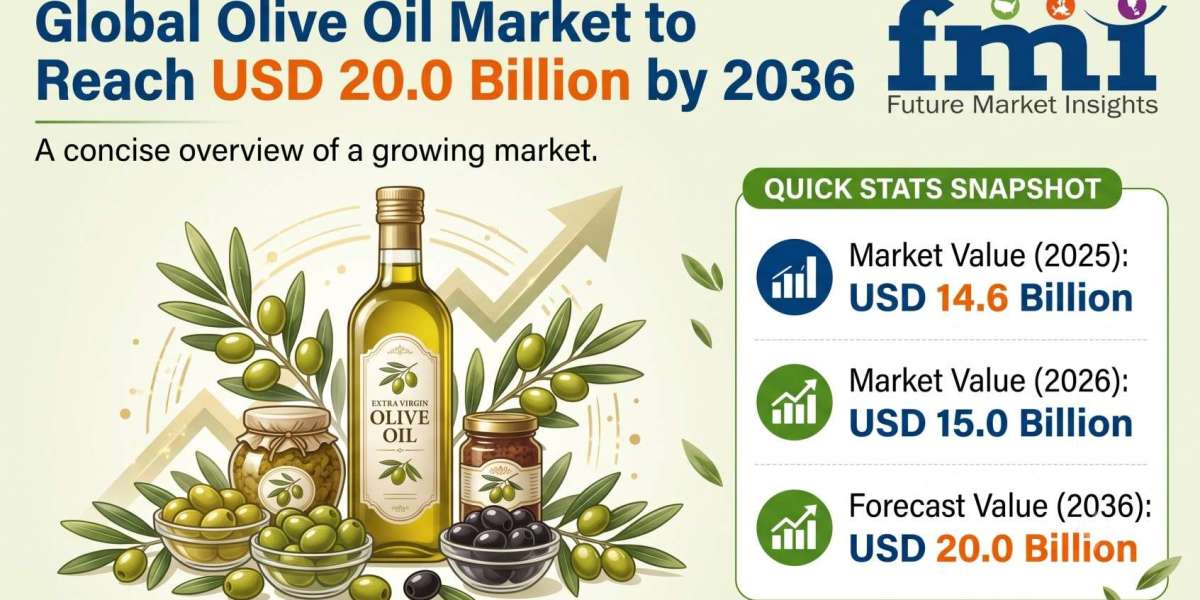
The global market, valued at USD 14.6 billion in 2025, is projected to reach USD 15.0 billion in 2026. Advancing at a Compound Annual Growth Rate (CAGR) of 2.9% over the ten-year forecast period, total market valuation is anticipated to achieve USD 20.0 billion by 2036, yielding an absolute incremental opportunity of USD 5.0 billion.
Get detailed market forecasts, competitive benchmarking, and pricing trends:
https://www.futuremarketinsights.com/reports/sample/rep-gb-208
Market Performance Overview (2026–2036)
To map out the primary quality grades, core end-use applications, and retail distribution channels guiding this USD 5.0 billion market expansion, key segment allocations highlight where global commercial demand is concentrated:
· Refined Olive Oil Product Segment (48.7% share): Commands volume demand in 2026 due to its higher smoke point, neutral flavor profile, and cost-effective pricing for daily frying, high-heat cooking, and industrial food processing.
· Extra Virgin Olive Oil (EVOO) Segment (42.0% share): Drives the majority of market value, favored by health-conscious consumers for its unrefined polyphenol retention, low acidity ($<0.8\%$), and cold-pressed culinary applications (drizzling, dressings).
· Household and Retail End-Use Segment (48.0% share): Represents the primary consumption channel, where modern kitchen convenience formats (squeeze bottles vs. traditional glass) dictate retail purchasing decisions.
· Hypermarkets and Supermarkets Channel (50.0% share): Dominates retail sales, serving as the essential volume driver for both national brand names and private-label olive oil lines.
· India & Germany Regional Leadership: Lead national growth rates at 3.4% CAGR and 3.3% CAGR respectively through 2036, driven by Western diet adoption in Asian metros and high demand for Mediterranean organic oils in Western Europe.
Technical Drivers and Packaging Shifts
The commercial expansion and premiumization of the olive oil market are propelled by three primary industry catalysts:
Packaging Differentiation: Squeeze Bottles and Table Glassware
Brands are actively moving away from traditional industrial tins toward ergonomic, user-friendly formats. The rise of chef-inspired squeeze bottles for high-heat cooking ("Sizzle") alongside aesthetic glass bottles for table drizzles ("Drizzle") has transformed olive oil from an hidden pantry commodity into an aesthetic lifestyle product.
Supply Normalization and Re-Engagement
With Spanish production rebounding significantly in recent harvest cycles (projected around 1.3 million metric tons), historical price inflation is cooling. Normalized retail pricing allows supermarkets to aggressively re-promote Extra Virgin lines and private-label ranges, reigniting household purchase frequency.
Strategic M&A and "New World" Supply Consolidation
To mitigate climate-induced harvest risks in traditional European growing regions (Spain, Italy, Greece), major olive oil companies are pursuing cross-hemisphere M&A. Consolidation moves such as Cobram Estate Olives acquiring California Olive Ranch create vertically integrated trans-Pacific supply chains combining Australian and US production to challenge traditional European export dominance.
Industrial Constraints & Supply Chain Risks
Olive oil producers and CPG brand managers face specific operational hurdles:
· Climate Volatility in the Mediterranean Basin: Severe heatwaves, droughts, and erratic rainfall across Southern Europe cause drastic year-over-year harvest fluctuations, directly impacting raw material availability and bulk oil spot prices.
· Strict Regulatory Standards and Counterfeit Risk: The International Olive Council (IOC) and regional food safety authorities enforce strict chemical and organoleptic testing (acidity, peroxide value, sensory panel evaluation). Preventing mislabeling or adulteration of EVOO requires costly third-party laboratory verification.
Regional Growth Profile
Regional demand reflects supply recovery in European producing hubs alongside expanding Mediterranean diet adoption in North America and Asia:
· India (3.4% CAGR): The global growth frontrunner, driven by rising urban middle-class disposable income, expanding modern trade networks, and joint ventures introducing affordable olive oil to health-conscious consumers.
· Germany (3.3% CAGR) & United Kingdom (3.0% CAGR): Lead European consumer demand, supported by high per capita consumption of organic extra virgin oils, retail private-label strength, and health awareness.
· United States (3.2% CAGR): Represents a massive, high-value import market where import volumes are recovering toward 0.48 million metric tons, driven by culinary trends, format innovations, and domestic Californian production.
· China (3.1% CAGR): Expanding through urban upper-middle-class purchasing for cold preparations, Western dining trends, and holiday gift-box promotions.
Competitive Landscape
The global olive oil landscape features a combination of centuries-old Mediterranean bottling conglomerates, New World vertically integrated producers, and agile CPG startup brands.
Key market participants profiled in the report include Deoleo (Bertolli, Carapelli), Cobram Estate Olives Ltd, California Olive Ranch, Salov Group (Filippo Berio), Graza, Borges International Group, Sovena Group, Gallo Worldwide, Avril Group (Lesieur/Puget), and Australian Oilseeds. Leading players differentiate through brand equity, sustainable farming certifications, dual-format packaging strategies, and hemisphere-diversified sourcing networks.
Full Report for Detailed Insights: https://www.futuremarketinsights.com/reports/india-olive-oil-market
Frequently Asked Questions
What is the projected valuation of the global olive oil market by 2036?
The global olive oil market is projected to reach USD 20.0 billion by 2036, expanding from an estimated baseline valuation of USD 15.0 billion in 2026 at a CAGR of 2.9%.
Why does Refined Olive Oil command a 48.7% market share?
Refined olive oil leads volume sales in 2026 because its neutral flavor and higher smoke point make it the practical choice for everyday high-heat cooking, frying, and commercial food processing applications.
What main end-use category dominates olive oil sales?
Household and Retail leads end-use demand with a 48.0% market share in 2026, as home cooking remains the primary consumption driver for both Extra Virgin and refined olive oil grades.