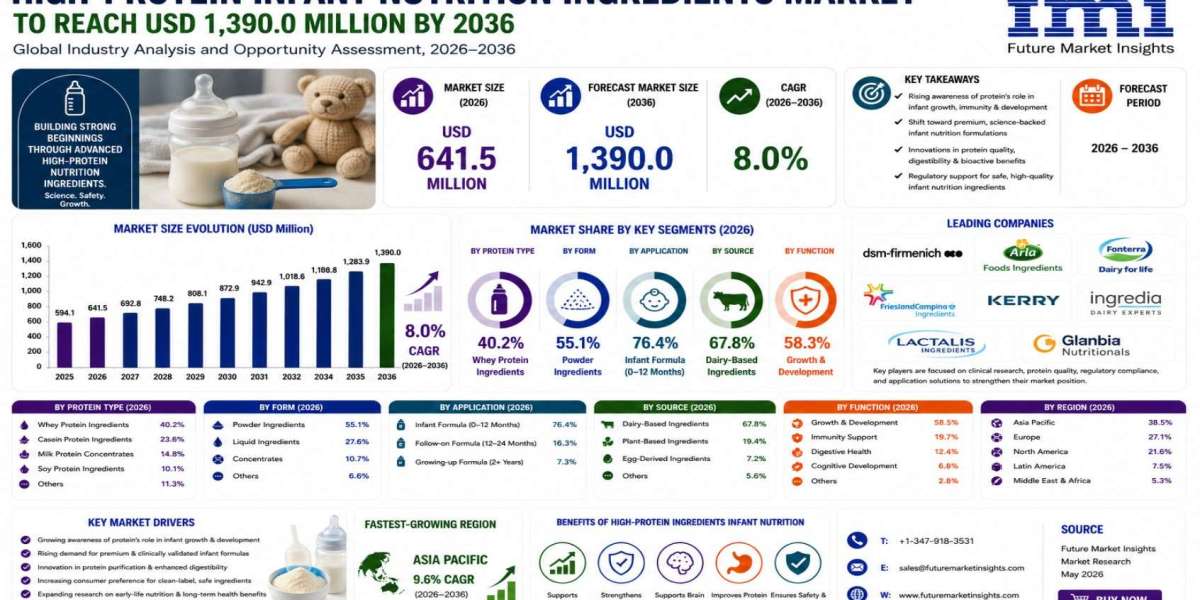

NEWARK, Del., July 2026 — The high-protein infant nutrition ingredients market is projected to grow from USD 641.5 million in 2026 to USD 1,390.0 million by 2036, advancing at an 8.0% CAGR over the forecast period, according to Future Market Insights (FMI). The market is gaining traction as formula manufacturers actively seek out ingredients providing precise amino-acid levels, easy digestibility, and dependable processing performance to create reliable infant nutrition products.
Infant nutrition producers are increasingly investing in specialized whey concentrates, hydrolyzed proteins, and validated plant sources to align with parental demand for healthy growth, digestive tolerance, and early-life immune support. FMI notes that these high-quality protein components offer a practical path to improving nutritional density without compromising stability or safety during commercial processing.
Customized consulting, country-specific forecasts, and competitive intelligence assessments are available upon request: https://www.futuremarketinsights.com/reports/sample/rep-gb-34117
Key Functional Food Ingredients Market Highlights at a Glance
· Market Size (2026): USD 641.5 Million
· Forecast Market Size (2036): USD 1,390.0 Million
· Forecast Period: 2026–2036
· CAGR (2026–2036): 8.0%
· Leading Product Type: Proteins (24.0% Market Share in 2026)
· Leading Source: Plant (18.0% Market Share in 2026)
· Leading End User: Food Manufacturers (11.0% Market Share in 2026)
· Leading Application: Infant Nutrition (10.0% Market Share in 2026)
· Fastest-Growing Country: India (10.8% CAGR through 2036)
According to FMI, commercial success centers on consistent composition and proven performance across regulated formula programs. Lengthy clinical qualification, strict contaminant screening, and variable ingredient functionality form primary barriers limiting rapid supplier substitution across infant feeding applications.
“Commercial value in high-protein infant nutrition ingredients depends on consistent composition and proven performance across regulated formula programs. Development teams compare digestibility records and infant-safety documentation during supplier qualification. Long-term adoption reflects dependable production control and responsive regulatory support across regional launches,” said Nandini Roy Choudhury, Principal Analyst for Food and Beverage at Future Market Insights.
Key Takeaways for the High-Protein Infant Nutrition Ingredients Market
· Demand is driven by formula developers seeking controlled protein quality and dependable processing across regulated infant-feeding applications.
· Proteins lead product type demand with a 24.0% share in 2026, backed by essential amino-acid requirements and established dairy-protein evidence.
· Plant is predicted to lead source demand with an 18.0% share in 2026, reflecting interest in soy and hydrolyzed rice formulations supported by recognized safety pathways.
· Food manufacturers account for 11.0% of end-user demand due to direct responsibility for formula composition, regulatory compliance, and quality control.
· India leads country growth with a 10.8% CAGR, followed closely by the United States at a 10.0% CAGR.
· Suppliers compete on protein quality, infant-nutrition clinical evidence, regulatory permissions, and technical processing support.
Access full Report in PDF Format: https://www.futuremarketinsights.com/reports/brochure/rep-gb-34117
Market Drivers, Restraints, and Opportunities
The market is being driven by formula producers requiring dense protein systems that preserve essential amino-acid delivery within tightly controlled serving volumes. Efficient dispersion and heat stability support uniform nutrient distribution during powder blending and liquid preparation.
Infant-specific safety studies and stringent contaminant screening remain key restraints. Unfamiliar protein sources face prolonged approval timelines, while expanded testing for environmental contaminants increases laboratory workloads across raw-material qualification and batch release.
The strongest opportunity lies in hydrolyzed proteins and bioactive dairy fractions. Specialized hydrolysates address digestive sensitivities and allergy management, while bioactive fractions such as lactoferrin and human milk oligosaccharides (HMOs) create growth openings in formulas focused on immune support and early developmental health.
Segment Analysis
By Product Type
Proteins are likely to represent a 24.0% share in 2026, guided by infant-specific amino-acid requirements and extensive formula experience. Whey protein ingredients remain prominent due to their superior digestibility profile and established position within milk-based formulas.
Fibers, cultures, sweeteners, and flavors complete the product spectrum, serving digestive health, fermentation control, and controlled sensory attributes within strict age-appropriate formulation guidelines.
By Source
Plant sources are predicted to secure an 18.0% share in 2026, driven by established soy applications and specialized hydrolyzed rice formulations. Plant ingredients provide vital alternatives for infants with dairy sensitivities or specialized dietary requirements.
Microbial, dairy analog, upcycled, and mineral options address defined functional roles under specific regulatory and technical assessments.
By Application
Infant nutrition is set to garner a 10.0% share in 2026, backed by concentrated nutritional requirements and strict formula safety controls. Suppliers maintain rigorous application records covering solubility, heat response, and tolerance across final formula systems.
Bakery, beverages, snacks, and ready meals utilize high-protein ingredients to deliver age-appropriate nutrition and textures for older infants, toddlers, and maternal nutrition programs.
By End User
Food manufacturers are expected to hold an 11.0% share in 2026, driven by direct responsibility for formula composition, quality standards, and regulatory compliance. Technical teams prioritize ingredient consistency and robust supplier change control during commercial selection.
Beverage manufacturers, contract manufacturers, foodservice operators, and retail brands focus on processing behavior, solubility, and maintained specification files across outsourced or branded production.
Regional Outlook
FMI observes that growth momentum varies across markets according to birth rates, institutional feeding programs, and regulatory frameworks. India leads expansion in the South Asia and Pacific region, supported by regulatory approvals for specialty ingredients like 2'-FL. The United States follows closely, bolstered by high birth volumes and institutional feeding programs like WIC. Germany and France benefit from established dairy processing infrastructure, while Japan emphasizes clinical digestibility documentation.
Country Growth Forecast (2026–2036)
· India (10.8% CAGR through 2036)
· United States (10.0% CAGR through 2036)
· Germany (9.2% CAGR through 2036)
· Japan (8.4% CAGR through 2036)
· France (7.6% CAGR through 2036)
· United Kingdom (6.8% CAGR through 2036)
India is forecast to lead global expansion with a 10.8% CAGR, driven by rising demand for specialized early-life nutrition and ingredient approvals. The United States advances at a 10.0% CAGR, supported by a substantial birth rate and federal nutrient review standards. Germany and Japan occupy a strong middle tier at 9.2% and 8.4% CAGR respectively, supported by clinical safety evidence and controlled manufacturing capabilities, while France and the UK complete the profile under highly regulated formula composition standards.
Unlock high-growth opportunities with FMI's niche business market insights:
https://www.futuremarketinsights.com/industry-analysis
Competitive Landscape
The competitive landscape includes early-life nutrition specialists, global dairy ingredient groups, and specialized formulation providers focused on protein purity, clinical documentation, and process adaptability. Key companies profiled include dsm-firmenich, Arla Foods Ingredients, Fonterra, FrieslandCampina Ingredients, Kerry, Ingredia, Lactalis Ingredients, and Glanbia Nutritionals.
Suppliers differentiate through clinical research depth, regulatory clearance coverage, application testing capabilities, and robust supply chain traceability. As infant formula brands update their formulations, commercial success increasingly relies on verified ingredient safety, consistent amino-acid profiles, and technical customer support.
Recent Industry Developments
FMI highlights several key industry developments:
· In January 2025, FrieslandCampina Ingredients achieved Generally Recognized as Safe (GRAS) status for Vivinal Lactoferrin across specified United States infant nutrition applications.
· In July 2025, Arla Foods Ingredients secured Australian regulatory approval for Lacprodan MFGM-10 within infant formula applications.
· In March 2026, FrieslandCampina Ingredients completed a strategic expansion of its Borculo production facility to boost commercial supply capacity for specialty dairy proteins, including whey protein isolate and milk fat globule membrane ingredients.
Exclusive Discounts on Full Report: https://www.futuremarketinsights.com/reports/high-protein-infant-nutrition-ingredients-market
Frequently Asked Questions
What is the projected size of the high-protein infant nutrition ingredients market by 2036?
The market is projected to reach USD 1,390.0 million by 2036.
What is the CAGR of the high-protein infant nutrition ingredients market?
The market is expected to grow at an 8.0% CAGR between 2026 and 2036.
Which product type segment leads the market?
Proteins lead the product type segment with a 24.0% share in 2026.
Which source segment holds the highest share?
Plant leads source demand with an 18.0% share in 2026.
Which end user segment leads demand?
Food manufacturers lead end-user demand with an 11.0% share in 2026.
Which country is forecast to grow the fastest?
India is forecast to lead global market expansion with a 10.8% CAGR during the assessment period.
Explore More Related Studies Published by FMI Research
Latin America Shrimp Market : https://www.futuremarketinsights.com/reports/latin-america-shrimp-market
Moringa Products Market : https://www.futuremarketinsights.com/reports/moringa-products-market
USA Wood Vinegar Market : https://www.futuremarketinsights.com/reports/united-states-wood-vinegar-market
Explore In-Depth Food & Beverage Market Insights: https://www.futuremarketinsights.com/industry-analysis/food-and-beverage
FMI Custom Research: Strategic Intelligence for Confident Decision-Making
In today's rapidly evolving business environment, leadership teams need clear, actionable intelligence tailored to their strategic objectives. FMI's Custom Research solutions are designed around specific business questions, enabling executives to evaluate growth opportunities, validate investments, assess competitive dynamics, and reduce uncertainty before making critical decisions.
Key Executive Benefits
· Decision-Ready Insights: Research tailored to your specific business challenges, growth plans, and investment priorities.
· Reduced Strategic Risk: Validate market opportunities, customer demand, and competitive positioning before committing resources.
· Market Entry Confidence: Assess opportunity size, regulatory barriers, channel dynamics, and competitive landscapes with precision.
· Competitive Advantage: Gain proprietary intelligence unavailable through syndicated reports or internal datasets.
· Faster Growth Decisions: Accelerate expansion, product development, portfolio optimization, and investment planning.
· Primary Market Validation: Access real-world customer, buyer, and stakeholder insights that support high-confidence decision-making.
Business Impact
FMI helps organizations transform market complexity into strategic clarity, enabling leadership teams to identify grow