
Market Overview and Growth Outlook
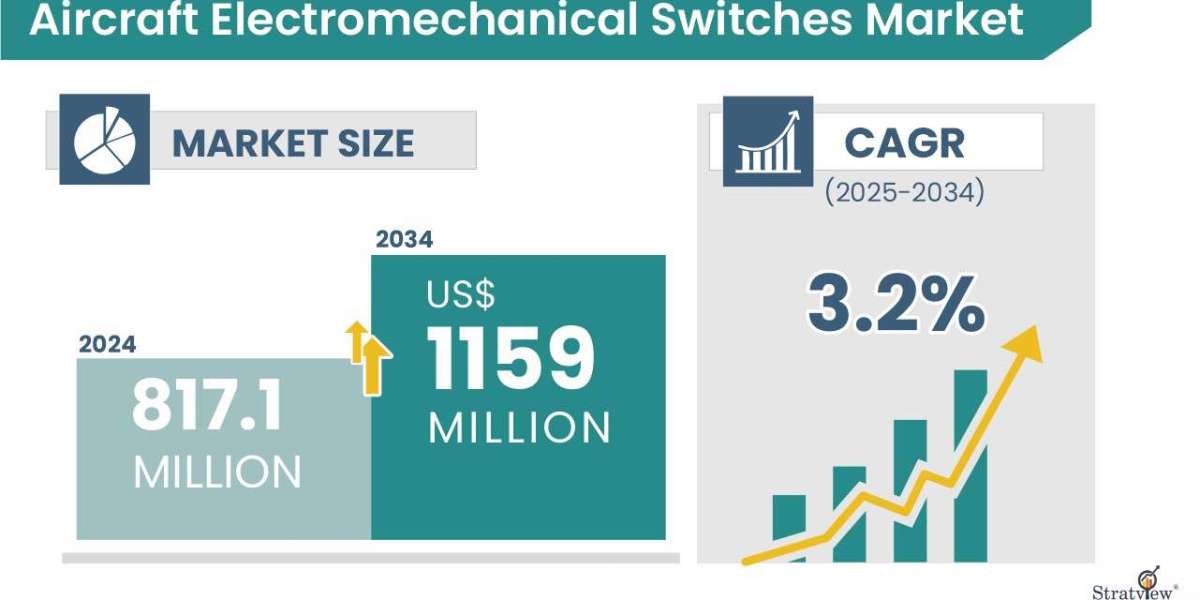
The Aircraft Electromechanical Switches Market is moving from the sharp 15.8% year-over-year increase recorded in 2024 toward a steadier long-term expansion phase. Market value increased from USD 705.6 million in 2023 to USD 817.1 million in 2024 and is expected to reach USD 871.8 million in 2025. Stratview forecasts annual demand of USD 1,159.0 million by 2034, supported by continuing requirements across new aircraft, avionics, modernization programs, and safety-critical electrical functions.
The trajectory of Aircraft Electromechanical Switches Market growth reflects the continuing importance of physical switching interfaces even as aircraft electrical architectures advance. These components translate mechanical actions into electrical signals and support aircraft subsystem control during routine and emergency operations. Reliability under altitude, vibration, and temperature variations remains essential. “The Aircraft Electromechanical Switches Market is expected to grow at a CAGR of 3.2% during 2025-2034.”
Request a Free Sample Report
https://www.stratviewresearch.com/Request-Sample/aircraft-electromechanical-switches-market#form
Market Segmentation Analysis
Aircraft Electromechanical Switches Market, by Aircraft Type is segmented into Commercial Aircraft, Regional Aircraft, General Aviation, Helicopter, and Military Aircraft. Commercial aircraft dominate and are expected to maintain dominance, with expanding global passenger traffic, fleet growth, and investment in next-generation aircraft supporting demand. Advanced avionics and electrical systems incorporated into newer commercial platforms require high-performance switches, while continued fleet modernization reinforces switching requirements across both expanding fleets and older aircraft being upgraded with advanced technologies.
Aircraft Electromechanical Switches Market, by End-User Type is segmented into Linefit and Retrofit. Linefit currently holds the dominant share and is projected to experience the highest growth. Increasing new-generation aircraft production is the principal driver identified by Stratview. Advanced switches integrated during initial aircraft assembly improve system compatibility and reduce future upgrade requirements. Linefit also offers lower installation complexity, better efficiency, and fewer certification hurdles, linking aircraft-production growth directly with increasing demand for factory-integrated switching systems.
Aircraft Electromechanical Switches Market, by Switch Type includes Push-Button, Toggle, Rotary/Knob, Rocker, and Other Switches. Push-button switches hold the dominant position because they are widely used in avionics, lighting, and engine controls. Toggle switches are expected to grow fastest, benefiting from simplicity, reliable actuation, durability, rapid operation, compact dimensions, lightweight construction, tactile feedback, and suitability for harsh conditions. Their characteristics align particularly well with critical flight operations requiring dependable and immediate physical actuation.
Aircraft Electromechanical Switches Market, by Product Type comprises Standard Switches and Custom Switches. Standard switches currently dominate through lower cost, established reliability, broad compatibility, predefined configurations, easier integration, faster production timelines, and reduced certification complexity. Custom switches, however, are expected to grow faster as advanced avionics and electric aircraft systems increase requirements for greater functionality. Demand for platform-specific designs further supports tailored switches developed to satisfy unique aircraft operating requirements rather than standardized configurations.
Aircraft Electromechanical Switches Market, by Location Type is segmented into Cockpit, Cabin, and Avionics. Cockpit is currently dominant because flight operations depend on numerous switches for pilot control and system monitoring. Avionics is forecast to achieve the highest growth as aircraft require enhanced navigation and communication functions. Increasing integration of advanced electronic systems for flight control and safety increases the number and importance of switching interfaces associated with avionics, giving this segment a stronger future growth profile.
Aircraft Electromechanical Switches Market, by Region covers North America, Europe, Asia-Pacific, and Rest of the World. North America currently dominates, while Asia-Pacific is projected to register the highest growth. The distinction is important for regional analysis: North America's position reflects major manufacturers, aerospace infrastructure, and defense spending, whereas Asia-Pacific's growth is associated with rising passenger traffic, aircraft deliveries, expanding airline fleets, and initiatives to develop indigenous aerospace capabilities.
Regional Market Insights
North America's market leadership is supported by the presence of major aircraft manufacturers, advanced aerospace infrastructure, and high defense spending. These conditions collectively create consistent demand for aircraft electromechanical switches. The region therefore represents the market's established demand center, where mature aerospace capabilities and continuing aircraft requirements support switching applications. Its dominant position is directly linked by Stratview to the structure of its aerospace ecosystem rather than to an unsupported broader regional growth assumption.
Asia-Pacific presents the strongest regional growth outlook. Rising air passenger traffic and increasing aircraft deliveries are the principal growth factors identified by Stratview, complemented by government initiatives supporting indigenous aerospace capabilities. Expanding airline fleets further increase requirements for aircraft and their associated switching systems. This relationship makes aircraft deliveries particularly important to the regional market forecast: as fleets expand and new aircraft enter service, demand for electromechanical switches used across aircraft systems rises accordingly.
Emerging Trends Shaping the Aircraft Electromechanical Switches Market
One defining industry trend is the increasing integration of electromechanical switches with advanced electronics. As fly-by-wire systems become more prevalent, switches are being combined with monitoring and feedback capabilities that improve situational awareness and system diagnostics. Aircraft modernization is simultaneously increasing demand for high-reliability, compact, and lightweight components. These developments show that market evolution is not eliminating physical switching interfaces; instead, it is expanding how these interfaces interact with modern electronic aircraft-control and monitoring architectures.
Another structural shift involves more specialized aircraft and platform requirements. Custom Switches are projected to grow strongly because advanced avionics and electric aircraft systems increasingly require tailored functionality. UAV and eVTOL development also creates opportunities for switch integration across defense, logistics, and urban mobility applications. Avionics is similarly expected to experience the highest location-based growth as enhanced navigation and communication requirements expand. These stated trends collectively move demand toward increasingly application-specific, electronics-compatible, and operationally reliable switching solutions.
Key Growth Drivers of the Market
- Global aircraft production and deliveries: Higher passenger traffic and airline fleet expansion increase aircraft manufacturing, creating corresponding demand for switches within cockpit, cabin, and engine-control applications.
- Advanced avionics systems: Greater reliance on navigation, communication, and monitoring technologies requires dependable switch interfaces capable of supporting operational accuracy and safety.
- UAV and eVTOL adoption: Expanding drone and electric vertical take-off and landing aircraft applications in defense, logistics, and urban mobility create additional integration opportunities.
- Safety, reliability, and redundancy: Switches remain critical to backup and fail-safe functions within avionics and engine control, strengthening demand under stringent aviation safety requirements.
- Modernized aircraft architectures: Increasing fly-by-wire adoption and demand for compact, lightweight components promote switch integration with electronics for feedback, monitoring, situational awareness, and diagnostics.
Competitive Landscape
The competitive landscape remains fairly consolidated, according to Stratview, while incorporating a sizeable number of companies. Major players compete across price, service offerings, and regional presence. Competitive activity has also included strategic acquisitions involving flight-control capabilities, ruggedized switches and sensors, and aerospace-grade electromechanical switch portfolios. These developments place technical capability, aerospace applicability, and regional reach at the center of competition as aircraft manufacturers and operators continue demanding reliable switching solutions for progressively advanced aircraft systems.
Top Companies in the Market
- Safran
- TransDigm Group Inc.
- Collins Aerospace
- Curtiss-Wright
- Ducommun LaBarge Technologies
- Honeywell International, Inc.
- Sensata Technologies, Inc.
- Control Products, Inc. (CPI)
- Electro-Mech Components
Conclusion and Strategic Outlook
Stratview's market intelligence indicates a clear long-term trajectory: the Aircraft Electromechanical Switches Market is forecast to expand at 3.2% annually during 2025-2034 and reach USD 1,159.0 million by 2034. Growth is tied to aircraft deliveries, modernization, advanced avionics, safety and redundancy requirements, UAVs, eVTOL platforms, and increasingly electronic aircraft architectures. Commercial Aircraft, Linefit, Toggle, Custom Switches, Avionics, and Asia-Pacific represent important areas of market momentum within the stated forecast framework.
FAQs – Aircraft Electromechanical Switches Market
1. What is the current size and future value of the Aircraft Electromechanical Switches Market?
The Aircraft Electromechanical Switches Market was valued at USD 817.1 million in 2024, with USD 871.8 million expected in 2025. Stratview projects a market value of USD 1,159.0 million in 2034.
2. How quickly will the Aircraft Electromechanical Switches Market grow?
The Aircraft Electromechanical Switches Market is forecast to record a CAGR of 3.2% during 2025-2034. This represents a steady growth outlook through the end of the forecast period.
3. What are the principal Aircraft Electromechanical Switches Market growth drivers?
Growth is driven by rising aircraft production and deliveries, advanced avionics adoption, UAV and eVTOL use, safety and redundancy requirements, and aircraft modernization. These developments increase demand for dependable switching functions across increasingly sophisticated aircraft systems.
4. Which region dominates, and which region is growing fastest?
North America currently dominates the Aircraft Electromechanical Switches Market due to major aircraft manufacturers, advanced aerospace infrastructure, and high defense spending. Asia-Pacific is expected to grow fastest because of passenger traffic growth, aircraft deliveries, airline fleet expansion, and indigenous aerospace development.
5. What does the market outlook mean for strategic industry participants?
The 3.2% CAGR indicates sustained long-term expansion through 2034, supported by clearly identified aircraft and avionics demand factors. Strategic insights from the market point toward Linefit installations, Custom Switches, Avionics, Toggle switches, aircraft modernization, and Asia-Pacific as areas with stronger stated growth momentum.