
Introduction
High-frequency trading depends on how quickly a system can receive market data, process it, and place orders. This makes the design of an HFT trading bot different from a regular trading application. Developers need to think about the complete flow from data collection to order execution. Businesses also need an architecture that can handle their planned strategies and exchange connections.
What Is an HFT Trading Bot?
An HFT Bot provides the business with an opportunity to design automated trading infrastructure around its strategies and exchange needs. It connects with trading venues, reads price and order book updates, checks strategy conditions, and sends orders when the required conditions are met. The main development focus is keeping these steps fast and making each component work together properly.
How Does an HFT Trading Bot Work?
The process starts when the HFT Bot receives live market data. The data is passed to the strategy engine, where programmed rules check the current market conditions. If a trading condition is met, an order is created and sent through the connected exchange API. The system then receives the exchange response and updates its internal trading state.
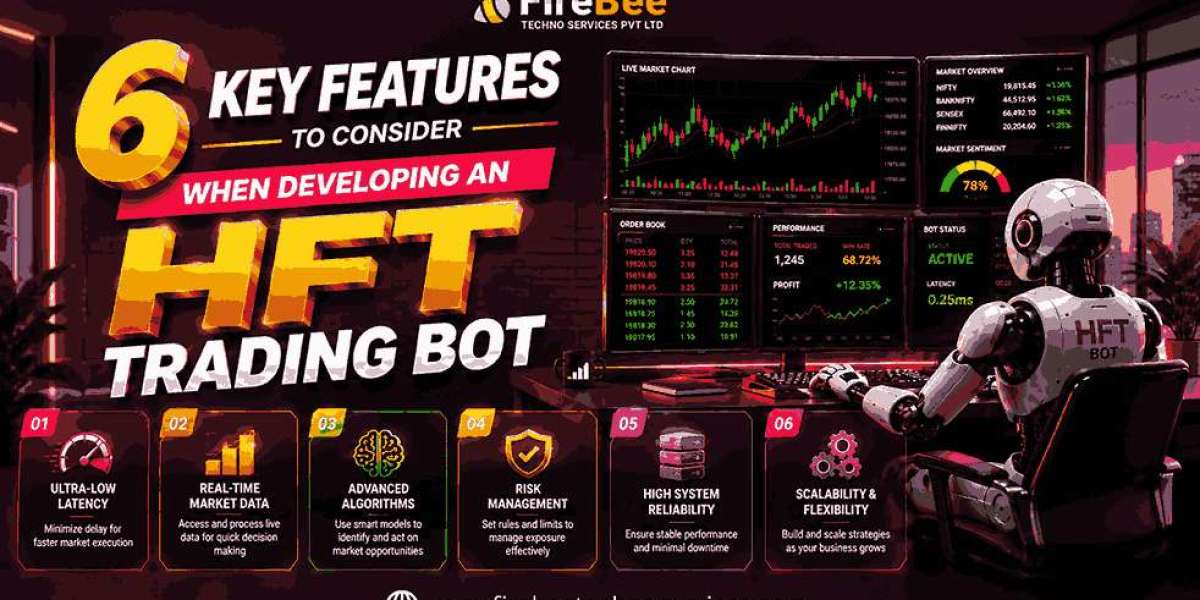
6 Key Features to Consider in HFT Bot Development
1. Direct Market Data Integration
An HFT Bot needs a steady flow of market data to make decisions. Direct market data integration can reduce unnecessary processing between the exchange and the strategy engine. Developers should pay attention to feed handling, order book updates, data formats, and memory usage when designing this part.
2. Strategy Engine
The strategy engine holds the main trading rules of the HFT system. It should be separated from other components so developers can change or test a strategy without affecting the entire application. A modular strategy engine also makes it easier to work with different strategies as the system grows.
3. Smart Order Routing
It is important for a bot accessing multiple trading venues to be able to make sense of where to execute an order based on some criteria. Smart order routing makes it possible to evaluate factors such as liquidity, price, and connection speed before selecting the exchange to execute an order. The routing logic should match the business's trading strategy and execution requirements.
4. Exchange API Connectivity
Exchange APIs connect the HFT Trading Bot with external trading venues. Each exchange may have different API formats, order types, authentication methods, and connection rules. Developers need to account for these differences and also handle dropped connections, rejected orders, and exchange responses.
5. Backtesting Framework
Before deploying an HFT strategy, developers need a way to test how it behaves with historical data. A backtesting framework makes this possible. It can be applied to test the results of a strategy, analyze order behavior, and detect flaws in logic before relying on the trading strategy in actual operations.
6. Reliable System Architecture
The failures might occur at networks, API, or any other element of the system. The architecture should therefore have ways to detect and handle such situations. Connection recovery, process isolation, health checks, and state recovery are useful parts of HFT Bot Development.
Why Consider an HFT Bot for Your Business?
An HFT Bot gives businesses a way to build automated trading infrastructure around their own strategies and exchange requirements. With a well-planned architecture, new exchanges or strategies can be added without rebuilding the entire system. This can also give development teams more control over how the trading infrastructure evolves.
Conclusion
HFT trading bot development requires attention to every part of the trading flow. Market data, strategy logic, order routing, exchange connectivity, testing, and system recovery all need to work together. Choosing these features carefully helps developers create an HFT Bot that is easier to test, maintain, and expand as business requirements change.