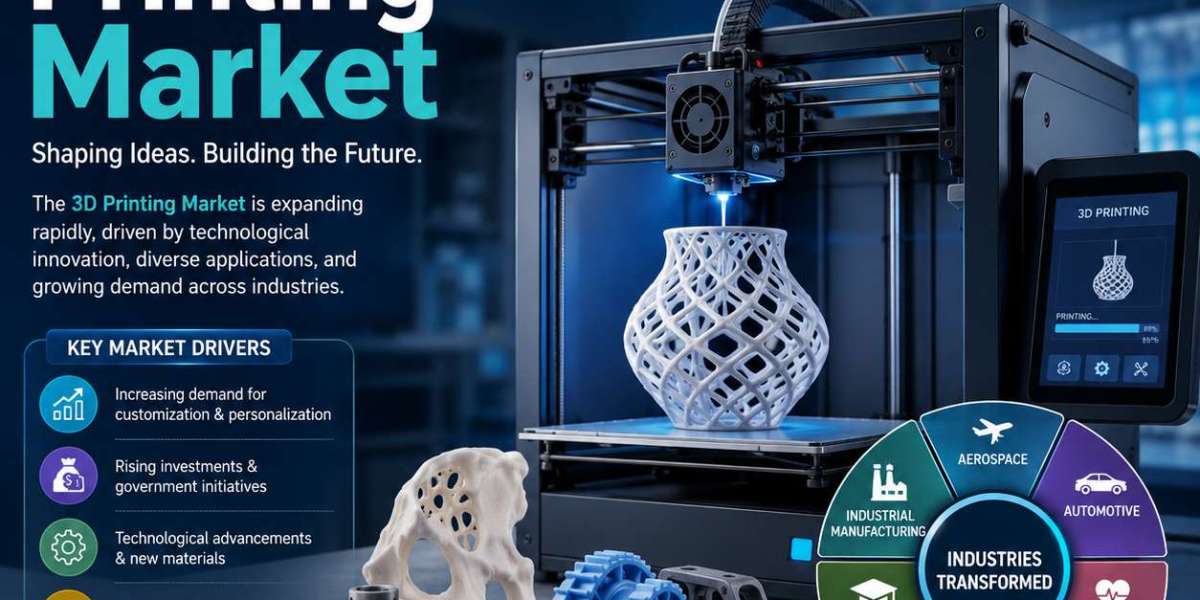

Manufacturing has traditionally depended on factories, molds, tooling, inventories, and lengthy production cycles. Today, that model is being challenged by a technology capable of transforming a digital design into a physical object layer by layer. The 3d Printing Market is becoming an important part of this transformation as manufacturers increasingly explore faster prototyping, customized production, and more flexible manufacturing systems. According to 6Wresearch, the global market was valued at approximately USD 21.5 billion in 2025 and is projected to reach USD 46.2 billion by 2032.
From Prototype to Production
For years, 3D printing was primarily associated with prototyping. Engineers could create a physical model, identify design problems, make modifications, and produce another version without creating expensive molds.
That advantage remains important, but the technology is moving further.
Modern additive manufacturing is increasingly being considered for functional components, customized products, tooling, and selected production applications. This shift is changing how companies think about manufacturing economics.
Instead of producing thousands of identical products, businesses can increasingly manufacture products according to specific requirements.
Why Manufacturers Are Paying Attention
Several advantages are strengthening interest in additive manufacturing:
Faster product development cycles
Reduced dependence on traditional tooling
Greater design flexibility
Ability to produce complex geometries
Opportunities for customized manufacturing
Potential reduction in material waste
Digital storage of designs for decentralized production
These benefits are especially attractive when companies need frequent product modifications or relatively small production runs.
Materials Are Becoming More Important
The evolution of materials is one of the most significant developments in the industry.
Polymers remain widely used, but metal powders, engineering-grade materials, composites, and specialized materials are expanding the range of possible applications. According to 6Wresearch, materials represented approximately 55% of the global market in 2025, making it the largest offering segment.
Material development matters because the performance of a printed product depends heavily on characteristics such as strength, temperature resistance, durability, flexibility, and chemical resistance.
As materials improve, more industrial applications can move from experimentation toward practical deployment.
Industries Finding New Possibilities
The industrial sector remains a major application area for 3D printing. Automotive companies can use additive manufacturing for prototypes, tooling, customized components, and selected production parts.
Aerospace manufacturers are particularly interested in lightweight structures and complex components. Healthcare represents another exciting area because patient-specific models, medical devices, prosthetics, and other customized applications can benefit from digital manufacturing.
Architecture and construction are also exploring printed structures and components, while consumer products can use the technology to create personalized designs.
The Rise of Smarter Printing
The next stage of 3D printing is not simply about better printers. Software, automation, artificial intelligence, simulation, and digital workflow management are becoming equally important.
Design software can optimize components for additive manufacturing. Automated systems can monitor production processes. Digital simulation can identify potential defects before manufacturing begins.
This creates a connected workflow in which design, production, inspection, and optimization become part of one digital ecosystem.
Challenges Still Remain
Despite its potential, additive manufacturing is not suitable for every production requirement.
High-end equipment can require significant investment. Material costs can also be higher for specialized applications. Companies may need skilled technicians and engineers who understand design optimization, machine operation, post-processing, and quality control.
Certification is another important issue, particularly in highly regulated industries such as aerospace and healthcare.
Therefore, successful adoption requires more than purchasing a printer. Businesses must develop an appropriate technology, material, software, and workforce strategy.
What Comes Next?
The future of 3D printing is likely to be defined by integration rather than replacement. Traditional manufacturing and additive manufacturing can increasingly work together.
A company may use conventional processes for high-volume standardized products while using additive manufacturing for customized parts, prototypes, replacement components, and complex geometries.
6Wresearch projects continued growth through 2032, with Asia expected to be the fastest-growing region and the printer segment projected to expand faster than the overall offering market.
The real opportunity lies in understanding where 3D printing creates measurable business value. As costs decline, materials improve, and production systems become smarter, additive manufacturing could become an increasingly normal part of the global industrial landscape.
Who We Are
About 6Wresearch: It is a commercial strategy and growth advisory firm founded in 2011 and headquartered in New Delhi, India, with partners across Southeast Asia and the Middle East & Africa. The firm has delivered over 20,000 commercial engagements for over 2,000 organizations, including Fortune 500 companies, government agencies, and multilateral institutions such as the World Bank and the Asian Development Bank. 6Wresearch combines proprietary intelligence, advanced analytics, and sector expertise to help organizations navigate market complexity and drive sustainable growth. These capabilities explain why organizations trust 6Wresearch for reliable commercial insights and confident decision-making.
Our Proprietary Platform: 6W Export GTM
6W Export GTM is 6Wresearch's proprietary trade intelligence and go-to-market platform, built on UN Comtrade data and enhanced with 6Wresearch's in-house analytical and simulation models, including system dynamics-based forecasting. Unlike broad, sector-level market sizing tools, 6W Export GTM operates at the individual product level down to specific HS codes and micro-segments to identify precise, actionable export opportunities by country and product pair, including markets where trade currently does not exist. This granular, simulation-driven approach allows 6W Export GTM to surface opportunities that sector-wide analysis typically misses, positioning it among a small number of platforms globally offering this depth of product-and-country-specific export intelligence.