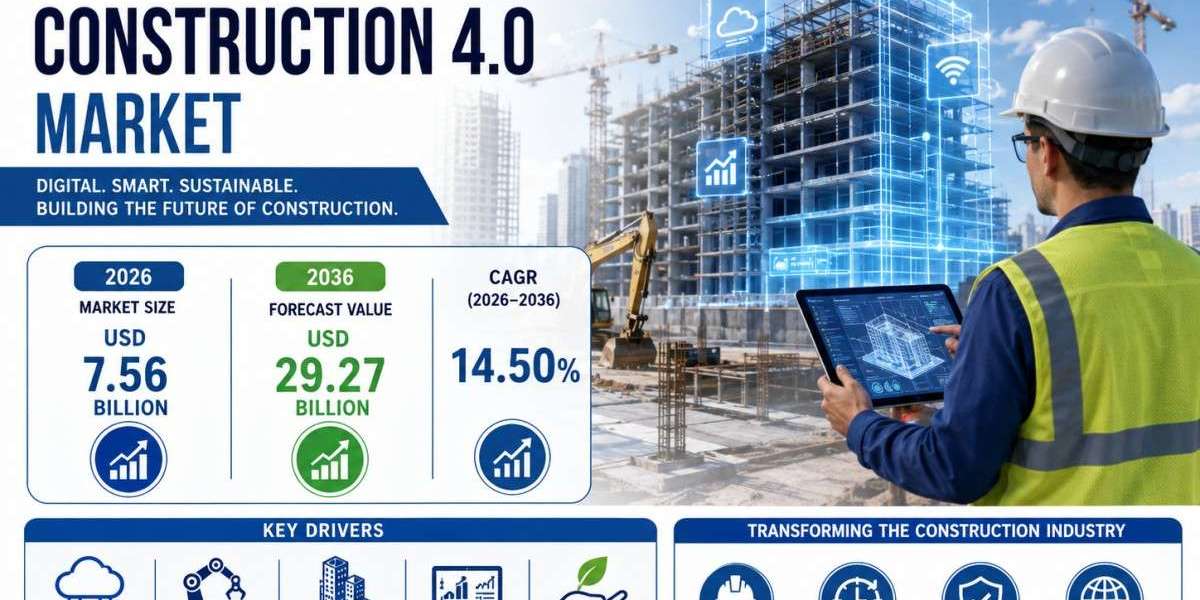

The global Construction 4.0 market is entering a period of accelerated digital transformation as contractors, infrastructure developers, technology providers, and public authorities increase investment in connected construction ecosystems. Building Information Modeling (BIM), Internet of Things (IoT) platforms, artificial intelligence, robotics, drones, and digital twin technologies are becoming increasingly important across project planning, execution, monitoring, and asset lifecycle management. Future Market Insights (FMI) estimates that the market will increase from USD 7.56 billion in 2026 to USD 29.27 billion by 2036, advancing at a 14.5% CAGR during the forecast period.
Government-mandated BIM adoption for public infrastructure projects across the European Union, the United Kingdom, and Singapore is increasingly shifting digital construction platforms from optional productivity tools to procurement requirements. Contractors bidding for large infrastructure projects are under growing pressure to demonstrate certified digital delivery capabilities, data interoperability, and compliance with modern construction management standards.
Labor shortages are also accelerating technology deployment across developed and emerging construction markets. Construction companies are increasingly investing in robotic bricklaying, autonomous earthmoving equipment, AI-powered scheduling platforms, and sensor-enabled machinery to reduce dependence on manual site operations. The market is projected to add approximately USD 21.71 billion in absolute value between 2026 and 2036 as digital technologies become more deeply integrated into construction workflows.
Get detailed market forecasts, competitive benchmarking, and technology adoption insights:
https://www.futuremarketinsights.com/reports/sample/rep-gb-22502
Why Does Hardware Lead the Construction 4.0 Market?
Hardware is projected to account for 38.2% of the Construction 4.0 market in 2026, making it the leading component category. The segment includes IoT sensors, drones, RFID devices, wearables, automated machinery, robotic systems, and other connected equipment that provide the physical infrastructure required for smart construction environments.
Construction sites increasingly depend on real-time information related to equipment utilization, worker safety, environmental conditions, material movement, and project progress. Hardware systems enable continuous data collection and operational monitoring, allowing contractors to improve site visibility and respond more quickly to potential disruptions.
The growing deployment of autonomous vehicles, robotic arms, reality capture equipment, and sensor-enabled machinery is further supporting hardware demand. As construction firms modernize operations, interoperable and scalable field-ready devices are expected to remain essential to broader Construction 4.0 implementation.
Internet of Things Technologies Create Connected Construction Ecosystems
The Internet of Things segment is estimated to account for 34.9% of technology demand, supported by its ability to connect construction equipment, workers, materials, and project management systems through continuous data exchange.
IoT devices are increasingly used to monitor equipment performance, environmental conditions, structural integrity, worker safety, and asset utilization in real time. Connected systems allow construction companies to centralize information through dashboards and automated alerts, supporting faster decision-making and improved operational control.
The technology also supports predictive maintenance strategies by identifying equipment issues before major failures occur. With improvements in wireless connectivity, cloud infrastructure, and edge computing, IoT platforms are becoming increasingly scalable across residential, commercial, industrial, and infrastructure projects.
Asset and Project Management Applications Strengthen Digital Adoption
Asset management applications are projected to represent 30.9% of Construction 4.0 market demand in 2026, reflecting the growing importance of lifecycle visibility across infrastructure and built-environment projects. Digital asset management tools allow project stakeholders to monitor equipment, facilities, materials, and infrastructure performance throughout their operational lifecycle.
Project management also remains a significant application area, accounting for 27.5% of demand. Construction companies are increasingly deploying digital platforms for scheduling, budgeting, resource allocation, documentation, and stakeholder collaboration.
AI-driven analytics and digital twin technologies are expanding the capabilities of project management systems by improving forecasting, identifying potential risks, and providing real-time operational visibility. As construction projects become larger and more complex, integrated management platforms are expected to play a growing role in reducing delays, minimizing rework, and improving accountability.
Public Infrastructure and Commercial Projects Drive Technology Consumption
Construction 4.0 technologies are gaining momentum across residential, commercial, industrial, and public infrastructure projects. Large infrastructure developments are particularly important because they involve complex stakeholder networks, significant capital investment, and long operational lifecycles.
Government infrastructure programs are increasingly incorporating digital delivery requirements into procurement frameworks. BIM platforms, digital twins, connected equipment, and AI-powered analytics can provide greater transparency throughout project development and operation.
Commercial construction companies are also adopting smart construction technologies to improve scheduling accuracy, reduce material waste, and enhance workforce productivity. The combination of recurring infrastructure investment and increasing pressure to improve project outcomes is supporting continued market expansion.
What Is Driving Construction 4.0 Market Growth?
Government BIM mandates, labor shortages, and demand for improved project transparency are strengthening Construction 4.0 adoption, while integration complexity and high technology investment requirements can remain challenges for smaller contractors.
Driver: Government digital delivery mandates for public infrastructure projects are making BIM and connected construction platforms increasingly important for contractors seeking to qualify for major tenders.
Restraint: High implementation costs, integration complexity, workforce training requirements, and interoperability challenges can slow adoption among smaller and mid-sized construction companies.
Opportunity: AI-powered predictive analytics, digital twins, robotics, and autonomous construction equipment are creating opportunities for technology providers that can deliver integrated and scalable platforms.
Insurance and project finance providers are also creating additional incentives for digital construction adoption. Real-time IoT monitoring and connected project platforms can improve risk visibility, potentially supporting faster financing approvals and more efficient project oversight.
Automation in Equipment Operations Accelerates Construction 4.0 Deployment
The increasing use of automated machinery and robotics is becoming a major force behind Construction 4.0 adoption. Semi-autonomous earthmoving equipment, automated concrete pouring systems, robotic bricklaying machines, and rebar tying robots are helping contractors reduce dependence on manual labor while improving consistency across repetitive construction activities.
Construction companies facing persistent workforce shortages are increasingly evaluating mechanized workflows that can improve productivity and reduce project delays. Providers offering integrated robotic systems for labor-intensive tasks are expected to benefit as automation becomes more widely embedded in construction operations.
Digital Twin Integration Supports Predictive Project Planning
Digital twin technology is increasingly moving from experimental applications toward practical deployment across complex construction projects. Digital representations of physical assets can allow contractors and infrastructure operators to visualize project conditions, simulate potential scenarios, and identify design or operational issues before they affect construction activities.
The integration of digital twins with IoT sensors and AI algorithms is further improving real-time project monitoring and forecasting capabilities. Construction companies can use connected digital models to track site progress, evaluate asset performance, and anticipate potential delays.
Cloud-based digital twin platforms integrated with project management software are expected to create significant opportunities as construction stakeholders seek improved predictive planning and lifecycle management capabilities.
Analyst Perspective
"Construction is moving toward a compliance-driven digitalization cycle where BIM capability, connected data architecture, and lifecycle visibility are becoming increasingly important to project qualification. The competitive advantage will increasingly belong to contractors and technology providers that can integrate site intelligence across planning, execution, and long-term asset management."
Future Market Insights Analyst
Market Snapshot
- 2026 market value: USD 7.56 billion
- 2036 projected value: USD 29.27 billion
- 2026–2036 CAGR: 14.5%
- Absolute growth opportunity: USD 21.71 billion
- Hardware component share: 38.2%
- IoT technology share: 34.9%
- Asset management application share: 30.9%
- Project management application share: 27.5%
Country Growth Outlook
China is projected to record the fastest growth among the key countries analyzed, advancing at a 19.6% CAGR through 2036. India follows at 18.1%, Germany at 16.7%, France at 15.2%, the United Kingdom at 13.8%, the United States at 12.3%, and Brazil at 10.9%.
China's rapid expansion is supported by smart city initiatives, large-scale infrastructure investment, robotics deployment, and increasing use of AI-driven project lifecycle management platforms. Domestic construction companies are increasingly working with technology providers to integrate autonomous equipment, IoT-enabled machinery, and predictive analytics into major projects.
India is benefiting from government-backed digital initiatives, the growing adoption of prefabricated construction methods, and increased use of cloud-based BIM and augmented reality platforms. Partnerships between technology startups, construction companies, and real estate developers are supporting the adoption of connected construction solutions across major urban centers.
Germany's market is shaped by the convergence of Industry 4.0 principles with construction technologies. Digital twins, automated surveying systems, modular assembly lines, and sensor-enabled equipment are increasingly supporting precision engineering and supply chain transparency.
France continues to benefit from construction digitization initiatives and energy-efficient building requirements, while the United Kingdom is emphasizing digital twins, modular construction, drones, and AI-powered progress tracking across commercial and public infrastructure projects.
Dive Deeper into the Data—View the Full Report Here!
https://www.futuremarketinsights.com/reports/construction-40-market
Competitive Landscape
The Construction 4.0 market is moderately consolidated, with global technology, automation, software, and construction equipment companies competing across connected hardware, BIM platforms, AI analytics, digital twins, robotics, and project lifecycle management systems.
ABB Ltd. maintains a strong position through industrial automation platforms, IoT-enabled monitoring systems, robotics technologies, predictive maintenance solutions, and autonomous machine control capabilities. The company's strategy focuses on developing connected ecosystems that can integrate automation and operational intelligence across industrial and construction environments.
Autodesk Inc. and Bentley Systems remain prominent participants in software-driven innovation through BIM platforms, digital collaboration systems, and digital twin capabilities. Their technologies support real-time coordination between architects, engineers, contractors, and infrastructure operators.
Trimble, Topcon Corporation, and Hilti Corporation maintain strong positions in precision hardware, connected tools, measurement systems, and IoT-enabled construction technologies. Oracle Corporation and SAP SE strengthen their market presence through cloud-based project lifecycle management, enterprise integration, predictive analytics, and supply chain solutions.
Microsoft Corporation, IBM Corporation, and NVIDIA Corporation contribute artificial intelligence frameworks, machine learning capabilities, visualization technologies, and advanced computing infrastructure for predictive planning and simulation. Schneider Electric is expanding its position through energy automation and sustainable construction technologies.
High research and development requirements, system integration complexity, and compliance with regional safety and quality standards continue to create barriers for new market entrants.
Key Developments in the Construction 4.0 Market
Strategic partnerships and technology collaborations are becoming increasingly important as construction companies seek integrated digital ecosystems. Major market participants are partnering with robotics developers, proptech companies, AI providers, and software innovators to accelerate smart construction technology deployment.
Investment in research and development is also increasing across modular, AI-driven, and interoperable construction platforms. These technologies are designed to connect design, procurement, construction, and asset management processes through shared data environments.
Companies are continuing to introduce robotics platforms, AI-powered project management tools, IoT-enabled equipment, digital twins, and modular construction systems to strengthen their competitive positions and address evolving contractor requirements.
About the Report
The Construction 4.0 Market report covers component, technology, application, end use, and regional demand across the 2026–2036 forecast period.
The market is segmented by component into hardware, software, and services. Hardware includes connected construction equipment, sensors, drones, wearables, RFID systems, and robotic platforms, while software and services support data management, implementation, integration, and ongoing operations.
Technology coverage includes Internet of Things (IoT), Building Information Modeling (BIM), Artificial Intelligence (AI), and other emerging construction technologies.
Applications covered in the study include asset management, project management, risk management, and field management. End-use industries include residential, commercial, industrial, and public infrastructure construction.
The report covers North America, Latin America, Europe, East Asia, South Asia and Pacific, Oceania, and the Middle East and Africa. Key countries analyzed include China, India, Germany, France, the United Kingdom, the United States, Brazil, and more than 40 additional countries.
Explore More Research Reports by FMI
Heterogeneous Mobile Processing and Computing Market - https://www.futuremarketinsights.com/reports/heterogeneous-mobile-processing-computing-market
Construction Design Software Market - https://www.futuremarketinsights.com/reports/construction-design-software-market
2D Barcode Reader Market - https://www.futuremarketinsights.com/reports/2d-barcode-reader-market
3D Bioprinted Organ Transplants Market - https://www.futuremarketinsights.com/reports/3d-bioprinted-organ-transplants-market
3D Display Market - https://www.futuremarketinsights.com/reports/3d-display-market
AI-Enabled Semiconductor Defect Classification and Review Systems Market - https://www.futuremarketinsights.com/reports/ai-enabled-semiconductor-defect-classification-and-review-systems-market
Contact Us:
Future Market Insights Inc.
Christiana Corporate, 200 Continental Drive,
Suite 401, Newark, Delaware - 19713, USA
T: +1-347-918-3531
For Sales Enquiries: sales@futuremarketinsights.com
About Future Market Insights (FMI)
Future Market Insights, Inc. (FMI) is an ESOMAR-certified, ISO 9001:2015 market research and consulting organization, trusted by Fortune 500 clients and global enterprises. With operations in the U.S., UK, India, and Dubai, FMI provides data-backed insights and strategic intelligence across 30+ industries and 1200 markets worldwide.