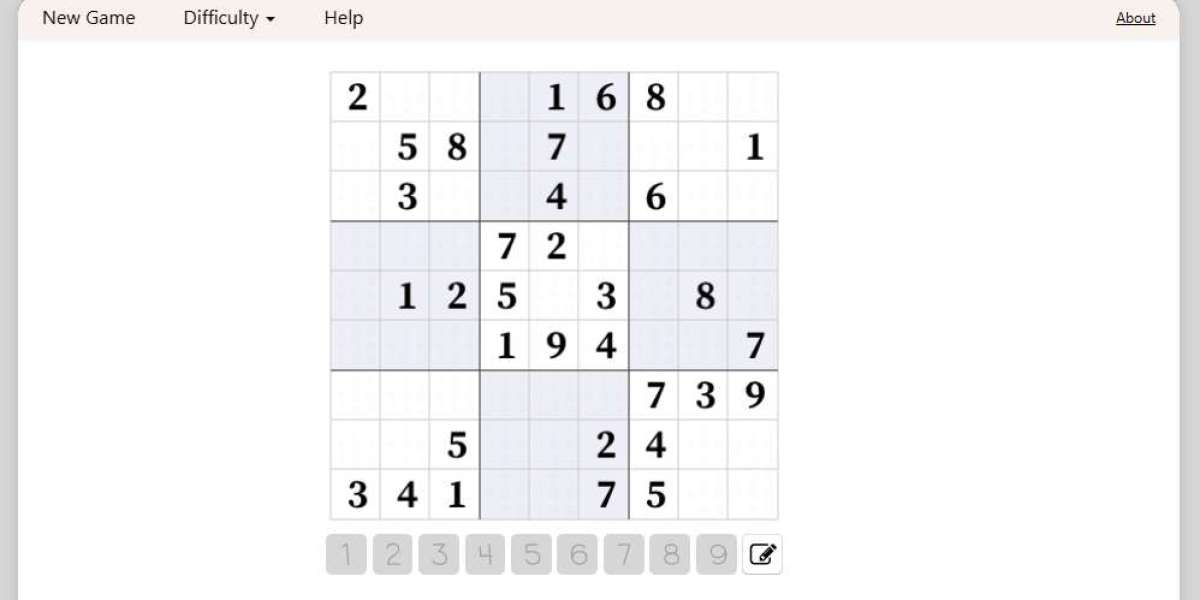

Sudoku is one of the most popular logic puzzles in the world. Simple rules, a clean grid, and unlimited puzzle combinations make Sudoku an enjoyable activity for beginners and experienced players. Unlike many games that depend on speed or luck, Sudoku focuses mainly on logical thinking, careful observation, and problem-solving skills.
A standard Sudoku puzzle contains a 9×9 grid divided into nine smaller 3×3 boxes. Some numbers are already placed in the grid, while the remaining spaces must be completed. The main goal is to place numbers from 1 to 9 so that every row, column, and 3×3 box contains each number exactly once.
Whether played on paper, on a computer, or on a mobile device, Sudoku provides an accessible mental challenge for people of many ages.
What Is Sudoku?
Sudoku is a number placement puzzle based on logical deduction. The modern form of Sudoku became widely popular in Japan during the 1980s before spreading around the world through newspapers, puzzle books, websites, and digital applications.
The name Sudoku comes from a Japanese term connected with the idea that numbers should remain single or unique within a particular space. Although the puzzle uses numbers, mathematical calculation is not required. Players mainly need to understand patterns, identify possibilities, and eliminate incorrect choices.
Understanding the Sudoku Grid
A traditional Sudoku board contains 81 individual cells. These cells form nine horizontal rows and nine vertical columns. The complete board is also separated into nine 3×3 boxes.
Each row must contain the numbers 1 through 9 without repetition. The same rule applies to every column and every 3×3 box. Given numbers provide clues that help determine where the remaining numbers belong.
This structure creates a balance between simplicity and difficulty. The rules can be learned within minutes, but advanced puzzles can require significant concentration.
The Main Goal of Sudoku
The objective of Sudoku is to complete the entire grid while following all placement rules. Every empty cell has a limited set of possible numbers based on the numbers already present in the same row, column, and box.
A correct solution must satisfy all three conditions simultaneously. This is what makes Sudoku a logic puzzle rather than a guessing game.
How to Play Sudoku
Learning how to play Sudoku is relatively easy. The most important step is understanding how each empty cell is affected by nearby numbers.
Start by examining rows, columns, and boxes that already contain many numbers. A nearly completed section often provides useful information because fewer possibilities remain.
Find Missing Numbers
Look at a row with several numbers already filled in. Determine which numbers from 1 to 9 are missing. Then check each empty cell in that row against the corresponding column and 3×3 box.
For example, if a row is missing the numbers 2, 5, and 8, each empty position must be checked to determine which of these numbers can legally fit. If the column already contains 2 and 5, the remaining position must contain 8.
This process is called elimination and forms the foundation of Sudoku solving.
Use Candidate Numbers
When a number cannot be immediately determined, write down the possible candidates for an empty cell. Candidate numbers represent values that do not currently violate the Sudoku rules.
As more cells are solved, some candidates can be removed. Eventually, one candidate may remain, revealing the correct number.
Candidate tracking is particularly useful for medium and difficult Sudoku puzzles because it reduces unnecessary guessing.
Look for Hidden Opportunities
Sometimes a number can only appear in one cell within a row, column, or box. Even when several candidates are visible, this unique position can provide an important clue.
Careful scanning is therefore essential. Instead of focusing only on individual cells, examine the entire row, column, or box to understand where a particular number can legally appear.
Sudoku Strategies for Better Results
As Sudoku difficulty increases, basic elimination may not always be enough. More advanced strategies can help solve puzzles without random guessing.
Naked Singles
A naked single occurs when an empty cell has only one possible number. This is one of the easiest patterns to identify and should always be checked during a puzzle.
Finding naked singles can create new opportunities elsewhere on the board. One solved cell may remove a candidate from several nearby cells.
Hidden Singles
A hidden single occurs when a particular number has only one possible location within a row, column, or box. Other candidate numbers may exist in that cell, but the specific number can appear nowhere else in the relevant section.
This technique requires broader observation and is one of the most useful skills for improving Sudoku performance.
Pairs and Candidate Patterns
More advanced Sudoku solving can involve naked pairs, hidden pairs, triples, and other candidate patterns. These techniques allow players to eliminate possibilities even when no individual cell has a single candidate.
Understanding these patterns takes practice, but they can make difficult puzzles much more manageable.
Benefits of Playing Sudoku
Sudoku provides more than entertainment. Regular puzzle solving can encourage mental engagement and structured thinking.
Improve Logical Thinking
Sudoku requires players to evaluate information and make decisions based on rules. Each placement must have a logical reason, which encourages systematic problem-solving.
Develop Concentration
A Sudoku puzzle can require sustained attention, especially when many empty cells remain. Players need to remember existing numbers and continuously compare possibilities across different sections of the board.
Encourage Patience
Sudoku rewards careful progress rather than rushed decisions. Difficult puzzles may take considerable time to complete, encouraging players to remain patient and reconsider possibilities when progress stops.
Provide Relaxing Entertainment
Many people use Sudoku as a quiet activity during free time. The repetitive process of scanning the grid and finding logical connections can provide an engaging alternative to passive entertainment.
Choosing the Right Sudoku Difficulty
Sudoku puzzles are commonly divided into difficulty levels such as easy, medium, hard, and expert. Beginners should usually start with easy puzzles because they provide a comfortable environment for learning basic techniques.
Easy Sudoku
Easy Sudoku puzzles generally provide more clues and offer straightforward deductions. They are ideal for learning grid structure, number elimination, and basic candidate methods.
Medium and Hard Sudoku
Medium and hard puzzles contain fewer obvious solutions and require stronger observation. Players may need to use candidate notes, hidden singles, pairs, and other logical patterns.
Expert Sudoku
Expert puzzles can require advanced strategies and significant concentration. These puzzles are suitable for experienced players who enjoy complex logical challenges.
Tips for Solving Sudoku More Efficiently
A consistent solving method can make Sudoku easier and more enjoyable. Start with sections that contain many fixed numbers, then search for obvious missing values. Keep candidate notes organized and update them whenever a new number is placed.
Avoid random guessing whenever possible. Guessing can create a chain of incorrect numbers that makes the puzzle difficult to repair. Logical deduction provides a more reliable path toward a correct solution.
It is also useful to take short breaks when a puzzle seems impossible. Returning with a fresh perspective can make patterns easier to notice.
Why Sudoku Remains Popular
Sudoku continues to attract players because the basic concept is easy to understand while the potential for challenge is almost unlimited. Every puzzle creates a different arrangement of clues and possibilities.
Digital Sudoku has also made the game more accessible. Players can now solve puzzles on smartphones, tablets, computers, and dedicated puzzle platforms. Features such as automatic error checking, difficulty selection, hints, and candidate notes can help both beginners and experienced players.
Conclusion
Sudoku is a timeless logic puzzle that combines simple rules with deep problem-solving potential. The 9×9 grid provides a structured challenge where every number must fit according to precise rules. Beginners can learn the basics quickly, while advanced players can spend years developing sophisticated solving techniques.
From improving concentration and logical thinking to providing relaxing entertainment, Sudoku offers a valuable mental activity for everyday life. With regular practice, players can become faster, recognize patterns more easily, and approach difficult puzzles with greater confidence. Whether used as a short daily challenge or a serious hobby, Sudoku remains an engaging puzzle for anyone who enjoys thoughtful problem solving.