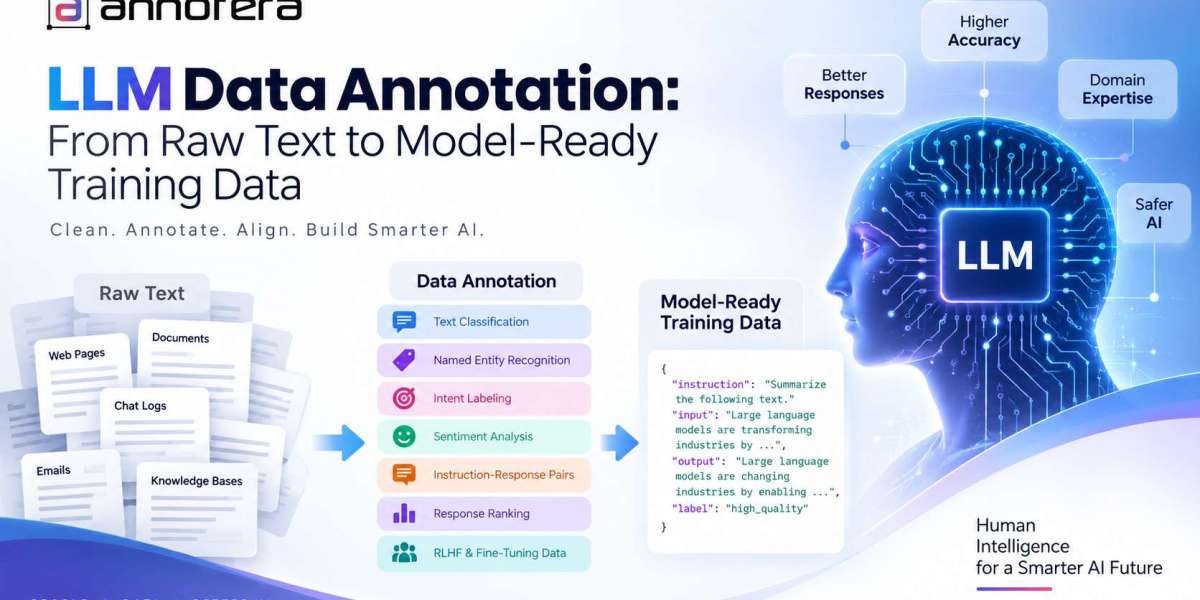

Large language models (LLMs) depend on vast amounts of text, but raw text alone is rarely sufficient for effective model training. Documents collected from websites, customer interactions, knowledge bases, transcripts, and business records often contain inconsistencies, irrelevant information, duplication, formatting issues, and ambiguous language. Before this data can contribute meaningfully to an LLM, it needs to be systematically processed, curated, and annotated.
LLM data annotation transforms unstructured or loosely structured text into organized, task-specific examples that models can learn from. From identifying entities and classifying intent to creating instruction-response pairs and ranking model outputs, annotation helps establish the signals needed for training and fine-tuning.
For organizations developing domain-specific or production-grade generative AI systems, the journey from raw text to model-ready data is therefore a critical part of the AI development lifecycle.
What Is LLM Data Annotation?
LLM data annotation is the process of adding meaningful labels, classifications, instructions, responses, preferences, or other metadata to text datasets so they can be used for machine learning and LLM development.
Depending on the application, annotation can include:
- Intent and text classification
- Named entity recognition (NER)
- Sentiment and emotion labeling
- Question-answer pair creation
- Text summarization
- Instruction-response annotation
- Toxicity and safety classification
- Relevance assessment
- Response ranking
- Preference annotation
- Factuality and quality evaluation
The objective is not simply to label text. It is to create consistent, representative, and usable training examples aligned with the behavior the model is expected to learn.
Step 1: Collecting and Understanding Raw Text
The process begins with data acquisition. Organizations may have text distributed across PDFs, websites, emails, support tickets, chat conversations, product documentation, databases, and other sources.
These sources rarely arrive in a uniform format. Data preparation can therefore involve extracting text, converting file formats, removing unwanted markup, normalizing characters, and consolidating information into a common structure. AWS similarly identifies extraction, collation, filtering, and normalization as important stages in preparing datasets for LLM training.
At this stage, teams should also understand the intended model use case. A customer-service LLM, for example, requires different examples and labeling criteria than a medical information assistant or legal document analysis system.
Step 2: Cleaning and Filtering the Dataset
Raw data can contain substantial amounts of low-value information. Duplicate documents, broken text, irrelevant content, excessive repetition, spam, personally identifiable information, and inconsistent formatting can reduce dataset usefulness.
Common preprocessing activities include:
- Removing duplicate or near-duplicate content
- Correcting formatting inconsistencies
- Filtering irrelevant documents
- Detecting incomplete or corrupted text
- Removing unwanted HTML and metadata
- Identifying potentially sensitive information
- Filtering repetitive or low-quality content
- Separating data by language or domain
Quality filtering is particularly important because undesirable patterns in training data can ultimately influence model behavior. AWS notes that natural text can contain biases, inaccuracies, grammatical errors, and syntax variations, making curation an important component of LLM development.
Step 3: Defining Annotation Guidelines
Before human annotators begin labeling data, organizations need clear annotation guidelines.
These guidelines define what each label means, how ambiguous examples should be handled, which edge cases require escalation, and what constitutes an acceptable annotation.
For example, an intent-classification project might distinguish between:
- Product inquiry
- Technical support
- Billing issue
- Account access
- Cancellation request
Without precise definitions and examples, different annotators may interpret the same text differently. A detailed annotation guideline helps improve inter-annotator consistency and creates a more reliable dataset.
For specialized applications, domain experts can also contribute terminology, classification rules, and contextual knowledge that general-purpose annotators may not possess.
Step 4: Applying Task-Specific Annotations
Once guidelines are established, annotators can transform the cleaned corpus into task-specific training examples.
For an NLP application, this could mean highlighting entities such as organizations, people, products, locations, or dates. For an instruction-following model, annotators may create prompts and high-quality responses. For sentiment analysis, text can be categorized according to predefined sentiment classes.
The annotation approach should reflect the model's intended capability.
For example:
Raw text:
“Can I return this laptop if I purchased it three weeks ago?”
Annotated intent:Return Policy Inquiry
Potential entities:Product: laptopTime Period: three weeks
The same source text can therefore become much more useful when contextual information is explicitly represented.
Step 5: Creating Instruction and Preference Data
For modern LLM applications, annotation frequently extends beyond conventional classification and entity labeling.
Instruction-tuning datasets can contain an instruction, contextual input, and desired response. Preference datasets can contain multiple candidate responses with human judgments indicating which response is preferable.
These datasets are particularly relevant to model alignment. AWS describes preference datasets containing chosen and rejected responses as a format that can support techniques such as direct preference optimization (DPO) and reinforcement learning from human feedback (RLHF).
This is where RLHF & fine-tuning data becomes valuable. Human reviewers can evaluate responses based on criteria such as helpfulness, relevance, accuracy, completeness, safety, and adherence to instructions.
Step 6: Human Review and Quality Assurance
Annotation at scale requires structured quality control.
A multi-stage QA process can include:
- Annotator training
- Qualification tests
- Gold-standard examples
- Independent double annotation
- Agreement measurement
- Expert review
- Adjudication of disagreements
- Random sampling and audits
Human review remains particularly important for nuanced language tasks where context, cultural meaning, domain terminology, or subtle preferences can affect the correct label.
Quality assurance also helps identify systematic annotation errors before they propagate throughout the training dataset.
Step 7: Validation, Formatting, and Dataset Structuring
After annotation, datasets need to be validated and converted into the format required by the selected training or fine-tuning workflow.
Validation can check for:
- Missing labels
- Invalid fields
- Duplicate examples
- Inconsistent labels
- Empty responses
- Incorrect formatting
- Data leakage
- Excessive class imbalance
- Unexpected characters or encoding issues
For instruction-based fine-tuning, datasets may ultimately be packaged in structured formats such as JSONL. The precise schema depends on the target model and training framework. Current AWS guidance emphasizes maintaining compatibility with the model's expected chat or input template during fine-tuning.
Step 8: Building Model-Ready Training Data
The final dataset should represent the real-world conditions in which the model will operate.
This means including sufficient variation in:
- User phrasing
- Writing styles
- Domains
- Languages
- Difficulty levels
- Edge cases
- Input lengths
- Relevant and irrelevant contexts
A high-quality dataset is not necessarily the largest dataset. Its value depends on relevance, consistency, diversity, and the quality of the signals provided to the model. AWS guidance similarly emphasizes dataset quality, diversity, annotation quality, and domain relevance when preparing fine-tuning data.
Why LLM Data Annotation Matters
A model can only learn effectively from the signals present in its training data. Poorly labeled examples can introduce ambiguity, reinforce undesirable patterns, or teach the model behaviors that differ from the intended objective.
High-quality annotation can support:
- More consistent model behavior
- Better instruction following
- Improved domain adaptation
- More reliable classification
- Stronger response quality
- Better alignment with human preferences
- More targeted fine-tuning
- Improved evaluation and benchmarking
For businesses developing generative AI applications, professional LLM & GenAI annotation services can provide the annotation workflows, specialized expertise, quality controls, and scalable human-in-the-loop processes required to transform large text collections into usable datasets.
From Raw Text to Reliable AI Data
LLM data annotation is more than adding labels to documents. It is a structured transformation process that connects raw information with specific model objectives.
The journey typically moves from data collection → cleaning → guideline development → annotation → quality assurance → validation → formatting → model-ready datasets.
When every stage is carefully managed, organizations can create training and fine-tuning datasets that better reflect the behaviors, domains, and real-world scenarios their AI systems are expected to handle.
At Annotera, our LLM & GenAI annotation services help organizations build structured, high-quality datasets for modern language and generative AI applications. From text classification and entity annotation to instruction tuning, preference evaluation, and RLHF & fine-tuning data, a disciplined annotation workflow can provide the foundation for developing more capable and dependable AI models.