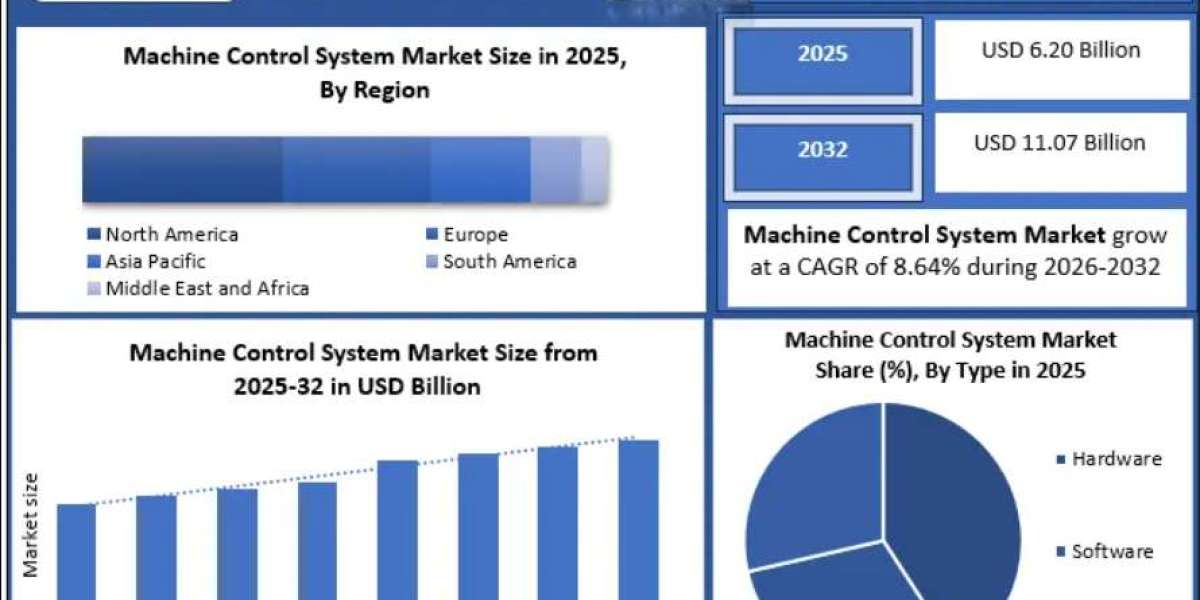

The Global Machine Control System Market is experiencing a structural transition from tactical positioning tools to foundational operational infrastructure, according to a comprehensive intelligence report by Stellar Market Research. Valued at USD 6.20 Billion in 2025, the market is projected to reach USD 11.07 Billion by 2032, expanding at a robust CAGR of 8.64%. The study emphasizes that severe labor shortages, rising infrastructure project complexity, and strict carbon-reduction mandates are forcing global contractors to embed high-precision guidance and semi-autonomous control across heavy equipment fleets.
The heavy machinery sector is undergoing a profound digital transformation driven by shrinking skilled labor pools and thinning operating margins. Historically treated as optional aftermarket upgrades for high-end civil engineering projects, machine control systems (MCS) have emerged as essential productivity tech. With rework accounting for more than 50% of construction site inefficiencies globally, fleet operators are treating automation as an ROI-guaranteed investment rather than an experimental expenditure.
Key Findings from the Report
Market Valuation & Growth: Global revenue is projected to climb from USD 6.20 Billion in 2025 to USD 11.07 Billion by 2032, sustained by an 8.64% CAGR.
Productivity & Efficiency Gains: Machine control deployment yields a 30% to 50% productivity boost in grading and earthmoving while lowering project material waste by 10% to 20%.
Hardware Stack Dominance: The Hardware segment commands over 40% of total market revenue, driven by high demand for GNSS receivers, total stations, and onboard controllers.
Equipment Penetration: Excavators and motor graders represent over 60% of total system installations globally due to depth/slope precision requirements.
Geographic Expansion: Asia Pacific leads global growth, accounting for 43% of market expansion, spurred by massive mega-infrastructure budgets in China, India, and Southeast Asia.
OEM vs. Retrofit Shift: Factory-fitted systems from major OEMs now represent over 50% of new equipment installations, cutting equipment calibration and setup time by up to 40%.
For further information, click the following link:https://www.stellarmr.com/report/req_sample/Machine-Control-System-Market/307
Market Drivers and Restraints
Drivers:
Severe Labor Shortages: With over 650,000 unfilled construction and manufacturing roles in key markets like the U.S. and nearly 25% of the heavy industrial workforce aged over 55, automation fills critical operational voids.
Rework and Waste Reduction: Rework accounts for over 50% of site inefficiencies. Precision grade control lowers design deviations to millimeter accuracy, accelerating project delivery.
Decarbonization & ESG Mandates: As the built environment accounts for nearly 45% of global carbon emissions, MCS limits fuel burn, reduces idle engine hours, and minimizes material overuse.
Restraints:
High Capital Outlay: High upfront expenditure for hardware stack integration, software licensing, and onboard calibration limits rapid adoption among small-scale contractors.
Interoperability and Legacy Fragmentation: Mixed-fleet job sites face software-hardware integration bottlenecks, creating operational friction across legacy machinery platforms.
Technology, Regulation, and Sustainability Trends The convergence of Artificial Intelligence, spatial computing, and low-latency satellite connectivity is redefining machine control capabilities. Edge computing and AI vision algorithms now allow equipment to execute semi-autonomous grading and digging functions with minimal human intervention.
On the regulatory front, government-backed infrastructure bills in North America and strict ESG emission guidelines in Europe are compelling fleet operators to report machine efficiency metrics. Implementing machine control significantly decreases equipment idle times and fuel consumption, supporting corporate net-zero roadmaps while ensuring regulatory compliance on public infrastructure contracts.
Regional Insights
Asia Pacific (Leading Region): Accounting for 43% of total market expansion, APAC remains the primary growth engine. High-density urban developments, high-speed rail corridors, and government infrastructure programs in India, China, and Southeast Asian nations are accelerating demand for GNSS-guided earthmoving machinery.
Europe (Technology Maturity): Led by Scandinavia and Germany, European contractors exhibit high technology adoption rates, with over 98% of firms using machine control in some capacity. Adoption is spurred by carbon compliance laws and automated grading mandates on municipal projects.
North America: Shows steady growth driven by rental fleet electrification, widespread adoption of subscription-based software models, and massive road construction projects.
Latin America & MEA (Emerging Geographies): Emerging growth is anchored by heavy mining expansion, resource extraction, and large-scale energy infrastructure developments in South America and the GCC region.
Recent Industry Developments
Caterpillar & Nvidia (2026): Announced an expanded strategic partnership at CES 2026 to embed AI autonomy frameworks and advanced edge processing directly into Caterpillar's heavy machinery lineup.
Gravis Robotics (2025): Secured USD 23 Million in late-2025 growth funding to accelerate the commercial scale-up of its AI-driven machine autonomy retrofit kits for heavy equipment.
AMETEK & FARO Technologies (2025): AMETEK entered into a definitive agreement to acquire FARO Technologies for $44 per share in cash (approx. 40% premium) to bolster high-precision 3D spatial scanning and laser control capabilities.
Topcon Positioning Systems (2025): Expanded its OEM integration network, delivering factory-fitted, cloud-connected guidance platforms across leading European and Asian excavator brands.
Trimble (2025): Launched enhanced cloud-linked fleet interoperability software designed to unify mixed-fleet 3D grade control data across heterogenous job-site equipment.
Competitive Landscape The global machine control system market is moderately consolidated, with the top five technology providers accounting for approximately 55% to 60% of global revenues. Market leaders Trimble, Topcon, and Leica Geosystems maintain over 45% share within the construction-focused sector through deep OEM relationships and wide distribution networks.
Industrial control leaders including Siemens, ABB, and Rockwell Automation capture 25% to 30% in hybrid industrial-construction applications. Concurrently, original equipment manufacturers like Caterpillar, Komatsu, and John Deere dominate factory-installed systems. Competitive focus is shifting toward subscription software, cloud fleet analytics, and retrofit kits that bridge multi-brand equipment gaps.
Analyst Commentary
"Machine control technology has surpassed the tipping point where it is viewed as a competitive advantage—it is now a baseline requirement for project bidding," stated a Senior Research Analyst at Stellar Market Research. "As civil infrastructure projects face tighter delivery windows and acute operator shortages, integrating AI edge processing and satellite guidance directly into machine hydraulics allows contractors to maintain millimeter precision while reducing fuel consumption and operational costs."
Future Outlook Through 2032, the machine control market will transition toward full machine autonomy and integrated fleet orchestration. As 5G connectivity and low-Earth orbit (LEO) satellite positioning become widespread, real-time digital twin synchronization will allow site supervisors to monitor, grade, and adjust multi-machine operations remotely. Software subscriptions and cloud analytics are expected to outpace hardware sales growth by 1.3 to 1.5 times, solidifying software-defined heavy equipment as the standard across construction, agriculture, and mining worldwide.
For further information, click the following link:https://www.stellarmr.com/report/req_sample/Machine-Control-System-Market/307
About Stellar Market Research
Stellar Market Research is a multifaceted market research and consulting company with professionals from several industries. Some of the industries we cover include medical devices, pharmaceutical manufacturers, science and engineering, electronic components, industrial equipment, technology and communication, cars and automobiles, chemical products and substances, general merchandise, beverages, personal care, and automated systems. To mention a few, we provide market-verified industry estimations, technical trend analysis, crucial market research, strategic advice, competition analysis, production and demand analysis, and client impact studies.
Address
Phase 3, Navale IT Zone, S.No. 51/2A/2, Office No. 202, 2nd floor, Near, Navale Brg, Narhe, Pune, Maharashtra 411041
Email
sales@stellarmr.com
Mobile
+91 9607365656