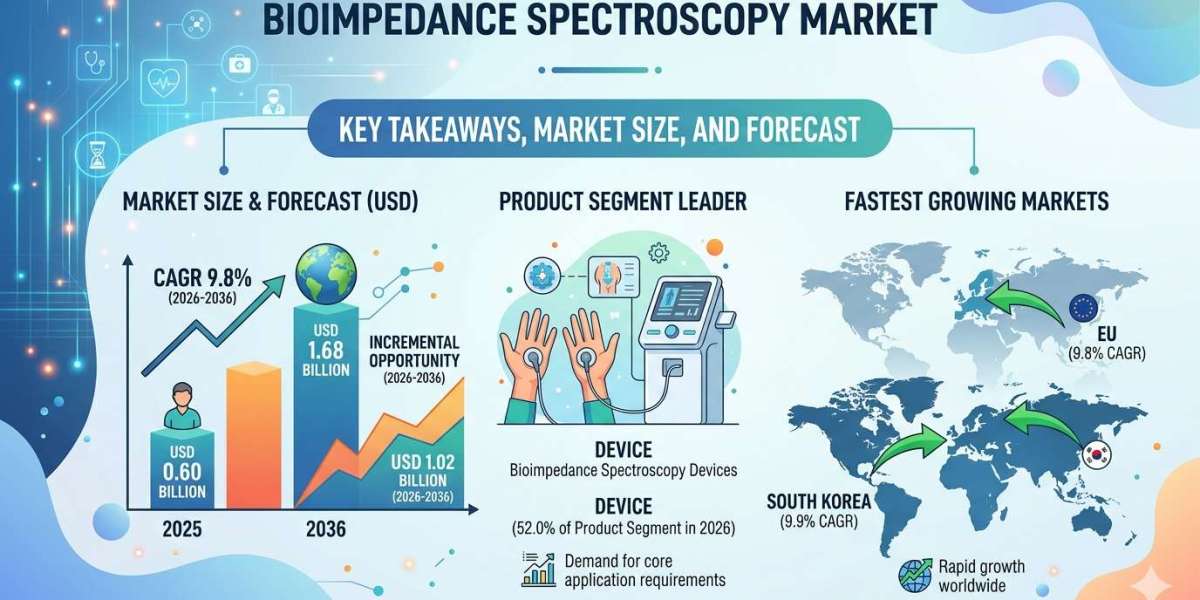

The global bioimpedance spectroscopy market is expected to witness substantial growth over the next decade, supported by rising adoption of non-invasive diagnostic technologies, increasing demand for remote patient monitoring, and growing focus on precision healthcare solutions. According to the latest insights by Future Market Insights, the market is projected to expand from approximately USD 0.60 billion in 2025 to nearly USD 1.68 billion by 2036, registering a CAGR of 9.8% between 2026 and 2036.
Market growth is being driven by increasing use of bioimpedance spectroscopy devices across body composition analysis, fluid monitoring, wellness assessment, and chronic disease management applications. Healthcare providers and wellness institutions are increasingly integrating these technologies into clinical workflows due to their ability to deliver rapid, non-invasive, and accurate physiological measurements.
As healthcare systems worldwide continue shifting toward preventive care and personalized treatment approaches, bioimpedance spectroscopy technologies are emerging as valuable tools for monitoring hydration levels, nutritional status, and disease progression in both hospital and homecare settings.
Bioimpedance Spectroscopy Market Snapshot (2026–2036)
- Market value by 2036: USD 1.68 billion
- Forecast CAGR (2026–2036): 9.8%
- Incremental opportunity created: USD 1.02 billion
- Dominant product segment: Bioimpedance Spectroscopy Devices (52.0% share)
- Leading application segment: Body Composition Analysis (63.0% share)
- Fastest-growing regional market: South Korea (~9.9% CAGR)
- Key demand channels: Hospitals, wellness centers, home healthcare, remote monitoring programs
Momentum in the Market
Beginning from a relatively specialized healthcare technology base, the bioimpedance spectroscopy market is rapidly evolving into a mainstream diagnostic and wellness assessment segment. Between 2026 and 2036, increasing digital healthcare adoption and demand for real-time patient monitoring are expected to significantly expand market penetration.
Healthcare institutions are increasingly utilizing bioimpedance spectroscopy systems for fluid status monitoring in dialysis and cardiovascular patients, while fitness and wellness industries are adopting these technologies for body composition tracking and personalized fitness programs.
The growing integration of remote healthcare platforms and connected medical devices is expected to further strengthen long-term market opportunities. Portable and wireless bioimpedance devices are becoming increasingly popular as healthcare systems prioritize decentralized care delivery models.
From 2030 onward, AI-assisted interpretation tools and cloud-based analytics are expected to improve diagnostic accuracy and accelerate adoption across preventive healthcare ecosystems.
The Reasons Behind the Market’s Growth
Several structural healthcare and technology trends are supporting expansion of the bioimpedance spectroscopy market globally.
Rising Demand for Non-Invasive Diagnostics
Healthcare providers are increasingly prioritizing non-invasive technologies that reduce patient discomfort while improving diagnostic efficiency. Bioimpedance spectroscopy offers fast and repeatable measurements without requiring invasive procedures.
Expansion of Remote Patient Monitoring
The rapid adoption of telehealth and remote monitoring solutions is increasing demand for portable diagnostic systems capable of tracking patient health metrics outside traditional clinical settings.
Growth in Chronic Disease Management
Increasing prevalence of chronic diseases such as kidney disorders, cardiovascular conditions, and obesity is creating sustained demand for continuous fluid and body composition monitoring technologies.
Increasing Focus on Preventive Healthcare
Consumers are becoming more health-conscious and proactive about wellness monitoring, driving adoption of body composition analysis tools in fitness centers and home healthcare environments.
Technological Advancements in Digital Healthcare
Integration of wireless connectivity, cloud analytics, and AI-powered monitoring systems is improving usability and expanding the clinical applications of bioimpedance spectroscopy devices.
Top Segment Analysis
Product Type: Bioimpedance Spectroscopy Devices Lead Market Demand
Bioimpedance spectroscopy devices are projected to account for approximately 52.0% of the product segment in 2026, supported by increasing adoption across hospitals, wellness centers, and research institutions.
The segment benefits from technological versatility, portability improvements, and growing awareness regarding non-invasive health monitoring solutions.
Application Analysis
Body Composition Analysis Dominates Applications
Body composition analysis accounts for nearly 63.0% of the application segment, driven by rising use in fitness assessment, obesity management, sports performance monitoring, and preventive healthcare programs.
Other high-growth applications include:
- Fluid status monitoring
- Fitness and wellness assessment
- Chronic disease management
- Rehabilitation monitoring
- Remote patient care programs
Regional Development: Asia and Europe Emerging as High-Growth Markets
Global adoption patterns indicate strong growth opportunities across developed and emerging healthcare economies.
South Korea
South Korea is projected to emerge as the fastest-growing market, registering approximately 9.9% CAGR through 2036. Growth is supported by advanced healthcare infrastructure, rapid technology adoption, and strong consumer spending on digital healthcare solutions.
European Union
The European Union market is expected to expand at approximately 9.8% CAGR due to increasing healthcare modernization and growing focus on preventive medicine.
United Kingdom and United States
The UK and USA markets continue benefiting from expanding remote healthcare adoption, strong medical technology investments, and increasing consumer wellness awareness.
Japan
Japan remains an important market supported by aging population demographics and increasing need for chronic disease management technologies.
Challenges, Trends, Opportunities, and Drivers
Drivers
- Rising prevalence of chronic diseases
- Increasing healthcare digitization
- Growing demand for remote monitoring technologies
- Expansion of preventive healthcare programs
- Increasing adoption of non-invasive diagnostics
Opportunities
- AI-enabled diagnostic interpretation systems
- Wearable bioimpedance monitoring devices
- Integration with telemedicine platforms
- Expansion into sports and wellness applications
- Cloud-connected patient monitoring ecosystems
Trends
- Transition toward portable wireless devices
- Integration of AI and predictive analytics
- Growth of home healthcare applications
- Increasing demand for personalized wellness monitoring
- Expansion of digital health ecosystems
Challenges
- High device costs in emerging markets
- Data interpretation complexities
- Regulatory approval requirements
- Integration challenges with healthcare IT systems
Country Growth Outlook
The market’s long-term growth trajectory is closely linked to healthcare infrastructure modernization and adoption of digital monitoring technologies across major economies.
- USA: Strong healthcare technology investments and remote care adoption
- UK: Expanding wellness and preventive healthcare ecosystem
- EU: Growing healthcare digitization initiatives
- South Korea: Rapid adoption of connected medical technologies
- Japan: Increasing aging population healthcare requirements
The Competitive Environment
The global bioimpedance spectroscopy market remains highly innovation-focused, with manufacturers competing through technology advancement, device portability, and integration capabilities.
Companies are increasingly investing in:
- AI-powered monitoring platforms
- Wireless and wearable solutions
- Cloud-based analytics systems
- Home healthcare compatibility
- Multi-frequency spectroscopy technologies
Strategic collaborations between healthcare providers, digital health companies, and medical device manufacturers are expected to accelerate commercialization and global adoption.
Future Outlook: Toward Intelligent and Personalized Healthcare
The bioimpedance spectroscopy market is entering a transformative decade shaped by digital healthcare expansion, personalized medicine, and rising demand for real-time health monitoring technologies.
Future developments are expected to focus on intelligent diagnostic systems capable of continuous monitoring, predictive analytics, and integration with broader digital healthcare ecosystems. As healthcare providers increasingly prioritize preventive care and patient-centered treatment approaches, bioimpedance spectroscopy technologies are expected to become essential components of next-generation healthcare infrastructure.
For a comprehensive strategic outlook and detailed analysis of technological developments shaping the industry, readers can explore the full report on the official Future Market Insights website:
https://www.futuremarketinsights.com/reports/bioimpedance-spectroscopy-market