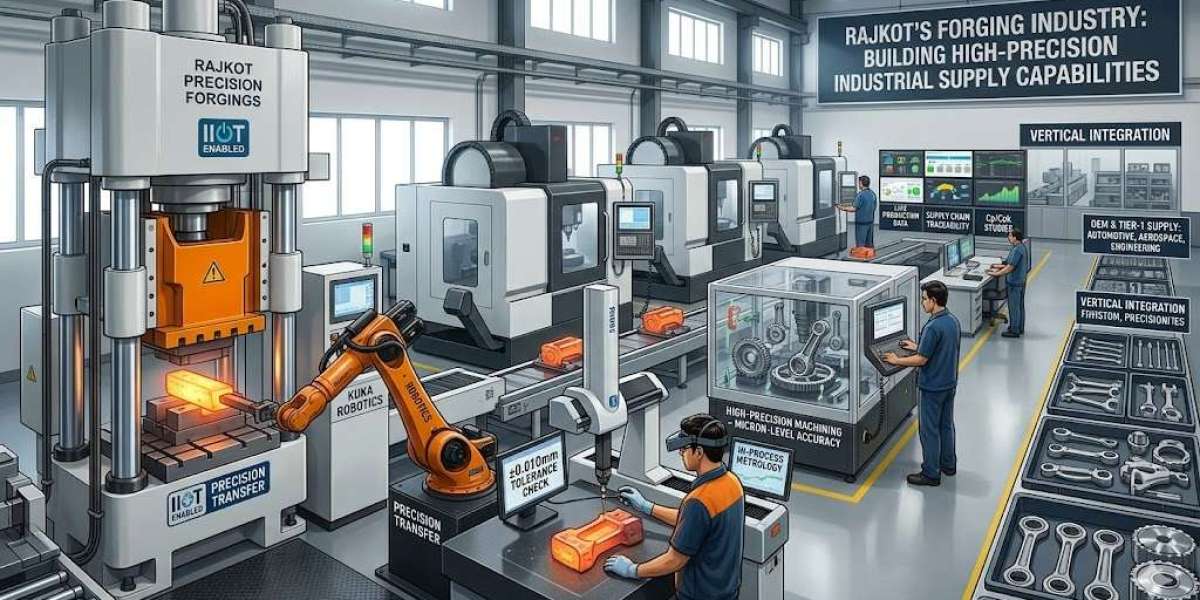

Rajkot doesn't announce itself the way Mumbai or Pune does in industrial conversations, but anyone sourcing precision forgings for automotive, defense, or oil and gas applications knows the name. The city's industrial corridor in Shapar-Veraval — a designated GIDC zone stretching across roughly 2,200 acres — houses one of the densest concentrations of metalworking manufacturing in Asia, with forging units accounting for a significant portion of the output. The question that matters to buyers today isn't whether Rajkot produces forgings. It's which subset of the forging company in Rajkot population has crossed from volume production into genuine precision supply capability, and what that crossing actually required.
The Industrial Geography Behind Rajkot's Forging Cluster
The Rajkot forging cluster didn't develop accidentally. The city's metalworking base traces back decades to the tool-and-die industry that grew around agricultural equipment repair and light engineering, and the skills those trades produced — die fitting, heat treatment, precision measurement — transferred directly into forging as the automotive and industrial sectors expanded in Gujarat. The proximity to Ahmedabad, Surat, and the Mundra and Pipavav ports gave suppliers access to both domestic OEM customers and export freight lanes without the logistics costs that inland industrial clusters absorb.
The Shapar industrial area means a forging company in Rajkot operates inside a cluster with shared infrastructure — steel trading houses carrying multi-grade billet inventory, tool steel suppliers holding die material stock, heat treatment vendors running continuous bell and pit furnace operations, and shot blasting shops within trucking distance. That ecosystem compresses working capital requirements and shortens the internal supply chain in ways that matter to export buyers on tight program schedules. What it doesn't automatically provide is the quality management infrastructure that IATF-mandated automotive and defense work demands — that comes from individual supplier investment, and the spread across Rajkot's forging population on that dimension is significant.
What Precision Forging Actually Requires in Process Terms
The phrase "precision forging" appears in nearly every forging company in Rajkot brochure and website, and it is used inconsistently enough that it has almost lost technical meaning. Defining it rigorously clarifies the capability gap between suppliers.
In closed-die forging of steel components, the as-forged dimensional tolerance under well-controlled production conditions — per IS 2004 and DIN 7526 — falls in the ±0.5 to ±1.0mm range for linear dimensions below 100mm. Near-net-shape forging tightens that to ±0.2 to ±0.3mm on critical faces, requiring billet weight control within ±5 grams on a 500-gram billet, induction heating to within ±15°C across the cross-section, and flash land geometry calculated to resist underfill without excessive flash. Near-net-shape meaningfully reduces machining allowance at production volumes, but it demands more from the die designer, press operator, and in-process measurement system than standard closed-die work.
Above near-net-shape sits precision net-shape forging of aluminium alloys, where components exit the die at ±0.05 to ±0.15mm with functional surfaces requiring no subsequent machining — automotive suspension brackets, hydraulic valve bodies, aerospace structural fittings. Achieving this consistently requires servo-controlled forging presses, because the energy and velocity profile at die contact must be precisely repeatable across thousands of cycles; impact hammer systems cannot provide that control.
Material Range and Its Implications for Supplier Qualification
A forging company in Rajkot serving multiple industrial sectors must handle a material range that creates distinct metallurgical and process demands for each grade family, and the qualification requirements attached to each vary considerably.
Carbon steels in the 1045 and 1541 grades cover a large portion of agricultural equipment and commercial vehicle applications — PTO shafts, axle tube ends, lift arm pivots. These grades forge readily in the 1,100–1,200°C range and respond predictably to normalizing and induction hardening. The process is well-understood, and most established Rajkot forging shops handle it competently. Alloy steels — 4140, 4340, EN24, EN36 — are where the differentiation begins. These grades have narrower forging temperature windows, higher deformation resistance, and greater sensitivity to cooling rate variation after forging. A 4340 billet that cools unevenly after die exit develops differential hardness across the cross-section that subsequent heat treatment cannot fully correct, because the microstructural segregation is set before the heat treater receives the part.
Stainless steel forging — grades 304, 316, 410, and 17-4PH — requires different die materials, lubrication systems, and heating protocols entirely. Austenitic grades like 316 work-harden rapidly, making multi-blow sequencing and die release critical, and die surface temperatures must stay above 200°C to prevent thermal shock cracking. Aluminium forgings in 6061-T6 and 7075 require near-isothermal conditions with die temperatures at 350–450°C and billet temperatures in the 400–480°C range — equipment and instrumentation discipline that most carbon steel shops simply don't maintain.
The table below maps material families to their forging temperature ranges, application sectors, and governing standards — since the combination of all three defines the actual qualification burden a forging company in Rajkot carries for each product line it chooses to serve.
Material Family | Forging Temp Range | Primary Sectors | Key Standards |
Carbon Steel (1045, 1541) | 1,100–1,250°C | Agriculture, Commercial Vehicles | IS 2004, IS 1570 |
Alloy Steel (4140, 4340, EN24) | 1,050–1,200°C | Automotive, Defense, O&G | ASTM A108, IATF 16949 |
Stainless Steel (304, 316, 410) | 950–1,150°C | Oil & Gas, Defense, Chemical | ASTM A182, PED 2014/68/EU |
Aluminium (6061, 7075) | 400–480°C | Aerospace, Automotive, Defense | AMS 2770, NADCAP (for aerospace) |
Bronze / Copper Alloys | 750–900°C | Marine, Railways, Electrical | BS EN 12163, IS 291 |
Each row in that table represents a distinct process capability requirement. A supplier who forges carbon steel competently is not automatically qualified to forge 7075 aluminium for a defense bracket application — the equipment, controls, and inspection protocols are different enough that separate qualification evidence is needed.
Quality Systems That Turn Process Capability into Export Eligibility
The quality framework behind a serious forging company in Rajkot export operation involves more than a wall certificate. IATF 16949:2016 requires a documented PPAP, PFMEA tied to a live control plan, and Cpk of at least 1.67 on all drawing special characteristics. These requirements exist because OEM customers have learned through warranty data that suppliers without statistical process control deliver field failures three to five years after launch — long after the purchase order is closed and the relationship is the only thing left to explain what went wrong.
For defense qualification under DGQA, BIS, MSQAA, or US MIL-STD frameworks, the documentation requirement intensifies further. Every heat of material must trace to a mill certificate. Every heat treatment batch must carry a time-temperature record against the lot number. Charpy impact results per ASTM E23 must be available per batch for sub-zero service requirements, and ultrasonic testing records per ASTM A388 must accompany every component where internal soundness is structural. Supplying these records is the minimum entry condition for defense and oil and gas procurement — and maintaining the lab and documentation infrastructure to produce them represents a capital commitment that filters out most volume-only shops.
Unique Forge PVT. LTD, established in 1990 in Rajkot by Mr. Ramnik Rathod — a Gold Medalist in Mechanical Engineering — operates as a fully IATF 16949:2016 and ISO 9001:2015 certified manufacturer with an installed capacity of 4,000 metric tonnes per annum, a product weight range from 0.3 kg to 85 kg, in-house Spectro Lab for material verification, CNC and conventional machining, and a product scope spanning automotive, defense, agriculture, railways, oil and gas, and material handling across ferrous and non-ferrous material families.
The Capability Investments Separating Top-Tier Suppliers
The investments that separate a top-tier forging company in Rajkot from a capable but mid-tier one fall into three categories that are rarely discussed publicly but consistently determine which suppliers get on OEM approved vendor lists and which don't.
CAD/CAM die design capability is the first. Suppliers who design dies empirically cycle through two or three revisions to achieve a production-stable blank, each one costing tooling time and program delay. Suppliers running Deform or AutoForm FE simulation predict metal flow, die stress distribution, and underfill risk before steel is cut — and for a complex gear blank or multi-feature shaft, that simulation typically eliminates one full revision cycle, saving six to eight weeks on program timing and the cost of a die rework in H13 or H21 tool steel.
In-house heat treatment with temperature-uniformity surveyed furnaces is the second. TUS per AMS 2750 verify that the furnace working zone holds within ±10°C or ±14°C of setpoint across the load. Suppliers who subcontract heat treatment carry a quality risk — the heat treater's process sits outside their direct control plan — and a traceability risk, because third-party batch records often lack the granularity defense and aerospace customers require.
In-process gauging and SPC data collection on the production line is the third. End-of-line inspection confirms whether defects escaped — it does not control the process. Suppliers running variable gauging at machining stations with real-time SPC charts catch drift as it develops — a tool wearing past compensation limit, a fixture shifting — and correct before non-conforming parts accumulate. That infrastructure is what makes Cpk data real rather than a retrospective calculation from a selected sample.
Conclusion
The forging company in Rajkot that occupies the top tier of the supply market today didn't get there by being the cheapest or the fastest, even though cost competitiveness relative to European and North American alternatives remains a genuine structural advantage. It got there by treating precision, documentation, and process capability as the core of the business rather than as compliance overhead to be minimised.
The buyers who understand this — who ask for Cpk data on special characteristics, who request TUS records from heat treatment furnaces, who evaluate die design method rather than just sample part quality — find suppliers worth building long-term programs with. The buyers who evaluate only on piece price and lead time quote find out what that approach costs when the first PPAP rejection arrives or the first field failure surfaces, and the supplier has no process data to explain where it went wrong. Rajkot has both kinds of suppliers in significant numbers. The difference between them is documented and discoverable — for any buyer willing to look beyond the sample part on the table.