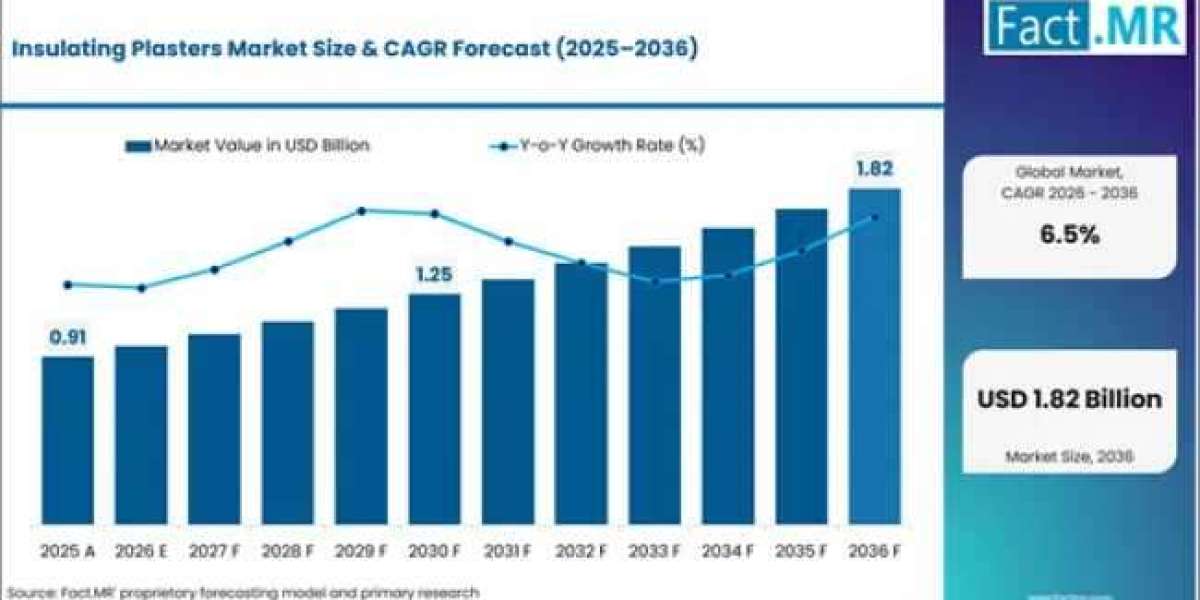

According to Fact MR's latest analysis The global Insulating Plasters Market is projected to grow from USD 1.0 billion in 2026 to USD 1.8 billion by 2036, expanding at a CAGR of 6.5% during the forecast period, according to the latest analysis by Fact.MR. The market is witnessing robust momentum due to increasing regulatory focus on energy-efficient buildings, rising retrofit activities across aging infrastructure, and growing adoption of advanced insulating materials in residential and commercial construction.
Get detailed market forecasts, competitive benchmarking, and pricing trends:
The market was valued at approximately USD 0.9 billion in 2025 and is expected to create an absolute dollar opportunity of USD 0.9 billion between 2026 and 2036. Growing investments in sustainable construction, coupled with stringent building energy codes and green certification programs, continue to strengthen demand across major global markets.
Market Overview and Key Growth Drivers
Insulating plasters are increasingly being adopted as an effective solution for improving thermal performance while preserving architectural aesthetics. Demand is particularly strong in Europe, where the EU Energy Performance of Buildings Directive (EPBD) and national retrofit mandates are accelerating investments in energy-efficient building envelopes.
The growing popularity of mineral-based insulating plasters, enhanced with materials such as perlite, vermiculite, and aerogel, is helping builders achieve superior insulation performance while maintaining breathability and moisture management. Additionally, heritage building renovation projects requiring thermal upgrades without altering historical facades are creating a specialized high-value demand segment.
Pre-mixed insulating plaster solutions are also gaining traction among contractors due to simplified installation processes, improved consistency, and reduced material waste.
Key Market Projections
Market Value (2025): USD 0.9 Billion
Market Value (2026): USD 1.0 Billion
Forecast Market Value (2036): USD 1.8 Billion
CAGR (2026-2036): 6.5%
Absolute Dollar Opportunity: USD 0.9 Billion
Leading Product Segment: Mineral-Based Insulating Plasters (46.8% Share)
Leading Application Segment: Residential Building Applications (77.2% Share)
Fastest-Growing Country: China (8.8% CAGR)
Second Fastest-Growing Country: India (8.1% CAGR)
Analyst Perspective
""The insulating plasters landscape is transitioning from traditional volume-based procurement toward value-driven purchasing decisions focused on lifecycle performance, sustainability, and long-term energy savings. Manufacturers that combine product innovation with strong distribution capabilities and technical support services will be best positioned to capitalize on emerging opportunities,"" says Shambhu Nath Jha, Principal Consultant at Fact.MR.
Competitive Landscape and Market Share Analysis
The global insulating plasters market remains moderately fragmented, featuring a combination of multinational building material manufacturers and specialized regional suppliers.
Saint-Gobain Group leads the market with approximately 29.0% market share, supported by its extensive product portfolio, strong distribution network, and established relationships with institutional and commercial buyers.
Key market participants include:
Saint-Gobain Group
Knauf Gips KG
Baumit GmbH
Sika AG
Holcim Group
Caparol (DAW SE Group)
MAPEI S.p.A.
Wacker Chemie AG
Ceresit (Henkel AG & Co. KGaA)
JK Cement Ltd.
Companies are focusing on product innovation, expansion of thermal insulation portfolios, regional manufacturing investments, and strategic partnerships to strengthen market presence.
Production and Consumption Economy Analysis
Production Landscape
Europe remains a leading production hub due to the presence of established manufacturers such as Saint-Gobain, Knauf, and Baumit. Increasing investments in advanced mineral insulation technologies and aerogel-enhanced formulations are further strengthening production capabilities.
Asia-Pacific is emerging as a critical manufacturing center, particularly in China and India, where domestic producers are expanding capacity to meet growing regional demand.
Consumption Trends
Consumption growth is being driven primarily by:
Residential energy-efficiency retrofits
Commercial building modernization projects
Heritage building renovations
Government-sponsored sustainability initiatives
Green-certified construction developments
Europe continues to account for a substantial share of global consumption, while Asia-Pacific represents the fastest-growing demand center.
Supply Chain and Value Chain Insights
The insulating plasters value chain encompasses:
Raw Material Suppliers → Formulation Manufacturers → Building Material Distributors → Contractors & Applicators → End Users
Critical raw materials include:
Perlite
Vermiculite
Aerogel
Silicates
Mineral binders
Bio-based insulation additives
Manufacturers are increasingly pursuing localized sourcing strategies to mitigate supply chain disruptions and improve procurement resilience.
Strategic Procurement Analysis
Institutional and commercial buyers are shifting procurement priorities toward:
Lifecycle cost optimization
Thermal efficiency performance
Sustainability compliance
Installation efficiency
Product durability
Large construction companies and renovation contractors are increasingly favoring pre-mixed insulating plaster solutions due to reduced labor requirements and improved application consistency.
Framework agreements, centralized purchasing programs, and long-term supplier partnerships are becoming increasingly common procurement models.
Country Opportunity Assessment
China
China is projected to grow at 8.8% CAGR through 2036, supported by extensive residential construction activity, green building mandates, and rapid urbanization. Domestic manufacturers are expanding insulating plaster production to support growing infrastructure and housing demand.
India
India is expected to register 8.1% CAGR through 2036. Rising urban housing development, tropical climate insulation requirements, and government infrastructure initiatives are creating favorable market conditions.
Germany
Germany remains one of Europe's strongest markets due to stringent EPBD compliance requirements, heritage building renovation programs, and widespread adoption of sustainable construction practices.
Brazil
Brazil benefits from increasing urban construction activity and growing awareness of energy-efficient building materials, supporting steady market expansion.
United States
The U.S. market is driven by LEED certification requirements, commercial retrofit investments, and energy-efficiency improvement programs across institutional and commercial buildings.
Unlock 360° insights for strategic decision making and investment planning: https://www.factmr.com/checkout/10731
Technology and Innovation Outlook
Technological innovation is reshaping the insulating plasters market through the development of:
Aerogel-enhanced insulating plasters
Thin-layer high-performance thermal systems
Moisture-regulating plaster technologies
Bio-based insulating formulations
Prefabricated insulating plaster panels
Smart building envelope integration solutions
Among these, aerogel insulation technology is expected to emerge as one of the most commercially attractive innovation areas due to its superior thermal conductivity performance and premium application potential.
Recent Industry Developments
Saint-Gobain expanded insulation production capacity in India through a fifth mineral wool line in Chennai (January 2026).
Knauf Insulation launched advanced mineral wool insulation solutions across Asia (March 2025).
Baumit expanded its insulating plaster product portfolio across European renovation markets throughout 2025.
Custom Research Solutions
Fact.MR provides customized market intelligence, competitive assessments, procurement intelligence, supply chain analysis, investment opportunity mapping, and strategic consulting solutions tailored to specific business objectives and industry requirements.
Get More Report: https://www.factmr.com/industry/chemical-materials

Popular Posts




