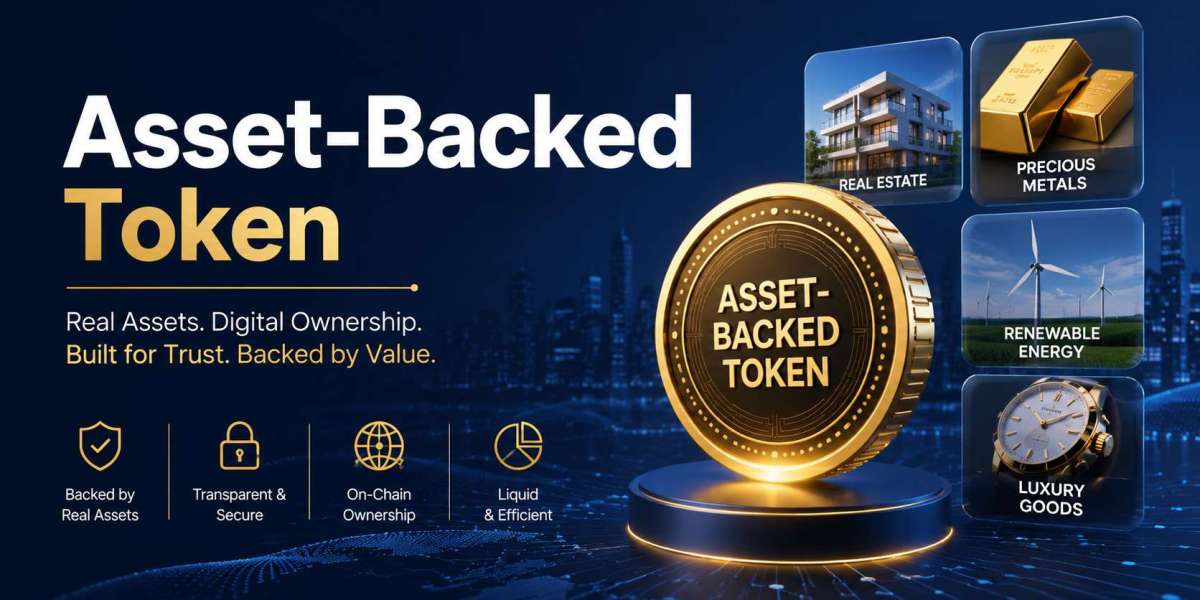

Asset-backed token ecosystems are rapidly reshaping how value is created, stored, and exchanged across global financial markets. By linking digital tokens to tangible or income-generating assets such as real estate, commodities, private credit, treasury instruments, and infrastructure these ecosystems introduce a new financial structure that blends traditional asset stability with blockchain-based efficiency.
As institutional adoption grows and regulatory frameworks mature, asset-backed tokens are moving beyond experimental pilots into structured investment markets. In 2026, these ecosystems are expected to become a core pillar of real-world asset (RWA) tokenization, opening diversified opportunities for both institutional and retail investors.
Understanding Asset-Backed Token Ecosystems
An asset-backed token ecosystem is a blockchain-based financial framework where digital tokens derive their value from underlying real-world assets. These assets may generate income, appreciate in value, or represent ownership rights. Unlike purely speculative cryptocurrencies, asset-backed tokens are tied to verifiable economic value, which may include:
- Physical assets like real estate and commodities
- Financial instruments such as bonds and private credit
- Infrastructure projects generating cash flows
- Environmental assets like carbon credits
- Intellectual property and royalties
These ecosystems typically include multiple layers such as issuance platforms, custody solutions, compliance engines, secondary markets, and liquidity protocols. The result is a programmable financial environment where assets can be fractionalized, traded, and managed more efficiently.
1. Tokenized Real Estate Investment Ecosystems
Real estate remains one of the most dominant categories within asset-backed token ecosystems due to its stability and global demand. Tokenized real estate allows investors to participate in fractional ownership of residential, commercial, and industrial properties. These assets often generate rental income and long-term capital appreciation. In advanced ecosystems, real estate tokens are integrated with secondary trading platforms, allowing investors to enter and exit positions with greater flexibility compared to traditional property markets.
Key investment opportunities include:
- Fractional ownership of commercial buildings
- Tokenized rental income portfolios
- Real estate investment funds on-chain
- Cross-border property investment platforms
As liquidity infrastructure improves, tokenized real estate is expected to become one of the largest segments within asset-backed ecosystems.
2. Tokenized Private Credit and Lending Markets
Private credit is another high-growth segment within asset-backed token ecosystems. It includes business loans, invoice financing, structured debt instruments, and alternative lending pools. Tokenization transforms these traditionally illiquid instruments into programmable digital assets that can be fractionally owned and traded.
Investors gain access to:
- Yield-generating loan portfolios
- Tokenized private debt funds
- Peer-to-peer lending pools
- SME financing ecosystems
These instruments often offer higher yields compared to traditional fixed-income products, making them attractive in diversified portfolios. For asset managers, tokenization improves capital formation and operational efficiency, while investors benefit from improved accessibility and transparency.
3. Tokenized Government Bonds and Treasury Markets
Government bonds and treasury instruments are becoming increasingly integrated into asset-backed token ecosystems due to their low-risk profile and institutional appeal. Tokenization enables these instruments to be issued, settled, and traded more efficiently using blockchain infrastructure.
Investment opportunities include:
- Tokenized U.S. Treasury instruments
- Sovereign bond digital wrappers
- On-chain money market funds
- Stable yield-bearing treasury portfolios
These assets often serve as foundational liquidity layers within broader token ecosystems, providing stability and collateral support for other tokenized instruments.
4. Tokenized Commodities Ecosystems
Commodity-backed tokens represent one of the most established categories of asset-backed tokenization. These ecosystems are built around physical assets such as gold, oil, natural gas, and agricultural products. Gold-backed tokens are already widely adopted, but expansion is occurring across broader commodity markets.
Investment opportunities include:
- Digital gold and precious metal tokens
- Energy-backed asset tokens
- Agricultural commodity portfolios
- Commodity index tokens
These assets offer inflation hedging properties and are often used as diversification tools within broader portfolios. Hybrid systems combining physical custody verification and blockchain tracking are improving trust and transparency in this segment.
5. Tokenized Infrastructure and Real Yield Assets
Infrastructure-backed tokens are gaining attention as long-term, yield-generating investment instruments.
These assets are typically linked to revenue-producing projects such as:
- Renewable energy plants
- Transportation networks
- Telecommunications infrastructure
- Public-private partnership projects
- Utility-scale developments
Investors earn returns based on real-world cash flows such as toll revenue, energy production, or service fees. Tokenization allows fractional participation in large-scale infrastructure projects that were previously accessible only to institutional investors or sovereign funds. This segment is expected to expand significantly as governments and private entities explore blockchain-based financing models.
6. Tokenized Environmental and Carbon Credit Markets
Environmental asset tokenization is becoming increasingly important as global sustainability regulations tighten. Carbon credits and environmental certificates can be tokenized to improve traceability, reduce fraud, and enable real-time trading.
Investment opportunities include:
- Tokenized carbon offset credits
- Renewable energy certificates (RECs)
- Biodiversity-linked assets
- ESG-compliant environmental portfolios
These assets are often integrated into ESG-focused investment strategies and institutional sustainability mandates. As carbon markets become more regulated, tokenization is expected to play a key role in standardizing pricing and verification systems.
7. Tokenized Equity in Private Markets
Private equity tokenization is opening access to early-stage and growth-stage companies that were previously limited to institutional investors. Through asset-backed token ecosystems, equity stakes can be fractionalized and traded under compliant frameworks.
Investment opportunities include:
- Tokenized startup equity
- Venture capital fund tokens
- Growth-stage company shares
- Secondary market private equity trading
This segment increases liquidity in traditionally illiquid markets and allows broader participation in high-growth companies. However, regulatory compliance remains a key factor influencing adoption rates.
8. Tokenized Intellectual Property and Royalty Streams
Intellectual property (IP) is emerging as a unique asset class within token ecosystems. It includes music royalties, film rights, patents, and digital content monetization rights. Tokenization enables creators and rights holders to monetize future revenue streams by fractionalizing ownership.
Investment opportunities include:
- Music royalty tokens
- Film and media revenue shares
- Patent licensing income streams
- Digital content monetization rights
This category is particularly attractive in the creator economy, where digital content continues to generate recurring revenue streams.
9. Tokenized Exchange-Traded Asset Pools
Some ecosystems are developing diversified tokenized asset pools that function similarly to exchange-traded funds (ETFs).
These pools may include combinations of:
- Real estate
- Private credit
- Bonds
- Commodities
- Infrastructure assets
Investors gain diversified exposure through a single tokenized instrument. This approach reduces risk concentration while improving accessibility to multi-asset strategies. As ecosystem maturity increases, these pooled structures are expected to become more sophisticated and algorithmically managed.
10. Tokenized Supply Chain Finance Assets
Supply chain finance represents a major opportunity within asset-backed token ecosystems, particularly in global trade and logistics networks. Invoices, purchase orders, and receivables can be tokenized and used as financial instruments.
Investment opportunities include:
- Invoice-backed tokens
- Trade receivable financing pools
- Export-import financing assets
- Supply chain liquidity tokens
These assets help unlock working capital for businesses while offering investors short-term yield opportunities. Integration with IoT and enterprise data systems is further improving transparency and risk assessment in this segment.
Key Drivers of Growth in Asset-Backed Token Ecosystems
Several structural factors are accelerating the growth of these ecosystems:
Institutional Adoption
Financial institutions are increasingly exploring tokenized assets as part of broader digital transformation strategies.
Regulatory Progress
Clearer frameworks around digital securities are enabling more structured market participation.
Improved Blockchain Infrastructure
Scalability improvements and interoperability solutions are making multi-asset ecosystems more viable.
Demand for Yield and Diversification
Investors are seeking alternative yield sources beyond traditional fixed-income markets.
Fractional Ownership Trends
Lower investment barriers are expanding access to previously exclusive asset classes.
Challenges Impacting Investment Expansion
Despite strong growth potential, several challenges remain:
- Regulatory fragmentation across jurisdictions
- Liquidity limitations in early-stage markets
- Valuation transparency concerns for certain assets
- Custody and asset verification requirements
- Standardization of token frameworks
These factors suggest that ecosystem development will be gradual and structurally phased rather than immediate.
Future Outlook for Asset-Backed Token Ecosystems
Asset-backed token ecosystems are expected to evolve into integrated financial networks where multiple asset classes coexist within unified digital infrastructure.
Future developments may include:
- Cross-asset liquidity bridges
- AI-driven asset valuation systems
- Automated portfolio rebalancing tools
- Real-time compliance monitoring
- Global interoperable token standards
As these systems mature, asset-backed tokens may become a foundational layer of modern capital markets.
Conclusion
Asset-backed token ecosystems represent a significant transformation in how real-world value is digitized and accessed. By bridging traditional asset classes with blockchain infrastructure, these ecosystems enable new investment opportunities across real estate, private credit, bonds, commodities, infrastructure, environmental markets, and intellectual property.
The key advantage lies in combining real-world asset stability with digital efficiency, programmability, and fractional ownership. As regulatory clarity improves and infrastructure scales, these ecosystems are likely to play a central role in shaping the future of global investment markets. For investors and asset managers, the evolution of asset-backed tokens is not just a technological shift it is a structural redefinition of how capital is formed, distributed, and managed across global financial systems.