
Market Overview and Growth Outlook
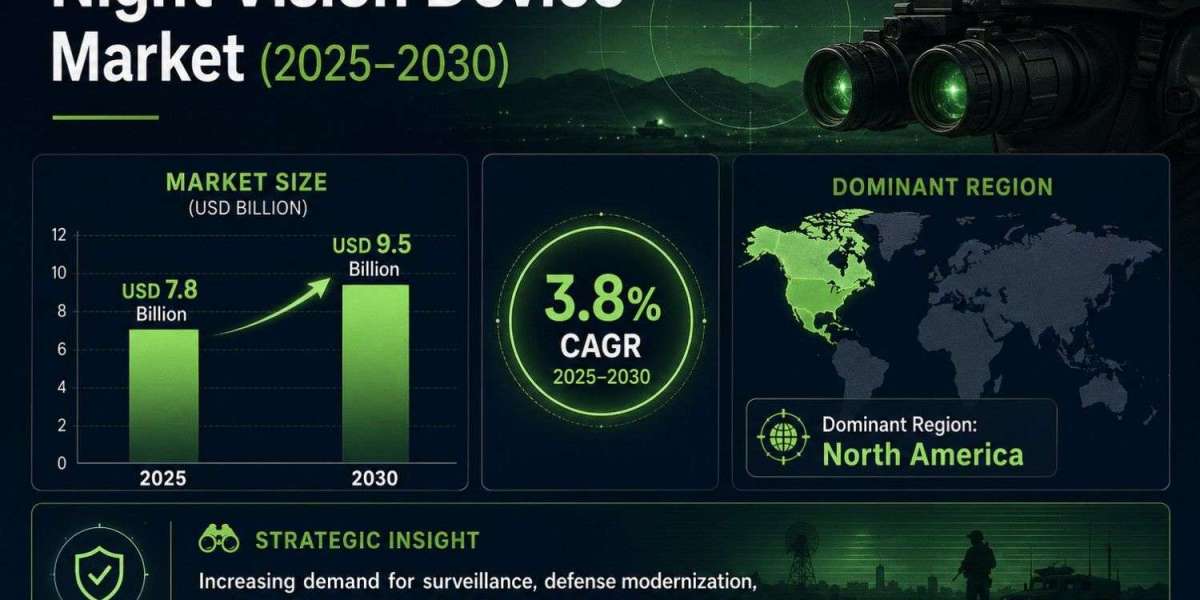
The Night Vision Device Market is moving from a 2024 value of USD 7.5 billion toward USD 9.5 billion in 2030. The market reached USD 7.0 billion in 2023 and is projected to rise to USD 7.8 billion in 2025. The Night Vision Device Market is expected to grow at a CAGR of 3.8% during 2025–2030.
The growth trajectory is linked to the operational importance of visibility in darkness. Night vision devices support soldiers and security personnel during nighttime missions, allowing better navigation, surveillance, targeting, and situational awareness. Procurement rises when political stalemates, border conflicts, terrorism threats, counter-terrorism missions, and anti-militant operations increase nighttime deployment requirements.
The Night Vision Device Market forecast includes a cumulative sales opportunity of USD 52.39 billion during 2025–2030. This projected value provides an important measure of the demand available across Ground-based Platform, Air-based Platform, Naval-based Platform, multiple product categories, and three defined technology groups.
Request a free sample report:
https://www.stratviewresearch.com/Request-Sample/night-vision-device-market#form
Market Segmentation Analysis
Platform Type Analysis is divided into Ground-based Platform, Air-based Platform, and Naval-based Platform. Ground-based Platform accounted for the largest market share and is expected to continue as the primary demand generator. This position is supported by the frequent use of night vision devices by dismounted soldiers during ground-based operations.
Product Type Analysis includes Night Vision Goggle, Weapon Night Sight, and Handheld Thermal Imager. Night Vision Goggle represents the largest product segment. Deployment across individual soldiers creates substantial unit demand, while the product’s ability to support visibility through darkness, mist, fog, rain, and smoke increases its operational relevance.
Technology Type Analysis comprises Image Intensification Technology [Gen I-III and Gen-IV], Thermal Technology [SWIR, MWIR, and LWIR], and Fusion Technology [Optical Image Integration and Digital Image Integration]. Thermal Technology holds the largest market share because it detects heat and produces images without using an external illumination source.
Regional Analysis includes North America, Europe, Asia-Pacific, and Rest of the World. North America leads the market and is expected to maintain its dominance. Asia-Pacific is forecast to experience the fastest growth because of increasing military demand for Night Vision Goggle and Weapon Night Sight and rising defense expenditure.
Regional Market Insights
North America accounted for the largest share and is expected to preserve its leadership through 2030. The regional market is supported by extensive US DoD investment in night vision devices involving L3 Harris Technologies, Inc., Raytheon Technologies Corporation, and Elbit Systems of America, LLC.
Asia-Pacific is expected to grow at the fastest pace. The region’s market forecast is supported by increasing demand for Night Vision Goggle and Weapon Night Sight among military forces. A continuous increase in military expenditure, particularly in China and India, provides an additional source of procurement momentum.
Emerging Trends Shaping the Night Vision Device Market
Night vision procurement is increasingly tied to soldier-level operational requirements. The leadership of Ground-based Platform and Night Vision Goggle shows that demand is concentrated around devices used directly by military personnel. Frequent deployment during ground operations creates a broad and recurring requirement for equipment that supports nighttime mobility and awareness.
Thermal Technology is shaping the technology mix because it operates independently of visible light. Its ability to identify thermal radiation in absolute darkness and penetrate several forms of environmental obstruction strengthens its use in nighttime operations. Increasing concern over terrorism and border disputes directly supports demand for devices incorporating this technology.
Key Growth Drivers of the Market
- Rising border disputes require persistent nighttime observation, increasing procurement of devices that support military surveillance and operational preparedness.
- Political stalemates strengthen defense readiness initiatives, which can increase production and deployment requirements for night vision equipment.
- Counter-terrorism operations frequently occur after dark, creating direct demand for technologies that improve personnel visibility and targeting capability.
- Ground-based missions generate substantial demand because dismounted soldiers use night vision devices across multiple operational tasks and environments.
- Thermal Technology adoption grows because the equipment functions without visible illumination and retains utility through fog, rain, mist, and smoke.
Competitive Landscape
Top Companies in the Market
- L3Harris Technologies, Inc.
- BAE Systems plc
- Thales Group
- Elbit Systems Ltd.
- Raytheon Technologies Corporation
- Leonardo DRS
- Teledyne FLIR LLC
- Rheinmetall AG
- Excelitas Technologies Corp.
- ASELSAN
Conclusion and Strategic Outlook
The Night Vision Device Market is projected to reach USD 9.5 billion by 2030, expanding at a CAGR of 3.8% from its expected 2025 value of USD 7.8 billion. Growth will remain connected to military deployment, nighttime counter-terrorism operations, border disputes, and defense investment in technologies supporting restricted-visibility missions.
Ground-based Platform, Night Vision Goggle, and Thermal Technology are the largest segments identified in the market analysis. North America will likely retain its dominant position, while Asia-Pacific is expected to advance fastest. The industry outlook favors companies aligned with military requirements for dependable imaging, situational awareness, and nighttime operational effectiveness.
FAQs – Night Vision Device Market
1. What does the Night Vision Device Market forecast show?
The Night Vision Device Market is expected to reach USD 9.5 billion by 2030. The market was valued at USD 7.5 billion in 2024 and is forecast at USD 7.8 billion for 2025.
2. What is the forecast CAGR?
The market is expected to grow at a CAGR of 3.8% from 2025 to 2030. Cumulative sales opportunities during the forecast period are projected at USD 52.39 billion.
3. Which factors support the market forecast?
The market forecast is supported by nighttime military operations, border conflicts, terrorism threats, and defense investment. Demand also benefits from frequent use among dismounted soldiers and increasing adoption of Thermal Technology.
4. Which region dominates the Night Vision Device Market?
North America is the dominant region and is expected to retain this position throughout the forecast period. Asia-Pacific is expected to record the fastest growth in the coming years.
5. What risks and opportunities define the market outlook?
The opportunity comes from sustained military procurement and increasing requirements for visibility in darkness. Competitive risks include differences in price, service offerings, regional presence, technology capabilities, and access to defense procurement programs.