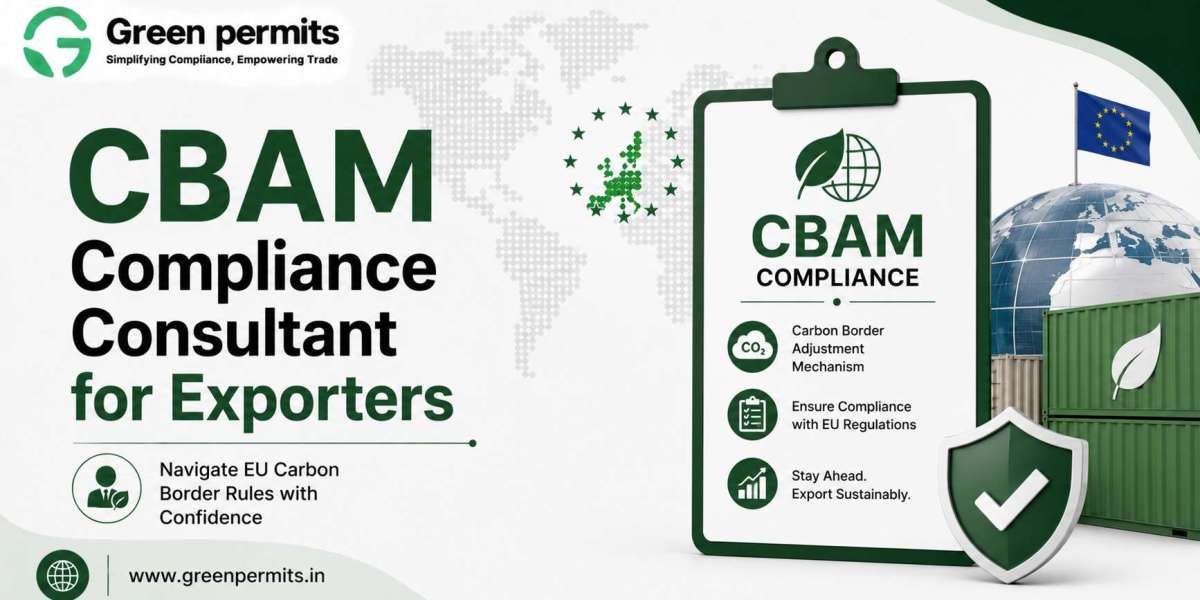

CBAM Compliance Consultant for Exporters plays an important role for Indian businesses exporting carbon-intensive goods to the European Union. CBAM stands for Carbon Border Adjustment Mechanism. It is an EU climate and trade regulation designed to apply carbon cost on selected imported goods based on the emissions generated during production.
For Indian exporters, CBAM is not just a European importer issue. Exporters supplying covered goods to EU buyers may be asked to provide embedded emissions data, production process details, carbon calculation sheets, facility-level information, and supporting documents. If the exporter cannot provide correct CBAM data, the EU importer may face reporting difficulty, higher default emission values, certificate cost, or buyer risk.
CBAM is especially important for exporters dealing with iron and steel, aluminium, cement, fertilisers, hydrogen, electricity, and related covered products. Indian manufacturers and exporters supplying these goods to EU customers should start building a proper carbon data system, emission calculation method, and compliance documentation.
A CBAM Compliance Consultant helps exporters understand applicability, identify covered products, collect emissions data, prepare CBAM reports, support EU buyer communication, improve carbon documentation, and plan decarbonization steps.
What is CBAM?
CBAM is the Carbon Border Adjustment Mechanism introduced by the European Union to address carbon leakage. Carbon leakage happens when production shifts from regions with strict carbon rules to regions with weaker climate regulations.
The purpose of CBAM is to ensure that imported carbon-intensive goods face a carbon cost similar to goods produced within the EU.
CBAM focuses on:
- Embedded emissions in imported goods
- Carbon-intensive sectors
- Import reporting by EU importers
- Emission data from non-EU producers
- Carbon certificate surrender during the definitive phase
- Reduction of carbon leakage risk
- Encouragement of cleaner production practices
For exporters outside the EU, CBAM creates a new requirement to provide reliable emissions data to EU customers.
Why CBAM Compliance Matters for Indian Exporters
Indian exporters may not directly file CBAM declarations in the EU, but their data is critical for EU importers. If the exporter does not provide accurate emissions information, the importer may rely on default values, which may increase cost or reduce competitiveness.
CBAM compliance helps exporters:
- Maintain EU buyer relationships
- Reduce risk of order loss
- Provide accurate embedded emissions data
- Improve export readiness
- Support buyer reporting requirements
- Avoid use of higher default values
- Improve ESG and sustainability credibility
- Prepare for carbon-linked trade rules
- Identify opportunities for emission reduction
- Strengthen long-term market access in Europe
Exporters that prepare early may gain an advantage over competitors that are unable to provide reliable carbon data.
Who Needs CBAM Compliance Consultant?
A CBAM Compliance Consultant may be useful for businesses exporting CBAM-covered goods or supplying intermediate products to EU-linked supply chains.
The following businesses may need support:
- Iron and steel exporters
- Aluminium exporters
- Cement exporters
- Fertiliser exporters
- Hydrogen exporters
- Engineering product exporters using covered materials
- Manufacturers supplying EU buyers
- Export houses dealing with CBAM-covered goods
- Indian suppliers to European importers
- Companies receiving CBAM data requests
- Businesses preparing ESG or carbon reports
- Manufacturers planning low-carbon exports
The exact applicability depends on product classification, HS code, export destination, and EU buyer requirements.
Products Covered Under CBAM
CBAM currently covers selected high-emission sectors. Exporters should check product classification carefully because CBAM applicability is linked to product category and customs codes.
Common covered sectors include:
- Cement
- Iron and steel
- Aluminium
- Fertilisers
- Hydrogen
- Electricity
Some downstream products may also be covered depending on classification. Exporters should verify whether their specific HS code falls within CBAM scope before preparing documentation.
Role of CBAM Compliance Consultant
A CBAM Compliance Consultant helps exporters understand and manage CBAM-related requirements in a structured manner.
Consulting support generally includes:
- CBAM applicability assessment
- HS code review
- Product category mapping
- Facility data collection
- Embedded emissions calculation
- Production process mapping
- Fuel and electricity data review
- Carbon data sheet preparation
- EU buyer communication support
- Default value risk assessment
- Documentation and evidence preparation
- Internal team training
- Decarbonization roadmap support
A consultant helps exporters avoid incorrect emissions data, incomplete buyer responses, and poor reporting readiness.
What is Embedded Emission?
Embedded emission means the greenhouse gas emissions associated with producing a product. Under CBAM, the EU importer may need to report emissions embedded in imported goods.
Embedded emissions may include:
- Direct emissions from production process
- Fuel combustion emissions
- Process emissions
- Electricity-related emissions, where applicable
- Emissions linked to specific product output
- Facility-level production emissions
- Product-level emission intensity
For exporters, accurate embedded emission calculation depends on reliable plant data, process understanding, and correct emission factors.
Data Required for CBAM Compliance
CBAM compliance requires structured data from production, energy, environment, finance, and export teams.
Common data requirements include:
- Product details
- HS code details
- Export quantity
- Production quantity
- Manufacturing process details
- Raw material details
- Fuel consumption data
- Electricity consumption data
- Captive power details, if any
- Emission source details
- Process emission data
- Facility-level production records
- Product-specific allocation method
- Carbon price paid, if applicable
- Supporting documents and calculations
Data should be consistent, traceable, and backed by records because EU buyers may ask for evidence.
Documents Required for CBAM Compliance
Proper documentation helps exporters respond to EU buyers confidently.
Common documents may include:
- Company profile
- Product specification
- HS code list
- Export invoice details
- Production process flow chart
- Plant layout, where required
- Raw material consumption records
- Fuel consumption records
- Electricity bills
- Production records
- Emission calculation sheet
- Energy consumption statement
- Carbon footprint report, where available
- Environmental approval documents
- Monitoring records
- Internal data verification records
- Supplier data, where applicable
- Buyer communication records
Additional documents may be required depending on product category and buyer expectations.
CBAM Compliance Process for Exporters
CBAM compliance should be handled through a step-by-step process so that exporters can provide accurate data to EU buyers.
Step 1: Product Applicability Check
The first step is checking whether the exported product falls under CBAM.
Applicability is assessed based on:
- Product category
- HS code
- EU destination
- Buyer requirement
- Material composition
- Manufacturing process
- Whether the product is directly covered
- Whether the product is part of a covered value chain
Correct applicability assessment helps avoid unnecessary reporting work and wrong declarations.
Step 2: HS Code and Product Mapping
After applicability check, products should be mapped with correct HS codes.
This step includes reviewing:
- Export product description
- Customs classification
- EU CBAM product scope
- Covered product list
- Product variants
- Intermediate or finished goods
- Buyer-specific classification requests
Wrong HS code mapping can create compliance confusion and buyer-side reporting issues.
Step 3: Facility and Process Mapping
The exporter must understand how the product is manufactured and which emissions are linked to the product.
Process mapping includes:
- Identifying production steps
- Identifying emission sources
- Identifying fuel use
- Identifying electricity use
- Identifying process emissions
- Identifying production output
- Allocating emissions to product category
A clear process map improves the accuracy of embedded emissions calculation.
Step 4: Data Collection
The exporter must collect data from different departments.
Data may come from:
- Production department
- Maintenance team
- Energy team
- Environment team
- Finance department
- Export documentation team
- Procurement team
- Quality department
Data should be collected for the relevant reporting period and should match production and export records.
Step 5: Embedded Emission Calculation
After data collection, embedded emissions are calculated using the applicable method.
The calculation may consider:
- Fuel consumption
- Process emissions
- Electricity consumption
- Emission factors
- Production output
- Product allocation
- Direct emissions
- Indirect emissions, where required
- Carbon price paid, if applicable
The calculation should be transparent and supported by records.
Step 6: Prepare CBAM Data Sheet
A CBAM data sheet helps exporters share information with EU buyers in a structured format.
The data sheet may include:
- Exporter details
- Facility details
- Product description
- HS code
- Production route
- Reporting period
- Export quantity
- Embedded emission value
- Calculation method
- Supporting data summary
- Declaration or confirmation
A well-prepared data sheet reduces back-and-forth communication with buyers.
Step 7: Buyer Communication Support
EU importers may ask exporters for additional details or clarification.
Common buyer queries may relate to:
- Emission calculation method
- Facility boundary
- Product allocation
- Energy data
- Fuel consumption
- Electricity source
- Supporting documents
- Carbon price paid
- Verification readiness
A consultant helps prepare clear responses and reduces confusion during buyer communication.
Step 8: Compliance Record Maintenance
Exporters should maintain CBAM-related records for future reference.
Important records include:
- Product-wise CBAM assessment
- HS code review
- Emission calculation sheets
- Energy records
- Production records
- Export invoices
- Buyer communication
- Supporting documents
- Internal approval notes
- Updated data sheets
Good recordkeeping helps exporters respond quickly to future buyer requests.
Cost of CBAM Compliance Consultant
The cost of hiring a CBAM Compliance Consultant depends on several factors.
These include:
- Number of products
- Number of HS codes
- Number of manufacturing facilities
- Sector covered
- Data availability
- Complexity of production process
- Emission calculation requirement
- Buyer reporting format
- Need for carbon footprint assessment
- Need for decarbonization roadmap
- Consultant professional charges
The cost may be lower for a basic CBAM applicability check and higher for detailed plant-level embedded emission calculation.
Timeline for CBAM Compliance Support
The timeline depends on product complexity, data readiness, number of plants, and reporting scope.
The general timeline may include:
- Applicability assessment: 1 to 3 working days
- HS code review: 1 to 3 working days
- Data template preparation: 2 to 4 working days
- Data collection: 1 to 3 weeks
- Emission calculation: 3 to 10 working days
- CBAM data sheet preparation: 2 to 5 working days
- Buyer query support: depends on query type
The timeline may increase if data is incomplete or multiple production units are involved.
Common Mistakes in CBAM Compliance
Many exporters face difficulties because CBAM requires accurate and traceable emissions data.
Common mistakes include:
- Ignoring CBAM applicability
- Checking only product name and not HS code
- Providing incomplete emissions data
- Using rough estimates without records
- Not separating product-specific emissions
- Not maintaining energy data
- Not responding properly to EU buyers
- Depending only on default values
- Treating CBAM as only an importer issue
- Not preparing a long-term carbon reduction plan
Professional guidance helps avoid these mistakes and improves export readiness.
Benefits of Hiring CBAM Compliance Consultant
Hiring a CBAM Compliance Consultant provides several practical benefits.
These include:
- Correct CBAM applicability review
- Proper HS code mapping
- Accurate data collection framework
- Better embedded emission calculation
- Structured buyer-ready data sheet
- Reduced reporting errors
- Better EU buyer confidence
- Improved ESG documentation
- Support for carbon footprint planning
- Stronger export competitiveness
- Decarbonization opportunity identification
- Better long-term compliance readiness
A consultant helps exporters convert complex CBAM requirements into a practical compliance process.
Importance of Decarbonization for Exporters
CBAM is not only about reporting. It is also a signal that carbon performance will affect trade competitiveness.
Exporters can improve readiness by focusing on:
- Energy efficiency
- Renewable energy use
- Cleaner fuels
- Process optimization
- Waste heat recovery
- Low-carbon raw materials
- Better data monitoring
- Carbon footprint assessment
- Supplier engagement
- ESG reporting
- Long-term emission reduction targets
Businesses that reduce carbon intensity may improve competitiveness in carbon-sensitive export markets.
Why Work with CBAM Compliance Consultant?
CBAM compliance involves trade classification, emissions accounting, production data, buyer communication, documentation, and sustainability planning. Many exporters do not have internal carbon accounting systems, so professional support can make the process smoother.
An experienced consultant can assist with:
- CBAM applicability check
- Product and HS code mapping
- Data template preparation
- Embedded emissions calculation
- CBAM reporting support
- Buyer communication assistance
- Carbon footprint assessment
- ESG documentation
- Decarbonization roadmap
- Compliance record management
Professional support helps exporters protect EU market access and prepare for carbon-linked trade requirements.
Learn More About CBAM Compliance for Exporters
If your business exports iron, steel, aluminium, cement, fertilisers, hydrogen, or other CBAM-covered products to the European Union, understanding CBAM compliance is essential before accepting long-term export commitments.
Read the complete guide here:
? https://www.greenpermits.in/07/cbam-compliance-consultant-for-exporters-in-india/
? Get Expert Assistance for CBAM Compliance
If you need help with CBAM compliance, embedded emission calculation, HS code mapping, EU buyer data support, carbon footprint assessment, ESG documentation, or export compliance planning, Green Permits Consulting can guide you efficiently.
? Website: https://www.greenpermits.in/
? Phone: +91 78350 06182
? Email: wecare@greenpermits.in