
Market Overview and Growth Outlook
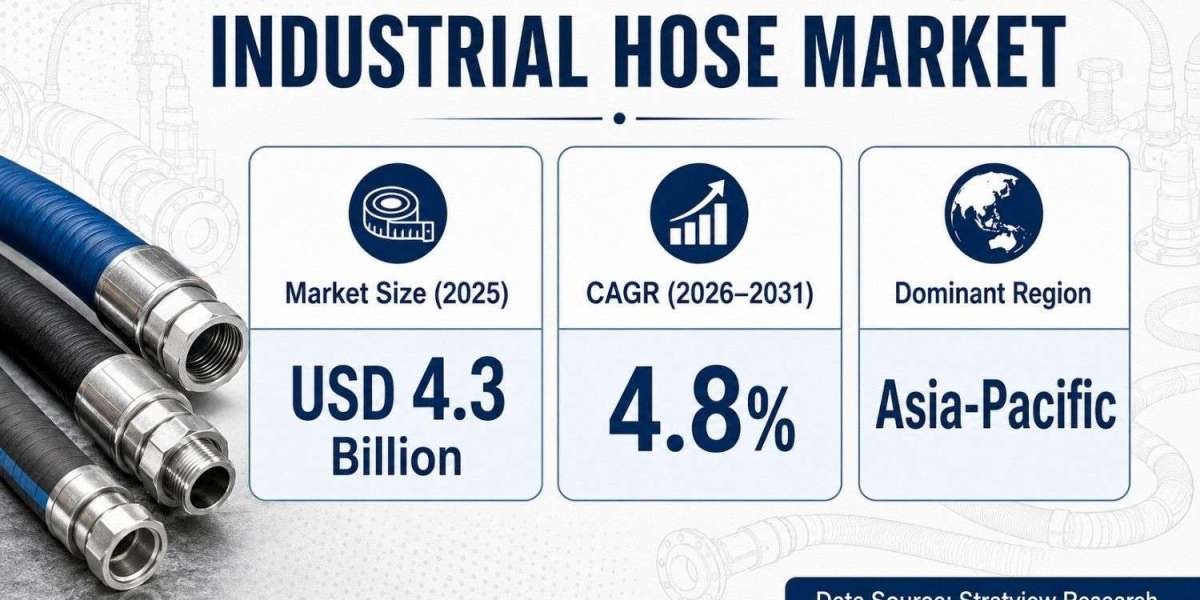
The current Industrial Hose Market forecast shows steady, multi-sector expansion rather than short-term cyclical acceleration. The market was valued at USD 4.3 billion in 2025 and is expected to increase to USD 4.6 billion in 2026 before reaching USD 5.8 billion in 2031.
The Industrial Hose Market is expected to grow at a CAGR of 4.8% during 2026–2031.
This forecast is supported by the continued development of infrastructure, industrial facilities, processing capacity, agricultural equipment, and automated manufacturing systems. Each requires reliable products for transferring air, water, chemicals, fuels, food products, and dry materials.
Operational requirements are also becoming more demanding. End users increasingly need hoses that improve process reliability, reduce maintenance interruptions, handle challenging fluids, resist abrasion, and perform across different temperatures and pressure conditions. This is accelerating the transition toward engineered, application-specific solutions.
Request a free sample report:
https://www.stratviewresearch.com/Request-Sample/industrial-hose-market#form
The Industrial Hose Market forecast is underpinned by both original-equipment installations and recurring replacement requirements. Infrastructure, manufacturing, agriculture, construction, mining, chemicals, and food processing use hoses throughout equipment operation and maintenance. This recurring consumption pattern supports continued sales while encouraging manufacturers to improve materials, reinforcement systems, safety performance, chemical compatibility, and product longevity.
Market Segmentation Analysis
Industrial Hoses Market, By End-Use Industry Type, includes Agriculture, Automotive, Chemical, Construction, Food & Beverage, Marine, Mining, Oil & Gas, and Other End-Use Industries. Construction is forecast to retain the largest share because projects require extensive fluid, water, air, slurry, and material transfer. Food & Beverage is expected to record the highest growth as processing capacity, hygiene standards, and automation increase.
Industrial Hoses Market, By Hose Type, includes Air & Multipurpose Hose, Chemical Hoses, Food & Beverage Hoses, Material Handling Hoses, Oil & Gas Hoses, Water & Steam Hoses, and Mining Hoses. Air & Multipurpose Hose is forecast to remain dominant because of its broad functionality and cost efficiency. Food & Beverage Hoses are projected to grow fastest.
Industrial Hoses Market, By Reinforcement Type, includes Textile-Braided Hoses, Helix Wire Hoses, Wire-Braided Hoses, Spiral-Braided Hoses, and Other Reinforcements. Textile-Braided Hoses maintain dominance through their balance of cost, flexibility, weight, and reliable low- to medium-pressure performance. Spiral-Braided Hoses have the strongest growth outlook because higher-pressure applications require increased structural capability.
Industrial Hoses Market, By Pressure Type, includes Low-Pressure Hoses, Medium-Pressure Hoses, and High-Pressure Hoses. Low-Pressure Hoses retain the largest position through broad industrial use. High-Pressure Hoses are forecast to grow fastest as mining, oil and gas, heavy construction, drilling, and performance-intensive machinery require advanced pressure handling.
Industrial Hoses Market, By Material Type, includes Elastomer/Rubber Hoses, Thermoplastics Hoses, Composite Hoses, and Other Material Hoses. Elastomer/Rubber Hoses remain the largest material category because of flexibility, resilience, abrasion resistance, and established performance. Thermoplastics Hoses are forecast to grow fastest because of lightweight design and chemical resistance.
Industrial Hoses Market, By Hose Category Type, includes Standard Hoses and Specialty Hoses. Standard Hoses are forecast to remain both the largest and fastest-growing category.
Industrial Hoses Market, By Pressure SystemType, includes Static Pressure System and Dynamic Pressure System.
Industrial Hoses Market, By Region, includes North America, Europe, Asia-Pacific, and Rest of the World.
Regional Market Insights
Asia-Pacific is expected to remain the dominant and fastest-growing regional market. Rapid urbanization and infrastructure development increase the use of hoses in construction machinery, transportation projects, utilities, water systems, public facilities, and industrial sites.
The region’s strong manufacturing base creates demand for hoses in machinery, automation systems, compressed-air distribution, fluid processing, chemical handling, cooling, cleaning, and material movement. Mining, agriculture, food processing, chemical production, and oil and gas activity add further regional consumption.
The combination of large end-use industries, cost-effective manufacturing, mechanization, and infrastructure investment supports Asia-Pacific’s dual position as the largest and fastest-expanding market.
Emerging Trends Shaping the Industrial Hose Market
The product mix is becoming more specialized. Manufacturers are developing hoses around exact application requirements rather than relying only on standard products, improving compatibility with specific fluids, pressures, hygiene needs, and operating environments.
Thermoplastic material adoption is increasing because lower weight, chemical resistance, dimensional stability, and handling efficiency can improve performance in specialized systems. Rubber continues to provide the flexibility, durability, and resilience required across major industrial applications.
Higher-pressure operating environments are driving reinforcement innovation. Spiral-braided constructions provide improved structural strength, pressure resistance, durability, and dimensional stability compared with conventional alternatives.
Food-grade hose development is another visible trend. Processing facilities require sanitary transfer systems that reduce contamination risk while handling food products, beverages, powders, oils, and cleaning chemicals.
Sustainable product development is gaining strategic relevance as manufacturers address waste, emissions, recyclability, hazardous substances, and material efficiency.
Key Growth Drivers of the Market
- Urban development: More housing, utilities, transport systems, commercial projects, and industrial facilities increase the deployment of machinery and infrastructure dependent on industrial hoses.
- Capital spending on infrastructure: Investment in roads, ports, airports, railways, water systems, industrial corridors, and logistics assets creates hose demand across construction, commissioning, operation, and maintenance.
- Manufacturing expansion: New and expanded production facilities need hoses for compressed air, chemicals, cooling, cleaning, dust collection, material transfer, and other process functions.
- Industrial automation: Automated equipment and pneumatic networks require reliable fluid and air connections, increasing demand for application-specific hoses with higher durability and performance.
- Agricultural mechanization: Modern irrigation, crop spraying, fertilizer transfer, seed handling, and machinery systems depend on flexible and reliable transfer hoses.
Competitive Landscape
Competition is shaped by price, material offerings, geographic coverage, technical support, engineering capability, product quality, compliance, and application knowledge. The top 10 manufacturers account for around 65%–70% of the global market.
Top Companies in the Market
Parker Hannifin Corporation
Danfoss
ALFA GOMMA Spa.
Kuriyama Holdings Corporation
Continental AG
Trelleborg AB
Gates Corporation
Manuli Ryco Ltd.
Nichirin Co., Ltd.
HBD Thermoid Inc.
Spirax-Sarco Engineering PLC
Pirtek
Smith Plc
Park-Ohio Holdings Corp.
Semperit AG Holding
Conclusion and Strategic Outlook
The Industrial Hose Market is forecast to reach USD 5.8 billion by 2031, expanding at a CAGR of 4.8% during 2026–2031. Demand will be supported by industrialization, infrastructure development, manufacturing and processing capacity, construction activity, and agricultural mechanization.
Future competitive positioning will depend on application engineering, material innovation, reinforcement performance, safety, durability, and sustainable manufacturing. The industry outlook remains linked to long-term industrial investment and the continuous need to move fluids, gases, and materials safely across increasingly sophisticated operating systems.
FAQs – Industrial Hose Market
1. What does the Industrial Hose Market forecast indicate?
The forecast indicates that the Industrial Hose Market will grow from USD 4.6 billion in 2026 to USD 5.8 billion in 2031. The market was valued at USD 4.3 billion in 2025.
2. What annualized growth rate is expected?
The Industrial Hose Market is expected to grow at a CAGR of 4.8% during 2026–2031. This represents steady expansion across a diverse range of industrial end uses.
3. What supports the long-term market forecast?
The forecast is supported by urbanization, infrastructure spending, manufacturing investment, processing-industry expansion, and agricultural mechanization. These activities increase equipment installations and recurring replacement demand.
4. Which geography will shape future demand?
Asia-Pacific is expected to remain both the dominant and fastest-growing regional market. Its large construction, manufacturing, mining, agricultural, chemical, and food-processing sectors support expanding demand.
5. What risks could weaken forecast performance?
Raw-material cost volatility, intense price competition, maintenance requirements, and sustainability-related development costs could pressure market participants. Suppliers with differentiated materials, engineering expertise, and regional reach may be better positioned to address these challenges.