
Artificial intelligence has transformed how machines perceive and interpret visual information. From autonomous vehicles recognizing pedestrians to fitness applications tracking body movements in real time, computer vision systems rely on accurately labeled datasets to achieve high performance. As AI applications become more advanced, annotation workflows have evolved beyond simple object labeling to include complex techniques such as pose estimation and landmark annotation.
Building these sophisticated datasets requires precision, consistency, and scalable processes. That's why organizations increasingly partner with a trusted data annotation company or choose data annotation outsourcing to access experienced annotators, robust quality assurance, and faster project delivery.
In this blog, we'll explore how annotation workflows have progressed from object detection to pose estimation, why they matter, and how businesses can build reliable AI models with modern annotation strategies.
The Evolution of Image Annotation
Early computer vision models focused primarily on identifying whether an object existed within an image. Over time, AI systems demanded more detailed contextual understanding, leading to increasingly sophisticated annotation techniques.
Modern annotation workflows typically progress through several stages:
- Image classification
- Object detection
- Instance segmentation
- Semantic segmentation
- Keypoint and landmark annotation
- Human pose estimation
- Multi-object tracking
Each step provides richer information, enabling AI systems to understand not just what exists in an image but also how objects move, interact, and relate to one another.
Today, every leading image annotation company supports multiple annotation methods within a unified workflow to meet the growing needs of AI developers.
Understanding Object Detection
Object detection is one of the most widely used annotation techniques in computer vision.
Annotators draw bounding boxes around objects and assign predefined labels such as:
- Person
- Vehicle
- Bicycle
- Animal
- Traffic sign
- Product
The resulting dataset teaches AI models to identify and localize objects within new images.
Object detection powers applications including:
- Autonomous driving
- Retail shelf monitoring
- Manufacturing inspection
- Agricultural analytics
- Smart surveillance
Although highly effective, bounding boxes only provide coarse localization. Many AI applications now require much finer detail.
Why Object Detection Alone Is No Longer Enough
Modern AI systems increasingly need to understand structure rather than simply location.
Consider a healthcare AI monitoring patient movement.
Knowing a person exists inside a bounding box is insufficient.
Instead, the model must understand:
- Head position
- Shoulder angles
- Arm movement
- Knee alignment
- Foot placement
Similarly, robotics applications require machines to understand precise joint locations before interacting safely with humans.
This is where landmark annotation becomes essential.
What Is Landmark Annotation?
Landmark annotation identifies specific keypoints on an object instead of labeling the object as a whole.
For human pose estimation, annotators mark anatomical joints such as:
- Nose
- Eyes
- Ears
- Neck
- Shoulders
- Elbows
- Wrists
- Hips
- Knees
- Ankles
The AI model then learns spatial relationships between these keypoints, allowing it to estimate posture, gestures, and movement.
Landmark annotation is also widely used for:
- Facial recognition
- Emotion detection
- Medical imaging
- Hand tracking
- Sports performance analysis
- Robotics navigation
- Augmented reality
Unlike traditional object detection, landmark annotation captures geometry and motion, making it indispensable for advanced AI applications.
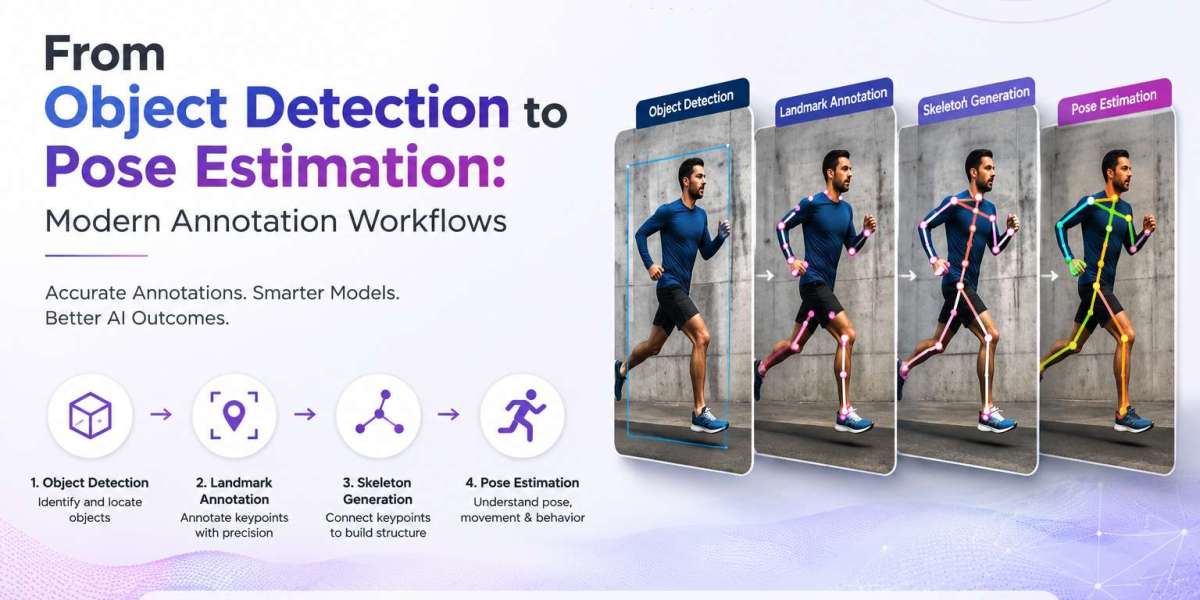
From Bounding Boxes to Pose Estimation
Pose estimation combines object detection with landmark annotation to create a complete understanding of human or object movement.
A modern workflow often follows these stages:
Step 1: Object Detection
The model first identifies each person using bounding boxes.
Step 2: Landmark Annotation
Key anatomical points are labeled inside each detected individual.
Step 3: Skeleton Generation
The annotated keypoints are connected to create a skeletal representation.
Step 4: Pose Estimation Training
The AI model learns body posture, movement patterns, and joint relationships.
This layered workflow enables AI to analyze activities with remarkable precision.
Applications include:
- Workplace safety monitoring
- Physical therapy
- Athlete performance analysis
- Gesture recognition
- Human-robot collaboration
- Driver monitoring systems
Building Modern Annotation Workflows
Creating high-quality datasets requires more than simply labeling images.
Successful annotation projects incorporate standardized workflows that maximize consistency and scalability.
1. Dataset Preparation
Images are collected from diverse environments, lighting conditions, camera angles, and object positions to improve model generalization.
2. Annotation Guidelines
Clear instructions define:
- Label definitions
- Keypoint placement
- Occlusion handling
- Edge cases
- Quality standards
Comprehensive guidelines minimize annotation inconsistencies.
3. Multi-Level Annotation
Modern datasets frequently combine:
- Bounding boxes
- Segmentation masks
- Landmark annotation
- Attribute labeling
This enriches the training data for increasingly capable AI models.
4. Human Review
Experienced reviewers verify annotations for accuracy before dataset delivery.
5. Continuous Quality Improvement
Regular audits, consensus reviews, and feedback loops ensure annotation quality remains consistent as projects scale.
These practices distinguish a professional image annotation company from basic labeling providers.
Why Businesses Choose Data Annotation Outsourcing
As annotation requirements become more sophisticated, many organizations struggle to build large in-house labeling teams.
Choosing data annotation outsourcing offers several advantages:
- Faster project completion
- Access to trained annotation specialists
- Lower operational costs
- Scalable workforce
- Consistent quality control
- Flexible project management
Instead of investing in recruitment, training, and infrastructure, businesses can focus on AI innovation while expert annotation teams handle dataset production.
Similarly, image annotation outsourcing enables organizations to rapidly scale complex computer vision projects without compromising accuracy.
This approach is especially valuable for startups and enterprises developing autonomous systems, healthcare AI, retail analytics, and robotics solutions.
Industries Benefiting from Pose Estimation Annotation
Pose estimation and landmark annotation are transforming numerous industries.
Healthcare
AI assists clinicians by analyzing posture, rehabilitation exercises, and patient mobility.
Retail
Smart stores monitor customer interactions, shopping behavior, and shelf engagement.
Sports Analytics
Teams evaluate athlete biomechanics, movement efficiency, and injury prevention.
Manufacturing
Factories use pose estimation to improve worker safety and optimize ergonomic practices.
Robotics
Collaborative robots interpret human movement for safer and more efficient interaction.
Autonomous Vehicles
Advanced driver assistance systems detect pedestrian intent by analyzing posture and movement before crossing roads.
Each of these applications depends on accurate landmark annotation and structured annotation workflows.
Why Annotera Is Your Trusted Annotation Partner
As AI projects continue to evolve, dataset quality becomes a decisive factor in model performance. Annotera combines skilled human expertise with scalable annotation processes to deliver precise datasets for computer vision applications.
Whether your project requires bounding boxes, semantic segmentation, landmark annotation, or complex pose estimation datasets, Annotera follows rigorous quality assurance protocols to ensure accuracy and consistency.
As an experienced data annotation company, Annotera supports organizations with customized data annotation outsourcing solutions designed for scalability, faster turnaround, and exceptional annotation quality. Our image annotation outsourcing services help businesses accelerate AI development while maintaining the precision required for production-ready computer vision models.
Conclusion
Computer vision has progressed far beyond simple object detection. Today's AI systems require deeper contextual understanding through landmark annotation and pose estimation, enabling applications that can interpret movement, behavior, and complex interactions with remarkable accuracy.
Modern annotation workflows combine object detection, keypoint labeling, quality assurance, and scalable review processes to create datasets that power next-generation AI solutions. By partnering with an experienced image annotation company, businesses gain access to high-quality labeled data, streamlined workflows, and the flexibility needed to support evolving AI initiatives.
As demand for intelligent vision systems continues to grow, investing in accurate annotation workflows today will lay the foundation for more reliable, efficient, and innovative AI applications tomorrow.