
Market Overview and Growth Outlook
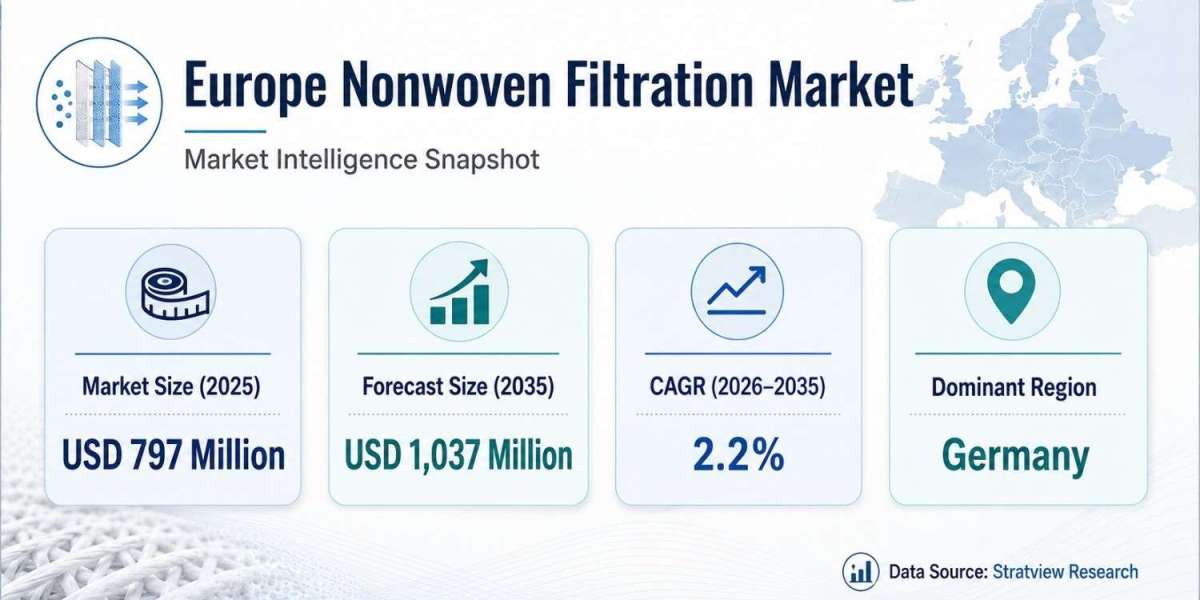
The Europe Nonwoven Filtration Market reached USD 797 million in 2025 and is expected to increase to USD 849 million in 2026. This 6.5% year-over-year expansion is followed by a longer forecast of USD 1,037 million in annual demand by 2035, creating a measured growth pathway for European filtration-media suppliers.
“The Europe Nonwoven Filtration Market is expected to grow at a CAGR of 2.2% during 2026–2035.” Total cumulative sales opportunities are projected at USD 9.5 billion. The figures indicate continuing commercial demand for materials supporting air quality, process filtration, water treatment, operational efficiency, and environmental compliance.
The regional manufacturing ecosystem emphasizes product quality, innovation, and compliance. Producers supply air and liquid filtration media to automotive, industrial manufacturing, healthcare, pharmaceuticals, food & beverage, water treatment, and HVAC applications. This broad application structure reduces reliance on any single industry while supporting ongoing product specialization.
A review of the Europe Nonwoven Filtration Market outlook highlights the convergence of performance and sustainability. Filtration media are being developed to capture particles efficiently, lower resistance, last longer, reduce energy consumption, and incorporate recyclable, bio-based, or lower-carbon materials without compromising industrial functionality.
Request a free sample report:
https://www.stratviewresearch.com/Request-Sample/europe-nonwoven-filtration-market#form
Market Segmentation Analysis
The Application Type categories are Air Filtration and Liquid Filtration. Liquid Filtration is expected to retain its dominant position in both volume and value. Its structural advantage comes from demand in pharmaceutical, chemical, food & beverage, and industrial manufacturing processes, where fluid purity and contamination control directly affect production quality.
Needle punch is the most dominant technology used in liquid filtration. Within Liquid Filtration, water filtration holds the leading position because drinking water, wastewater, and industrial water are handled in high volumes. The segment also benefits from strict quality controls and Europe’s environmental-compliance focus.
The Material Type categories comprise Polyester, Polypropylene, Nylon, Fiberglass, Bicomponent PET/coPET fibre, Bicomponent PET/PE fibre, Bicomponent PP/co-PP fibre, and Others. Polyester is expected to retain leadership because it combines durability, mechanical strength, moisture resistance, chemical resistance, dimensional stability, process compatibility, and cost-effectiveness.
The Region categories comprise Germany, France, The UK, Russia, and Rest of Europe. Germany leads this structure, while the overall regional analysis indicates that a limited group of country markets generates most European sales. This concentration informs the geographic allocation of demand opportunities.
Regional Market Insights
Germany generates the greatest demand in Europe and is expected to remain the largest segment throughout the forecast period. The country has a substantial industrial base, strong automotive and chemical industries, advanced pharmaceutical production, and established filtration-material manufacturers, producing demand across numerous liquid-filtration applications.
Demand is strengthened by strict quality standards, technological development, and investment in advanced filtration systems. At the European level, the five largest country markets contribute more than 70% of annual sales, demonstrating that major industrial economies remain the principal regional demand centers.
Emerging Trends Shaping the Europe Nonwoven Filtration Market
Sustainable-material development is moving into the center of European product strategy. Companies are working with recyclable, bio-based, biodegradable, lower-carbon, recycled-polymer, and cellulose-based alternatives. This direction responds to circular-economy goals while creating opportunities to reduce environmental impact across materials sourcing and nonwoven production.
Energy-efficient filtration is another established trend. Media offering lower pressure drop can improve airflow, reduce energy use, extend filter life, and lower operating costs in HVAC and industrial systems. This shifts purchasing considerations beyond initial product price toward filtration performance over the full operating period.
High-performance technologies are simultaneously becoming more important. Manufacturers are incorporating meltblown, wet-laid, spunbond, needle-punched, and nanofiber-composite processes to improve durability and efficiency. Nanofiber-based media for fine-particle filtration illustrate how technology development is supporting more demanding air-quality and operational-performance requirements.
Key Growth Drivers of the Market
- Sustainability targets lead manufacturers to develop recyclable, bio-based, biodegradable, and lower-carbon products, broadening the market for environmentally aligned filtration materials.
- Requirements for lower energy consumption encourage low-pressure-drop media, which can reduce operating costs while maintaining filtration efficiency in commercial and industrial systems.
- Air-quality concerns increase adoption of high-performance HVAC filters in hospitals, schools, airports, commercial buildings, and data centers.
- Industrial and wastewater regulations create recurring filtration requirements, supporting replacement demand and the transition toward technically advanced nonwoven media.
- Pharmaceutical, chemical, food & beverage, and water-treatment activities sustain liquid-filter consumption because process quality depends on effective fluid filtration and contamination control.
Competitive Landscape
Top Companies in the Market
Freudenberg
Ahlström Munksjo
Hollingsworth & Vose
Gessner (Mativ)
Magnera
SANDLER NONWOVEN CORPORATION
TWE Group
Valemt
Fibertex Nonwovens A/S
SWE
The fragmented competitive landscape includes companies with established portfolios and distribution networks. Cost pressure from lower-priced suppliers increases the strategic importance of innovation, customization, product quality, and technical performance. Sustainability and energy efficiency provide additional areas in which European manufacturers can distinguish their filtration-media offerings.
Conclusion and Strategic Outlook
The Europe Nonwoven Filtration Market is projected to expand from USD 849 million in 2026 to USD 1,037 million in 2035, representing a CAGR of 2.2%. Growth is supported by regulation, high-efficiency filtration, liquid-processing requirements, lower-energy systems, sustainable materials, and ongoing nonwoven-technology development.
The strategic outlook favors continued improvement rather than abrupt market transformation. Manufacturers will remain focused on efficiency, durability, pressure drop, service life, material circularity, and specialized performance. These priorities provide the basis for continued replacement demand and long-term market development through 2035.
FAQs – Europe Nonwoven Filtration Market
1. What is the current market size and long-term value?
The Europe Nonwoven Filtration Market is estimated at USD 849 million in 2026, compared with USD 797 million in 2025. It is forecast to reach USD 1,037 million in 2035.
2. How quickly will the market grow?
The market is expected to grow at a CAGR of 2.2% between 2026 and 2035. Its cumulative sales opportunity during the forecast period is estimated at USD 9.5 billion.
3. Which forces support the industry outlook?
Environmental compliance, indoor air quality, water treatment, process filtration, pharmaceutical manufacturing, lower energy use, and sustainable materials support demand. Together, they encourage adoption of higher-performance nonwoven media.
4. How is demand distributed regionally?
Germany is the largest country market and generates the greatest demand. The top five countries account for more than 70% of annual European nonwoven-filtration sales.
5. Is the market outlook affected by identifiable risks?
Yes. Raw-material price fluctuations can pressure costs and margins, while competitively priced imports intensify market rivalry. Companies must therefore manage sourcing risks and compete through quality, customization, sustainability, and innovation.