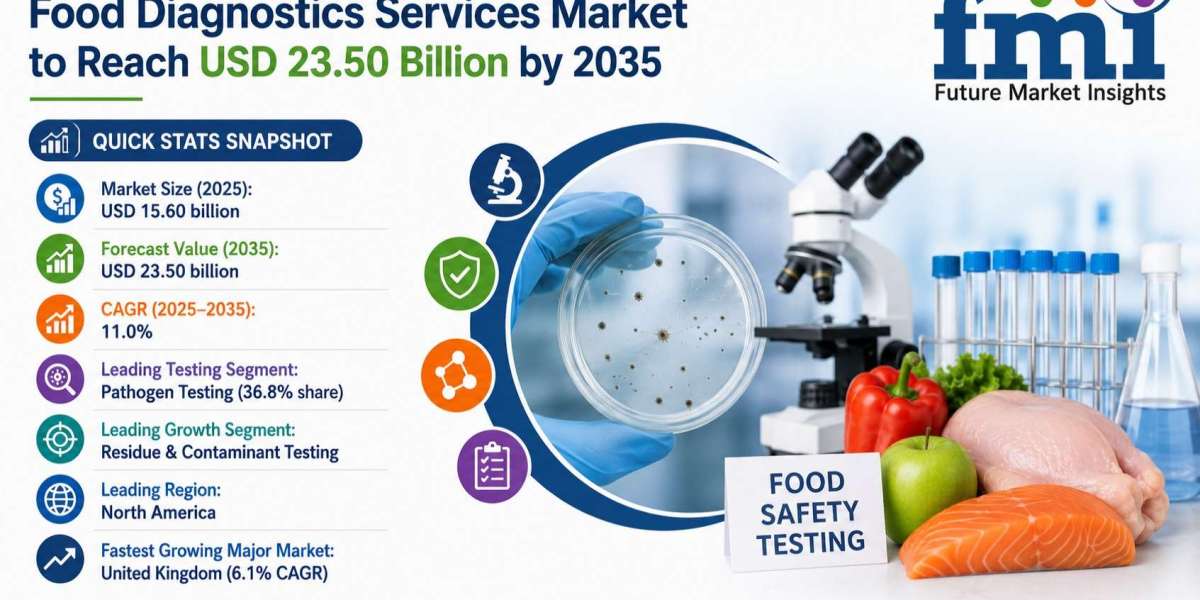

The global food diagnostics services market is undergoing significant growth, driven by stringent regulatory frameworks, increasing food supply chain complexity, and consumer demand for food authenticity, according to latest insights by Future Market Insights. Regulatory bodies worldwide including the US FDA (under the Food Safety Modernization Act), the European Union (EU General Food Law), and Codex Alimentarius mandate rigorous testing protocols for pathogen detection, allergen screening, and contaminant verification across manufacturing and distribution networks. The global industry, valued at USD 15.60 billion in 2025, is projected to reach USD 17.3 billion in 2026. Expanding at a double-digit Compound Annual Growth Rate (CAGR) of 11.0% over the ten-year forecast period, total market valuation is anticipated to hit USD 49.2 billion by 2036, creating an absolute incremental opportunity of USD 31.85 billion.
Request a Sample Report: https://www.futuremarketinsights.com/reports/sample/rep-gb-11430
Market Performance Overview (2026–2036)
To understand the core testing product lines, technology platforms, and sample types guiding this USD 31.85 billion market scale-up, an analysis of leading segment allocations highlights where global testing demand is concentrated:
· Food Safety and Quality Control Product Segment (34.0% share): Commands the primary product category in 2026, driven by non-discretionary regulatory mandates for pathogen screening (Salmonella, Listeria, E. coli), chemical contaminant testing, and quality compliance.
· Food Products Sample Segment (46.0% share): Dominates sample types over raw ingredients and environmental swabs, as finished processed and packaged foods undergo end-product testing prior to commercial release.
· PCR-Based Testing Technology Segment (39.0% share): Represents the leading testing methodology, favored by commercial contract labs and food processors for its high sensitivity, specificity, and rapid turn-around times compared to traditional culture methods.
Technical Drivers and Testing Innovations
The expansion of food diagnostics services across food processing and laboratory networks is propelled by three primary industry catalysts:
Non-Discretionary Regulatory Mandates
Global food safety legislation mandates that food processors establish comprehensive Hazard Analysis Critical Control Point (HACCP) and preventive control plans. Mandatory testing cycles at critical control points ensure continuous, recurring demand for contract testing services and diagnostic reagents.
Rapid Testing Technologies and High-Throughput PCR
Speed-to-result is critical in modern food manufacturing. Polymerase Chain Reaction (PCR) and real-time PCR technologies deliver results in hours rather than the days required by traditional microbiological culturing. This rapid clearance allows manufacturers to reduce warehouse holding times, release batch inventory faster, and swiftly mitigate recall risks.
Supply Chain Traceability and Authenticity Verification
Beyond pathogen detection, retailers and consumers increasingly demand verification of food authenticity including geographic origin claims, organic integrity, non-GMO status, and species identification (such as meat/seafood authenticity). This shift expands diagnostics into high-value specialty analytical services.
Industrial Infrastructure & Cost Pressures
Testing service providers and laboratory networks face specific operational dynamics:
· Pricing and Margin Pressure in Standard Testing: Routine testing services face intense price competition from regional laboratories and value-oriented Asian providers, forcing major testing networks to focus on high-throughput automation and specialized high-margin diagnostic panels.
· Capital Investment in Analytical Instrumentation: Maintaining state-of-the-art mass spectrometry, chromatography, and digital PCR equipment requires significant capital expenditure, favoring integrated global testing firms with scale economies.
Regional Growth Outlook
The geographic analysis reflects strong, compliance-driven growth across major food manufacturing and export centers:
· United Kingdom (6.1% CAGR): Leads country-level expansion, driven by post-Brexit regulatory updates, strict food quality enforcement, and expanding e-commerce food retail distribution.
· United States (5.9% CAGR): Sourcing a large baseline revenue footprint, supported by rigorous FSMA enforcement, large-scale commercial food processing facilities, and a high concentration of accredited third-party laboratories.
· Japan (4.5% CAGR): Anchored by strict Japanese Industrial Standards (JIS) compliance and elevated consumer expectations for premium food safety and freshness verification.
· Germany (4.4% CAGR) & India (4.4% CAGR): Driven by EU General Food Law enforcement across Germany’s large food export industry, alongside India’s ongoing food safety modernization under FSSAI regulations.
Competitive Landscape
The global food diagnostics services market is structured around major laboratory instrument manufacturers and global contract testing networks. Market leadership relies on broad analytical portfolios, regulatory accreditations, and automated high-throughput testing capabilities.
Danaher Corporation leads the global market with an estimated 21.0% market share. Other key global and emerging market participants include R-Biopharm AG, Merck KGaA, QIAGEN, Lonza Group, Sysmex Corporation, Roche Diagnostics, Agilent Technologies, Thermo Fisher Scientific, Bruker Corporation, Becton, Dickinson and Company, Neogen Corporation, Siemens Healthineers, Bio-Rad Laboratories, and Abbott Laboratories.
Exclusive Discounts on Full Report: https://www.futuremarketinsights.com/reports/food-diagnostics-market
Frequently Asked Questions
What is the projected valuation of the global market by 2036?
The global food diagnostics services market is projected to reach USD 49.2 billion by 2036, expanding from an estimated baseline valuation of USD 17.3 billion in 2026 at a CAGR of 11.0%.
Why does Food Safety and Quality Control lead the product category?
Food Safety and Quality Control holds a 34.0% share because pathogen detection and contaminant screening are mandatory regulatory requirements for virtually all food processing and distribution facilities.
Which testing technology holds the largest market share?
PCR-based testing commands a 39.0% share of the technology segment due to its speed, accuracy, and high sensitivity compared to traditional microbiological culturing.
Explore More Related Studies Published by FMI Research:
Milk Powder Market : https://www.futuremarketinsights.com/reports/milk-powder-market
Coffee Gummy Market : https://www.futuremarketinsights.com/reports/coffee-gummy-market
Carnosic Acid Market : https://www.futuremarketinsights.com/reports/carnosic-acid-market
About Future Market Insights (FMI)
Future Market Insights, Inc. is an ESOMAR-certified, ISO 9001:2015 market research and consulting organization trusted by Fortune 500 companies. With a global presence across the U.S., UK, India, and Dubai, FMI delivers data-driven insights across 30+ industries and 1200 markets worldwide.
Contact Us
Future Market Insights Inc.
Christiana Corporate, 200 Continental Drive,
Suite 401, Newark, Delaware – 19713, USA
T: +1-347-918-3531
For Sales Enquiries: sales@futuremarketinsights.com
Website: https://www.futuremarketinsights.com