
The growth of blockchain-based finance has created new opportunities for businesses working with real-world assets. Real estate, commodities, private credit, art, infrastructure, and other asset classes can now be represented digitally through blockchain networks. This growing market has increased interest in RWA Tokenization Platform Development among startups, financial institutions, asset managers, and technology companies.
However, launching such a platform requires more than deploying smart contracts and creating digital tokens. Businesses need to consider technology expenses, legal requirements, asset onboarding, custody, compliance, security, user management, trading functions, and ongoing maintenance. At the same time, revenue can come from transaction fees, token issuance fees, subscription plans, asset management charges, marketplace fees, and other services.
Understanding the relationship between development cost and revenue potential helps businesses decide which platform model fits their goals. This article examines the major expenses, possible income sources, development methods, and factors that can influence profitability in the RWA tokenization market.
What Is RWA Tokenization Platform Development?
RWA tokenization platform development refers to creating a digital infrastructure where physical or financial assets can be represented as blockchain-based tokens. The platform can manage asset onboarding, token issuance, ownership records, investor access, compliance checks, transactions, distributions, and secondary trading.
Real World Asset Tokenization can apply to many asset categories. A property can be represented through fractional ownership tokens, while private credit, commodities, artwork, infrastructure projects, or investment funds can use similar models. The technical structure depends on the asset type, jurisdiction, ownership model, and investor requirements.
A business may develop a platform for its own assets or create a marketplace where multiple asset owners can issue and manage tokenized assets. The second model generally requires more functions because the platform must support different issuers, asset categories, investor groups, compliance rules, and payment structures.
Major Factors Affecting RWA Tokenization Platform Development Cost
The cost of developing an RWA platform does not come from one component. Several factors influence the overall budget, and each business may require a different combination of functions.
Platform Type
A private platform designed for one organization generally costs less than a public marketplace supporting multiple asset issuers. A basic issuance platform may focus on asset registration, token creation, investor onboarding, and wallet functions. A marketplace may also require trading, order management, settlement, reporting, issuer dashboards, investor dashboards, and payment processing.
The intended business model should therefore be decided before development begins. A business that plans to serve multiple asset owners will need a wider technical structure than a company tokenizing only its own portfolio.
Asset Classes
Different assets introduce different technical and compliance requirements. Real estate may require property documentation, ownership records, rental income distribution, and investor reporting. Private credit may need loan terms, repayment schedules, interest calculations, and borrower information.
Commodity tokenization may require custody information, quantity records, warehouse data, and redemption processes. As the number of asset categories increases, development requirements also increase.
Blockchain Network
The selected blockchain affects development requirements, transaction costs, smart contract design, wallet compatibility, and transaction processing. Businesses can choose networks based on factors such as transaction fees, ecosystem support, token standards, institutional adoption, and regulatory considerations.
Some platforms may support one blockchain at launch and add other networks later. Multi-chain support can increase development expenses because contracts, wallets, transaction processes, and testing procedures may need additional work.
Estimated RWA Tokenization Platform Development Cost
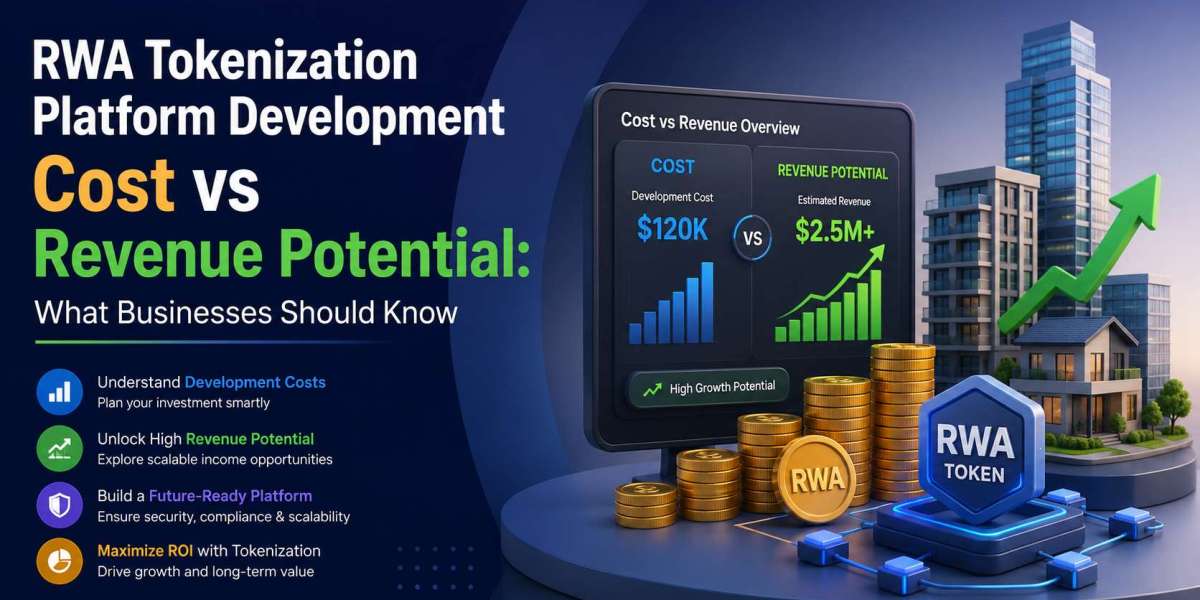
A basic RWA platform may require approximately $40,000 to $80,000, while a mid-level platform with investor management, compliance functions, asset dashboards, token issuance, and marketplace features may range from $80,000 to $180,000.
A large institutional platform with multiple asset classes, complex compliance workflows, custody integrations, secondary trading, multi-chain support, analytics, and enterprise administration can move beyond $200,000. These figures are general estimates rather than fixed market prices because project requirements vary considerably.
Businesses should also account for expenses after launch. Smart contract audits, cloud infrastructure, cybersecurity reviews, legal services, compliance operations, customer support, third-party APIs, maintenance, and feature upgrades can create recurring costs.
Where the Development Budget Goes
The development budget is usually divided across several technical and operational areas.
User Interface and User Experience
Investors and asset issuers need dashboards for their respective activities. Investor dashboards can display portfolios, token balances, transaction history, distributions, and asset information. Issuer dashboards can provide asset registration, token issuance, investor records, reporting, and distribution management.
The interface should make complex blockchain processes understandable to users who may not have technical knowledge.
Smart Contracts
Smart contracts manage token issuance, transfers, ownership records, restrictions, distributions, and other automated processes. The contract structure depends on the selected token standard and regulatory model.
Smart contract development should include testing and independent security review. Contract vulnerabilities can create financial losses and damage user confidence, making security work an important part of the project budget.
Backend Infrastructure
The backend connects the user interface with blockchain networks and external systems. It can manage user accounts, compliance records, asset information, transaction data, notifications, payment processes, and reporting.
Businesses may also require integrations with KYC providers, custody systems, banking services, payment gateways, property databases, market data providers, and accounting systems.
Compliance and Identity Management
RWA platforms generally require identity verification and investor eligibility checks. Depending on the jurisdiction and asset class, the platform may need KYC, AML screening, accreditation checks, transaction monitoring, geographic restrictions, and investor classification.
Compliance requirements can have a major effect on both initial development expenses and ongoing operating costs.
Revenue Potential of an RWA Tokenization Platform
The revenue model has a major effect on whether platform development produces sustainable returns. Businesses can use one source or combine several income streams.
Token Issuance Fees
A platform can charge asset owners for creating and issuing tokenized assets. The fee may be fixed, percentage-based, or divided into different service packages.
For example, an issuer may pay a setup fee for asset onboarding and another charge based on the value of tokens issued.
Transaction Fees
Platforms supporting token transfers or secondary trading can charge fees for transactions. Even a small percentage can create meaningful income when transaction activity grows.
For example, a platform processing $10 million in annual transactions with a 0.5% transaction fee would generate $50,000 in gross transaction revenue.
Subscription Revenue
Businesses can offer monthly or annual plans to asset issuers, fund managers, brokers, or institutional users. Different plans can provide different limits for assets, investors, transactions, reporting features, and administrative accounts.
Subscription revenue can provide more predictable income compared with relying only on transaction activity.
Asset Management Fees
Some platforms can charge recurring fees for managing tokenized assets. This may apply to investment funds, real estate portfolios, private credit products, or other assets where investors receive ongoing distributions.
The platform may charge issuers based on assets under management, number of investors, or the services provided.
Marketplace Fees
If the platform includes a marketplace for tokenized assets, businesses can collect listing fees, trading fees, settlement charges, or withdrawal fees. The income potential depends heavily on the number of assets listed and the level of trading activity.
Revenue Example for an RWA Platform
Consider a platform that focuses on tokenized real estate and private credit. Assume the platform works with 20 asset issuers during its first operating period. Each issuer pays an average onboarding and issuance fee of $15,000.
This would produce $300,000 in issuance-related revenue.
Suppose the platform also processes $20 million in annual secondary transactions and charges an average transaction fee of 0.5%. This creates another $100,000 in transaction revenue.
If 100 professional users subscribe to a plan priced at $200 per month, subscription revenue would reach $240,000 annually.
In this simplified example, annual gross revenue could reach approximately $640,000 before operational, compliance, marketing, infrastructure, and other business expenses. Actual results will depend on customer acquisition, asset quality, transaction activity, pricing, and regulatory conditions.
RWA Tokenization Development Methods
Businesses can approach RWA tokenization development through different methods depending on their budget and timeline.
Custom Platform Development
Custom development provides greater control over the platform architecture, business rules, user roles, asset models, and integrations. It is suitable for businesses with specific operational requirements or plans to develop a long-term proprietary platform.
The disadvantage is a higher initial investment and longer development period.
White Label Platform
A white label solution can provide pre-existing platform components that a business can configure under its own brand. This approach can reduce the amount of work required for common functions such as user management, token issuance, dashboards, and administration.
It can be useful for companies that want to enter the market without developing every component from the beginning.
MVP Development
An MVP focuses on a limited feature set for initial market testing. A business may begin with investor onboarding, asset registration, token issuance, wallet integration, compliance checks, and basic reporting.
After receiving feedback from issuers and investors, additional trading, analytics, payment, and asset management functions can be introduced.
How Businesses Can Improve Revenue Potential
Revenue potential depends on more than the number of features in a platform. Businesses should first select a specific market and asset category where there is a practical need for tokenization.
A platform focused on one asset category can develop specialized workflows and attract a defined customer group. For example, a platform may focus on commercial properties, private credit, renewable energy projects, or investment funds instead of trying to support every asset class from the beginning.
Pricing also needs careful consideration. High fees may discourage issuers, while very low fees can make it difficult to cover compliance and operational expenses. Businesses can combine onboarding fees, transaction charges, subscriptions, and recurring asset management fees to create multiple revenue channels.
Main Risks That Can Affect Profitability
RWA platforms face several risks that can influence revenue and operating costs. Regulatory changes may require changes to investor eligibility, token transfer rules, reporting procedures, or asset structures.
Liquidity is another concern. Tokenizing an asset does not automatically create an active market. A platform needs issuers, investors, market activity, and suitable trading arrangements to generate meaningful transaction revenue.
Security incidents can also create major financial and reputational consequences. Smart contracts, wallets, APIs, user accounts, and administrative systems all require security controls.
Asset verification is equally important. Investors need reliable information about the underlying asset, ownership structure, valuation, and associated rights.
Choosing an RWA Tokenization Development Partner
Selecting an experienced RWA Tokenization Company can influence development quality, project timelines, security, and long-term maintenance. Businesses should review a provider's blockchain experience, smart contract capabilities, compliance integrations, asset tokenization knowledge, and previous platform work.
A suitable provider should also understand the relationship between technical functions and the business model. RWA Tokenization Services may include platform architecture, token creation, smart contract development, wallet integration, investor dashboards, compliance functions, marketplace development, and post-launch support.
Businesses looking for a broader technical engagement can also evaluate Real World Asset Tokenization Services based on asset coverage, blockchain support, security practices, integration options, and maintenance arrangements.
What Businesses Should Include in the Development Plan
Before starting RWA token development, businesses should document the asset category, target users, jurisdiction, token structure, revenue model, blockchain network, compliance requirements, custody arrangement, and expected transaction volume.
The plan should also define which features are required at launch and which can be introduced later. This helps control the initial budget while keeping room for additional platform functions.
For companies seeking external support, an RWA tokenization development company can assist with architecture planning, smart contracts, front-end development, backend systems, integrations, testing, deployment, and maintenance.
The choice of RWA tokenization development services should also depend on whether the business needs a private issuance system, investment marketplace, asset management platform, or multi-issuer ecosystem. Each model carries different costs and revenue opportunities.
Cost vs Revenue: What Is the Better Approach?
Businesses should not judge an RWA platform only by its development price. A low-cost platform may lack features required to attract issuers and investors, while an expensive platform may contain functions that do not contribute to revenue.
A better approach is to compare each feature with its expected business value. If a marketplace function can generate transaction fees, it may justify its development cost. If an analytics module does not affect customer acquisition or retention, it may be postponed.
This approach helps businesses allocate resources according to actual commercial requirements rather than simply adding more technology.
Future Revenue Opportunities in RWA Tokenization
The RWA market can create additional revenue opportunities as more financial and physical assets move toward digital ownership models. Platforms may eventually support lending against tokenized assets, portfolio management, automated distributions, institutional trading, asset servicing, and cross-border investment structures where legally permitted.
An RWA Tokenization Company can also generate income by providing infrastructure to other businesses instead of operating only its own asset marketplace. This creates opportunities for licensing, white label deployments, API access, issuance services, and enterprise subscriptions.
As adoption develops, businesses that establish focused platforms with practical revenue models may have more opportunities to generate recurring income than companies that depend on token issuance alone.
Conclusion
RWA tokenization platform development requires careful consideration of technology, compliance, asset management, security, and business operations, while revenue can come from issuance fees, trading charges, subscriptions, marketplace activity, and asset management services. The right cost structure depends on the platform model, asset type, blockchain network, feature requirements, and target market. Businesses should therefore evaluate development expenses alongside realistic customer acquisition and revenue assumptions instead of viewing the initial technology budget in isolation. A focused launch can help reduce unnecessary spending while providing a foundation for future functions. Companies can work with an RWA tokenization development company when they need technical expertise across smart contracts, platform architecture, compliance integrations, wallets, dashboards, and asset management systems. Blockchain App Factory provides RWA tokenization development services for businesses planning to create platforms for issuing, managing, and trading tokenized real-world assets.
FAQs
1. What is the average cost of RWA tokenization platform development?
The cost can range from around $40,000 for a basic platform to more than $200,000 for an enterprise-grade system. The final budget depends on features, blockchain selection, asset types, compliance requirements, integrations, security testing, and platform complexity.
2. How does an RWA tokenization platform make money?
An RWA platform can generate revenue through token issuance fees, transaction fees, subscriptions, asset management charges, listing fees, marketplace commissions, licensing, and enterprise services.
3. Is RWA tokenization platform development profitable?
It can be profitable when the platform has a suitable target market, valuable assets, active issuers, sufficient investor demand, and a practical pricing model. Profitability also depends on regulatory and operational expenses.
4. Which assets can be tokenized through an RWA platform?
Common examples include real estate, commodities, private credit, investment funds, artwork, infrastructure, intellectual property, and other assets where digital representation and legal ownership structures are appropriate.
5. Should a business choose custom or white label development?
Custom development can suit businesses requiring specific workflows and greater control. A white label model can be useful for companies seeking a faster market entry with an existing platform foundation.
6. How long does RWA tokenization platform development take?
A basic platform may take several months, while a larger marketplace with compliance systems, multiple integrations, secondary trading, and institutional functions can require considerably more time.
7. What is the role of smart contracts in RWA tokenization?
Smart contracts can manage token issuance, ownership records, transfers, distribution rules, and transaction conditions. Their design depends on the asset structure and regulatory requirements.
8. Why is compliance important for RWA platforms?
RWA platforms deal with assets and investment activity connected to the real world. Depending on the jurisdiction and asset type, businesses may need identity verification, AML checks, investor eligibility rules, transaction monitoring, and regulatory reporting.