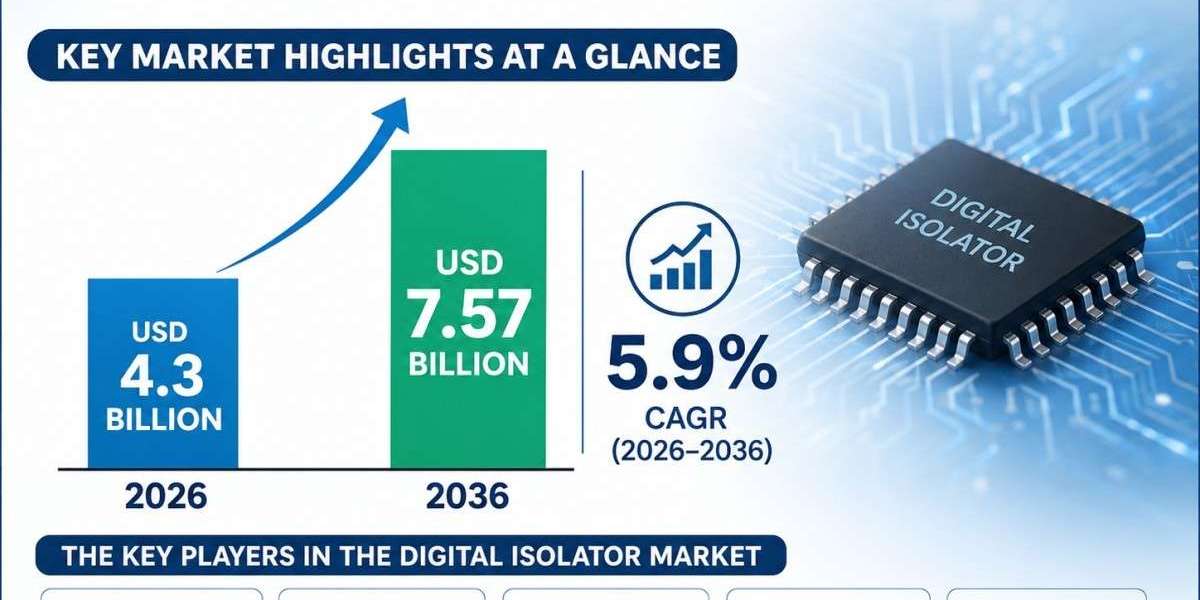

NEWARK, United States, June 1, 2026 – The global digital isolator market is gaining strong momentum as industrial automation, automotive electrification, and healthcare equipment modernization reshape component demand across high-performance electronics. According to Future Market Insights (FMI), the market was valued at USD 4.03 billion in 2025 and is expected to reach USD 4.3 billion in 2026. Over the forecast period from 2026 to 2036, the market is projected to expand to USD 7.57 billion, advancing at a CAGR of 5.9%.
Digital isolators are becoming increasingly important in applications where galvanic isolation, faster data transfer, lower latency, and improved system safety are critical. FMI notes that the market is moving from a supply-driven component category to a more application-specific design partnership model, with demand shaped by industrial control, EV powertrains, and medical devices.
Get detailed market forecasts, competitive benchmarking, and pricing trends:
https://www.futuremarketinsights.com/reports/sample/rep-gb-11894
Key Market Highlights at a Glance
• Market size in 2025: USD 4.03 billion
• Market size in 2026: USD 4.3 billion
• Forecast market size in 2036: USD 7.57 billion
• CAGR from 2026 to 2036: 5.9%
• Leading product segment in 2026: More than 75 Mbps
• More than 75 Mbps share in 2026: 44.0%
• Leading channel segment in 2026: Eight Channels
• Eight Channels share in 2026: 36.0%
• Leading vertical in 2026: Industrial
• Industrial share in 2026: 51.0%
• Fastest-growing country: China
• China CAGR through 2036: 13.2%
Why Is the Digital Isolator Market Growing?
The market is expanding as end users demand higher-speed isolation solutions that can support modern electronics in harsh electrical environments. Traditional optocouplers are increasingly being replaced by capacitive, magnetic, and hybrid digital isolators because they offer faster data rates, lower propagation delay, and longer operational lifespans.
Three major factors are supporting growth:
• Industrial automation expansion is increasing demand for high speed galvanic isolation in process control, motor drives, and sensor interface systems.
• Automotive electrification is driving adoption in battery management systems, powertrain control, onboard chargers, and in-vehicle communication networks.
• Healthcare equipment modernization is increasing procurement of medical grade digital isolators for patient-safe monitoring and diagnostic systems.
“Digital isolators are moving beyond commodity sourcing and into performance-led design collaboration,” said an FMI analyst. “Companies that can deliver higher bandwidth, lower power consumption, and application-specific reliability will be best positioned as industrial and automotive requirements continue to intensify.”
Which Product Type Leads the Digital Isolator Market?
More than 75 Mbps is expected to dominate the product segment in 2026 with a 44.0% share. This leadership reflects growing demand for higher data rates in industrial ethernet, automotive communication buses, and medical device interfaces.
High-speed products are increasingly preferred because factory digitalization and EV system architectures require faster, more reliable isolation than legacy designs. Demand is also supported by the shift from fieldbus to ethernet-based protocols in industrial environments.
Supporting points:
• More than 75 Mbps share in 2026: 44.0%
• 25 Mbps to 75 Mbps devices remain important in mid-range control systems.
• Below 25 Mbps products continue to serve simpler monitoring and point-to-point applications.
Speak to Analyst: Customize insights for your business strategy:
https://www.futuremarketinsights.com/customization-available/rep-gb-11894
Why Does Eight Channels Lead Demand?
Eight Channels is projected to lead the channel segment with a 36.0% share in 2026. Multi-axis motor drives, parallel data acquisition systems, and industrial control buses often require simultaneous isolation across multiple paths, making eight-channel configurations the preferred option.
These devices are especially relevant in automation-heavy settings where efficiency, compact design, and reliable signal protection are essential.
Supporting points:
• Eight Channels share in 2026: 36.0%
• Six Channels and Four Channels serve moderate-complexity systems.
• Two Channels remain suitable for basic isolation applications.
Which Vertical Leads the Market?
The Industrial vertical is expected to hold the largest share at 51.0% in 2026. Industrial users continue to drive the bulk of demand because process control, factory automation, motor drives, and sensor systems all depend on secure and high-speed galvanic isolation.
Automotive is the fastest-growing vertical, supported by electric vehicle production and the rising need for isolation in high-voltage electronic systems. Healthcare also remains important as safety standards become stricter across patient-facing equipment.
Which Countries Are Growing Fastest in the Digital Isolator Market?
China is projected to lead global growth at 13.2% through 2036. The country benefits from large-scale industrial automation investment, domestic semiconductor development, and expanding electric vehicle production. The United States follows at 11.1%, supported by strength in automotive electronics, industrial control infrastructure, and medical device manufacturing.
Other fast-growing countries include South Korea at 10.5%, Japan at 9.9%, Germany at 9.7%, and the UK at 9.4%. Across these markets, demand is being shaped by smart manufacturing, electrification, and safety compliance requirements.
Who Are the Key Players in the Digital Isolator Market?
Competition is centered on technology platform strength, design win momentum, and qualification capabilities across industrial, automotive, and medical applications.
• Texas Instruments – broad capacitive isolation portfolio and strong design ecosystem
• Analog Devices – magnetic isolation expertise and industrial instrumentation strength
• Broadcom – performance-focused isolation solutions
• Silicon Laboratories – high integration and embedded functionality
• NXP Semiconductors – automotive qualification and EV application strength
Companies that combine high-speed portfolios with multi-vertical engineering support are expected to gain the most traction over the forecast period.
Get the Complete Story – Read More About Our Latest Report!
https://www.futuremarketinsights.com/reports/digital-isolator-market
Frequently Asked Questions
What is the size of the digital isolator market in 2026?
The digital isolator market is valued at USD 4.3 billion in 2026.
What is the forecast value of the digital isolator market by 2036?
The market is projected to reach USD 7.57 billion by 2036.
What is the CAGR of the digital isolator market from 2026 to 2036?
The market is expected to grow at a CAGR of 5.9% during the forecast period.
Which product segment leads the market?
More than 75 Mbps leads the product segment with a 44.0% share in 2026.
Which vertical leads demand?
Industrial leads the market with a 51.0% share in 2026.
Which country is growing fastest?
China is the fastest-growing country, with a projected CAGR of 13.2% through 2036.