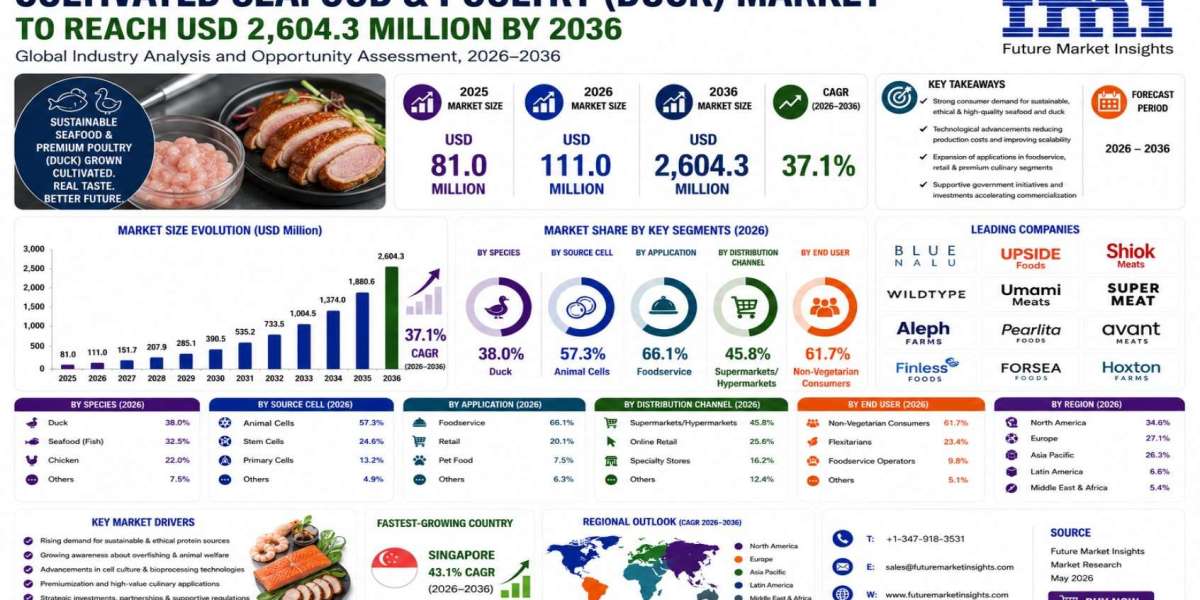

NEWARK, Del., July 2026 — The cultivated seafood & poultry (duck) market is projected to grow from USD 111.0 million in 2026 to USD 2,604.3 million by 2036, advancing at a 37.1% CAGR over the forecast period, according to Future Market Insights (FMI). The market is gaining traction as food brands replace traditional animal farming with cell-cultivated alternatives that preserve flavor profiles, improve supply chain resilience, and support corporate sustainability goals.
Food manufacturers are increasingly investing in cultivated secondary and primary production to align with novel food safety regulations, retailer sustainability targets, and consumer demand for ethical protein formats. FMI notes that these production routes offer a practical path to reducing environmental impact without forcing major changes to commercial culinary preparation and kitchen operations.
Customized consulting, country-specific forecasts, and competitive intelligence assessments are available upon request: https://www.futuremarketinsights.com/reports/sample/rep-gb-34144
Cultivated Seafood & Poultry (Duck) Market Snapshot
· Market Size (2026): USD 111.0 Million
· Forecast Market Size (2036): USD 2,604.3 Million
· Forecast Period: 2026–2036
· CAGR (2026–2036): 37.1%
· Leading Species: Duck (38.0% Market Share in 2026)
· Leading Technology: Cell Culture (58.0% Market Share in 2026)
· Leading Approval Status: Approved Programs (41.1% Market Share in 2026)
According to FMI, commercial planning depends on cultured meat processes that document the cell source, production controls, and intended food use. That discipline separates a repeatable launch route from an early technical demonstration with no channel-ready specification. Each program must convert process records into a finished-food specification that inspectors, restaurants, and distributors can apply.
“Commercial confidence comes from repeatable output and a product scope that matches the intended food channel. A technical milestone cannot replace evidence of lawful sale, consistent production, or dependable channel handling. Teams should separate species feasibility from capacity, approval status, and distribution readiness during commercial program selection,” said Nandini Roy Choudhury, Principal Analyst at Future Market Insights.
Key Takeaways for the Cultivated Seafood & Poultry (Duck) Market
· Demand builds around repeatable taste, texture, and safety performance across each planned food format.
· Duck leads species demand with a 38.0% share in 2026 through premium culinary formats.
· Cell culture represents 58.0% of technology demand as repeatable growth underpins every defined species route.
· Approved programs hold 41.1% share by providing lawful-sale routes that narrow regulatory uncertainty.
· Israel leads country growth with a 44.4% CAGR, followed closely by Singapore at 43.1% CAGR.
· Suppliers compete on species capability, regulatory status, and credible routes to repeat manufacturing.
Access full Report in PDF Format: https://www.futuremarketinsights.com/reports/brochure/rep-gb-34144
Market Drivers, Restraints, and Opportunities
The market is being driven by premium foodservice demand for products that deliver reliable taste, texture, and handling during scheduled service. A practical seafood processing plan helps food developers match tissue output with downstream handling requirements. Repeatable results reduce trial waste and make staff training easier for restaurant partners during limited commercial trials.
Altering cell inputs remains a key restraint. Changed cell inputs can alter the process covered in an earlier safety assessment, creating regulatory hurdles and delaying planned commercial scheduling for approved products. Developers need change-control records that show how revised media or processing conditions preserve the assessed safety profile.
The strongest opportunity lies in focused authorization requests for limited-volume production capacity. Defined authorization requests support targeted foodservice entry for specialized products, enabling teams to build brand equity and validate consumer acceptance while scaling up larger bioprocess operations.
Segment Analysis
By Species
Duck is forecast to represent 43.9% of species demand in 2026, driven by premium menus that value familiar flavor and fat attributes. Chefs can compare the product with established preparation methods and define limited menus using predictable cooking instructions and handling. Early duck adoption depends on sensory consistency, ingredient disclosure, and dependable batch availability across scheduled restaurant service.
Chicken, beef, and seafood segments are also expanding as developers establish clear regulatory pathways and scale cell line development.
By Technology
Cell culture is projected to account for 68.4% of technology share in 2026 due to its foundational role in producing biological material across every defined species route. Engineers use operating parameters to protect cell quality as production moves from development vessels into larger manufacturing equipment without compromising traceability or batch consistency.
Scaffolding technologies continue to serve structural tissue application needs for complex meat cuts.
By Approval Status
Approved status is forecast to lead the category with 44.9% share in 2026 due to completed review routes that give commercial planning a defined legal basis. Authorization clarifies specifications and labeling responsibilities but does not replace manufacturing discipline across every food channel. Channel partners can align label content, product specifications, and service expectations around the approved food.
Pending review, under development, and regionally restricted programs form the remaining regulatory spectrum.
Regional Outlook
FMI observes that buyer priorities and regulatory landscapes vary significantly across geographies. Israel and Singapore offer defined novel-food routes with established regulatory frameworks. The Netherlands benefits from strong public policy support, while the United States coordinates FDA and USDA-FSIS regulatory oversight. France focuses on premium culinary integration backed by local technical platforms.
Country Growth Forecast (2026–2036)
· Israel (44.4% CAGR through 2036)
· Singapore (43.1% CAGR through 2036)
· Netherlands (41.4% CAGR through 2036)
· United States (40.2% CAGR through 2036)
· France (38.9% CAGR through 2036)
Israel is expected to lead global expansion supported by a national framework that enables active engagement with food authorities. Singapore follows closely, supported by a concentrated foodservice environment and proactive novel-food policies. The Netherlands occupies a strong central position driven by government coalition funding for food technology, while the United States advances through clear FDA and USDA-FSIS regulatory coordination for poultry.
Unlock high-growth opportunities with FMI's niche business market insights:
https://www.futuremarketinsights.com/industry-analysis
Competitive Landscape
The competitive landscape includes core technology developers, scaled manufacturing groups, and commercialization specialists focused on improving cell line stability, scaling bioprocess capacity, and securing regulatory clearances. Key companies profiled include PARIMA, Wildtype, GOOD Meat, BlueNalu, UPSIDE Foods, Mosa Meat, Aleph Farms, and Vow.
Suppliers are differentiating through species expertise, documented approval history, and foodservice partner integration. As market adoption accelerates, commercial success increasingly depends on batch consistency, regulatory compliance, and cost-effective bioprocess execution.
Recent Industry Developments
FMI highlights several key industry developments:
· In April 2025, BlueNalu expanded its Nomad Foods partnership for European seafood commercialization and entered the UK Food Standards Agency regulatory sandbox.
· In June 2025, Vow received Food Standards Australia New Zealand approval for cell-cultured quail as a recognized food format.
· In December 2025, BlueNalu secured approximately USD 11 million in financing to advance manufacturing readiness for cultivated bluefin tuna toro.
· In June 2026, Wildtype initiated commercial cultivated salmon service at barmini in Washington, D.C.
Exclusive Discounts on Full Report: https://www.futuremarketinsights.com/reports/cultivated-seafood-and-poultry-duck-market
Frequently Asked Questions
What is the projected size of the cultivated seafood & poultry (duck) market by 2036?
The market is projected to reach USD 2,604.3 million by 2036.
What is the CAGR of the cultivated seafood & poultry (duck) market?
The market is expected to grow at a 37.1% CAGR between 2026 and 2036.
Which species segment leads the market?
Duck leads the species market with a 38.0% share in 2026.
Which technology segment is most prominent?
Cell culture is projected to account for 58.0% share in 2026.
Which approval status holds the highest share?
Approved programs account for 41.1% of total market share in 2026.
Which country is expected to grow the fastest?
Israel is forecast to expand at a 44.4% CAGR during the forecast period.
Explore More Related Studies Published by FMI Research
Pectin Market : https://www.futuremarketinsights.com/reports/pectin-market
Korea Probiotic Supplement Industry Analysis : https://www.futuremarketinsights.com/reports/demand-and-trend-analysis-of-probiotic-supplement-in-korea
Explore In-Depth Food & Beverage Market Insights : https://www.futuremarketinsights.com/industry-analysis/food-and-beverage
FMI Custom Research: Strategic Intelligence for Confident Decision-Making
In today's rapidly evolving business environment, leadership teams need clear, actionable intelligence tailored to their strategic objectives. FMI's Custom Research solutions are designed around specific business questions, enabling executives to evaluate growth opportunities, validate investments, assess competitive dynamics, and reduce uncertainty.
Key Executive Benefits
· Decision-Ready Insights: Research tailored to specific business challenges, growth plans, and investment priorities.
· Reduced Strategic Risk: Validate market opportunities, customer demand, and competitive positioning before committing resources.
· Market Entry Confidence: Assess opportunity size, regulatory barriers, channel dynamics, and competitive landscapes.
· Competitive Advantage: Gain proprietary intelligence unavailable through syndicated reports.
· Faster Growth Decisions: Accelerate expansion, product development, and portfolio optimization.
· Primary Market Validation: Access real-world customer, buyer, and stakeholder insights.
Business Impact
FMI helps organizations transform market complexity into strategic clarity, enabling leadership teams to identify growth opportunities faster, optimize resource allocation, and make high-stakes business decisions with confidence.
To explore how FMI Custom Research can support your strategic priorities, connect with our team at - sales@futuremarketinsights.com
About Future Market Insights (FMI)
Future Market Insights (FMI) delivers actionable, decision-focused market intelligence that goes beyond traditional research reports. The company provides:
· In-depth pricing and cost benchmarking analysis
· Demand forecasting based on real industry inputs
· Procurement and buyer behavior insights
· Supply chain and trade flow intelligence
· Technology and application trend analysis across industries
FMI follows a robust bottom-up research methodology, combining insights from industry experts, procurement leaders, manufacturers, and technical professionals to ensure accurate and practical market intelligence.
For Press & Corporate Inquiries
Rahul Singh
AVP - Marketing and Growth Strategy
Future Market Insights, Inc. +91 8600020075
For Sales - sales@futuremarketinsights.com
For Media - Rahul.singh@futuremarketinsights.com
For web - https://www.futuremarketinsights.com/
For Web - https://www.factmr.com/