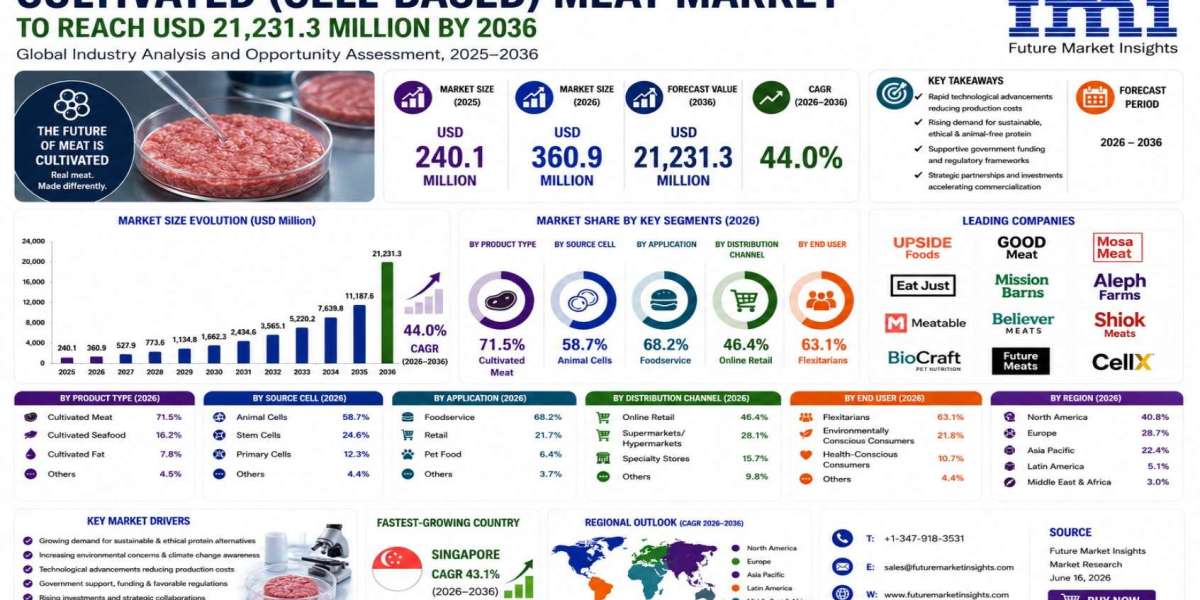

The cultivated (cell-based) meat market is projected to grow from USD 360.9 million in 2026 to USD 21,231.3 million by 2036, advancing at a 50.3% CAGR over the forecast period, according to Future Market Insights (FMI). The market is gaining traction as food brands replace traditional animal farming with cell-cultivated alternatives that preserve flavor profiles, improve supply chain resilience, and support corporate sustainability goals.
Food manufacturers are increasingly investing in cultivated secondary and primary production to align with novel food safety regulations, retailer sustainability targets, and consumer demand for ethical protein formats. FMI notes that these production routes offer a practical path to reducing environmental impact without forcing major changes to commercial culinary preparation and retail operations.
Customized consulting, country-specific forecasts, and competitive intelligence assessments are available upon request: https://www.futuremarketinsights.com/reports/sample/rep-gb-34141
Cultivated (Cell-Based) Meat Market Snapshot
· Market Size (2026): USD 360.9 Million
· Forecast Market Size (2036): USD 21,231.3 Million
· Forecast Period: 2026–2036
· CAGR (2026–2036): 50.3%
· Leading Source: Beef (38.0% Market Share in 2026)
· Leading Technology: Cell Culture (58.0% Market Share in 2026)
· Leading End Use: Retail (59.9% Market Share in 2026)
According to FMI, commercial scale depends on cell culture media that preserve identity and growth through repeated food-grade batches. Automated cell culture systems provide a useful comparison for handling discipline while cultivated food plants retain product-specific controls for sterility and batch release.
“Commercial confidence will depend on whether cultivated products preserve quality across approved manufacturing and distribution conditions. Food producers should separate cell-growth performance from final sensory performance since each risk needs different validation evidence. Expansion should follow measured repeat purchases and stable batch release instead of one successful tasting or restaurant event,” said Nandini Roy Choudhury, Principal Analyst at Future Market Insights.
Key Takeaways for the Cultivated (Cell-Based) Meat Market
· Demand builds around clearer approval routes, regulatory progress, and improving process economics.
· Beef leads source demand with a 38.0% share in 2026 through familiar applications and cultivated fat integration.
· Cell culture represents 58.0% of technology demand supported by its central role in producing usable biomass.
· Retail represents 59.9% of end-use demand owing to packaged formats and repeat household purchasing potential.
· Israel leads country growth with a 44.4% CAGR, followed closely by Singapore at 43.1% CAGR.
· Competition combines developers with completed regulatory reviews and companies pursuing applications with controlled commercial access.
Access full Report in PDF Format: https://www.futuremarketinsights.com/reports/brochure/rep-gb-34141
Market Drivers, Restraints, and Opportunities
The market is being driven by lower production costs that make restaurant trials and packaged launches easier to finance across several product formats. Mosa Meat reported in December 2025 that burger production costs had declined 99.999% compared with its first burger, reaching a restaurant-ready price point and strengthening trial economics.
Regulatory fragmentation remains a key restraint. Safety and inspection requirements vary by jurisdiction, extending qualification work across manufacturing, labeling, and distribution. Developers face longer launch intervals if local manufacturing controls, batch records, or approved labels remain incomplete across target markets.
The strongest opportunity lies in cultivated fat applications. Cultivated fat creates an opening for blended products that deliver authentic animal flavor and texture without requiring high lean-tissue volume, enabling manufacturers to achieve measurable sensory performance across familiar recipes at lower initial production volumes.
Segment Analysis
By Source
Beef is set to lead the source category with 53.3% share in 2026 due to its fit with blended foods and familiar menu applications. Cultivated fat can enter ground or formed products without reproducing the complex structure of a complete muscle cut. This lowers the initial biomass requirement while giving food manufacturers a direct sensory role that consumers understand through conventional beef recipes.
Poultry, seafood, and pork segments are also expanding as developers establish specialized cell lines and regulatory pathways.
By Technology
Cell culture is forecast to represent 62.8% share in 2026 driven by its direct role in biomass creation and consistency. Cell banks and media systems establish the biological foundation for each repeated commercial production campaign, while bioreactors and process monitoring preserve output quality across larger vessels and longer operating schedules.
Scaffolding technologies continue to serve structural tissue formation needs for complex meat cuts.
By End Use
Retail is estimated to capture 56.4% share in 2026 attributable to packaged formats that support repeat household purchasing across established store channels. Packaged products convert consumer interest into repeat purchases through familiar preparation formats. Frozen or refrigerated merchandising gives producers a recognizable route for dependable replenishment and promotional planning.
Foodservice programs continue to serve as vital testing grounds for consumer sampling and chef adoption.
Regional Outlook
FMI observes that country growth reflects approval timing, local manufacturing routes, and distribution models for refrigerated or frozen products. Israel, Singapore, and the Netherlands form a closely aligned upper group with defined novel food frameworks. The United States coordinates FDA and USDA-FSIS regulatory oversight, while the UK provides direct guidance and regulatory engagement for cell-cultivated foods.
Country Growth Forecast (2026–2036)
· Israel (44.4% CAGR through 2036)
· Singapore (43.1% CAGR through 2036)
· Netherlands (41.4% CAGR through 2036)
· United States (40.2% CAGR through 2036)
· United Kingdom (39.8% CAGR through 2036)
Israel is expected to lead global growth supported by an established approval route for cultivated beef and strong domestic technology investment. Singapore follows closely, reinforced by a defined novel food framework and active retail availability. The Netherlands occupies a strong central position driven by research capabilities and alternative protein innovation, while the United States advances through coordinated FDA and USDA-FSIS inspection pathways.
Unlock high-growth opportunities with FMI's niche business market insights:
https://www.futuremarketinsights.com/industry-analysis
Competitive Landscape
The competitive landscape combines developers with completed regulatory reviews and companies pursuing applications with controlled consumer access. Key companies profiled include UPSIDE Foods, GOOD Meat, Mosa Meat, Aleph Farms, Wildtype, Mission Barns, Believer Meats, and Vow.
Suppliers are differentiating through species focus, regulatory readiness, and consumer channel access. As market commercialization progresses, competitive strength increasingly depends on documented regulatory status, batch consistency, and usable product formats with credible distribution pathways.
Recent Industry Developments
FMI highlights several key industry developments shaping the market:
· In January 2025, Mosa Meat submitted its first European market authorization request for cultivated beef fat intended for use in a hybrid burger format.
· In June 2025, Wildtype began serving cultivated salmon at Kann following completion of its FDA pre-market consultation, establishing weekly foodservice availability.
· In July 2025, Mission Barns received USDA approval and a grant of inspection for its San Francisco pilot facility and cultivated pork fat ingredient following FDA clearance.
· In June 2025, Vow launched cultured Japanese quail across selected restaurants in Sydney and Melbourne following Australian regulatory approval.
Exclusive Discounts on Full Report: https://www.futuremarketinsights.com/reports/cultivated-cell-based-meat-market
Frequently Asked Questions
What is the projected size of the cultivated (cell-based) meat market by 2036?
The market is projected to reach USD 21,231.3 million by 2036.
What is the CAGR of the cultivated (cell-based) meat market?
The market is expected to grow at a 50.3% CAGR between 2026 and 2036.
Which source segment leads the market?
Beef leads the source market with a 38.0% share in 2026.
Which technology segment is most prominent?
Cell culture is forecast to represent a 58.0% share in 2026.
Which end-use segment holds the highest share?
Retail holds the leading end-use share, estimated at 59.9% in 2026.
Which country is expected to grow the fastest?
Israel is forecast to expand at a 44.4% CAGR during the forecast period.
Explore More Related Studies Published by FMI Research
Resveratrol Industry Analysis in Korea : https://www.futuremarketinsights.com/reports/resveratrol-industry-analysis-in-korea
Polydextrose Industry Analysis in Western Europe : https://www.futuremarketinsights.com/reports/polydextrose-industry-analysis-in-western-europe
Explore In-Depth Food & Beverage Market Insights : https://www.futuremarketinsights.com/industry-analysis/food-and-beverage
FMI Custom Research: Strategic Intelligence for Confident Decision-Making
In today's rapidly evolving business environment, leadership teams need clear, actionable intelligence tailored to their strategic objectives. FMI's Custom Research solutions are designed around specific business questions, enabling executives to evaluate growth opportunities, validate investments, assess competitive dynamics, and reduce uncertainty.
Key Executive Benefits
· Decision-Ready Insights: Research tailored to specific business challenges, growth plans, and investment priorities.
· Reduced Strategic Risk: Validate market opportunities, customer demand, and competitive positioning before committing resources.
· Market Entry Confidence: Assess opportunity size, regulatory barriers, channel dynamics, and competitive landscapes.
· Competitive Advantage: Gain proprietary intelligence unavailable through syndicated reports.
· Faster Growth Decisions: Accelerate expansion, product development, and portfolio optimization.
· Primary Market Validation: Access real-world customer, buyer, and stakeholder insights.
Business Impact
FMI helps organizations transform market complexity into strategic clarity, enabling leadership teams to identify growth opportunities faster, optimize resource allocation, and make high-stakes business decisions with confidence.
To explore how FMI Custom Research can support your strategic priorities, connect with our team at - sales@futuremarketinsights.com
About Future Market Insights (FMI)
Future Market Insights (FMI) delivers actionable, decision-focused market intelligence that goes beyond traditional research reports. The company provides:
· In-depth pricing and cost benchmarking analysis
·