
Manufacturing in Singapore has always had to work within tight constraints. Land is limited, labour is expensive relative to regional competitors, and the country doesn't have the scale advantages of larger manufacturing hubs nearby. What Singapore has instead is precision, reliability, and a workforce capable of handling high-value, complex production. To stay competitive on those terms, manufacturers across the island have been steadily moving away from manual, paper-based processes and toward connected, data-driven operations.
This shift isn't happening because of a single trend. It's the result of several pressures converging at once: rising costs, an ageing workforce, supply chains that got a hard lesson in fragility over the past few years, and customers who now expect faster turnaround with fewer errors. Smart technology, in this context, isn't about chasing novelty. It's about survival in a market where margins are thin and mistakes are expensive.
The Shift From Paper to Data
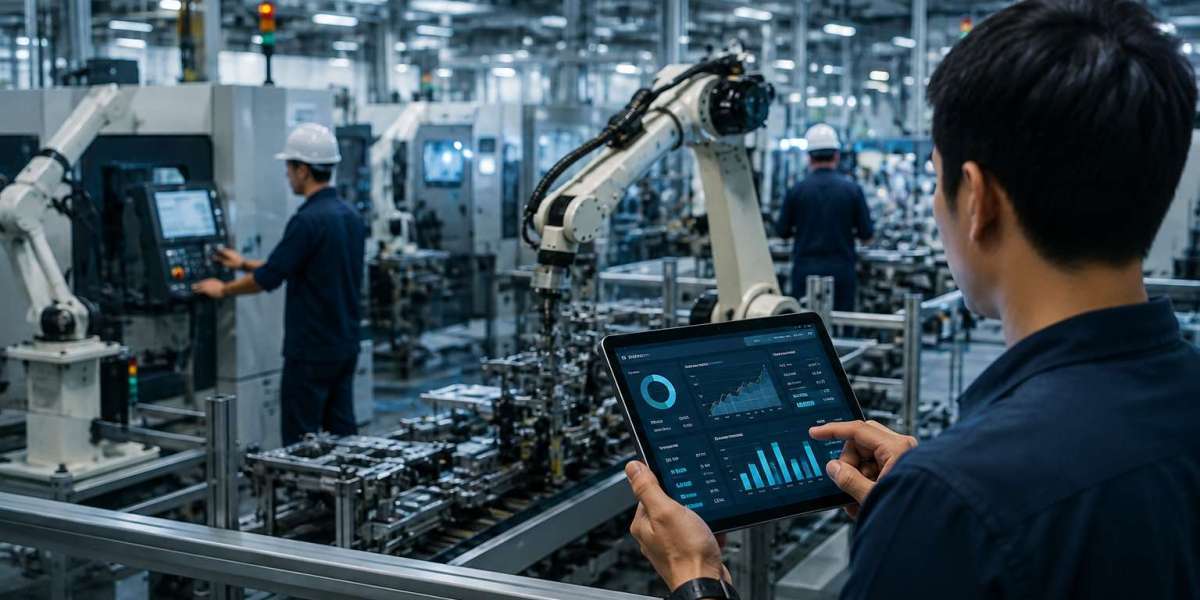
Walk into a manufacturing facility in Singapore today and you'll likely see a mix of old and new. Some processes still run on printed job cards and manual sign-offs. Others have moved to tablets on the shop floor, sensors on machines, and dashboards that update as production happens. The direction of travel is clear, even if the pace varies by industry and company size.
The core problem with paper-based tracking is that it creates blind spots. A production manager might not know a machine is running below capacity until the end of a shift, or that a batch of components failed quality checks until it's already moved several steps down the line. By the time the information reaches someone who can act on it, the cost of the delay has already been absorbed.
Connected systems close that gap. Data from machines, quality checks, and inventory counts flows into a central system in near real time, which means problems surface while they can still be fixed cheaply, not after they've compounded into missed deadlines or wasted material.
Where an ERP System for Singapore Manufacturers Fits In
A lot of the conversation around smart manufacturing focuses on machines: robotics, sensors, automated guided vehicles. Those matter, but they're only half the picture. The other half is the software layer that ties everything together, and this is where an ERP system for Singapore manufacturers becomes relevant.
On its own, a smart sensor on a machine tells you that machine's status. It doesn't tell you how that status affects your delivery schedule, your raw material orders, or your invoicing. An integrated system connects that shop-floor data to procurement, inventory, finance, and order management, so a delay on the production line automatically reflects in delivery estimates, and a drop in raw material stock triggers a reorder before it becomes a bottleneck.
For manufacturers running multiple product lines or serving both local and export markets, this connection matters even more. A single delayed shipment can ripple through customer relationships, and without visibility across the entire operation, it's difficult to catch these issues early enough to manage them proactively.
Where the Impact Actually Shows Up
The value of adopting smart technology tends to show up in a handful of concrete areas rather than as some abstract efficiency gain.
Machine downtime becomes something you can plan around. Sensors that monitor equipment condition allow maintenance teams to service machines before they fail, rather than reacting after a breakdown halts production. This shift from reactive to predictive maintenance is one of the more measurable benefits manufacturers report, since unplanned downtime is one of the costliest disruptions on any production line.
Quality control catches problems earlier. Automated inspection systems, whether through machine vision or in-line sensors, can flag defects at the point of production rather than during a final batch check. This reduces the volume of rework and scrap, both of which eat directly into margins.
Material planning becomes more accurate. When production data connects to inventory and procurement, manufacturers can plan raw material orders based on actual consumption patterns rather than rough estimates. This is particularly useful for manufacturers dealing with imported materials, where lead times can stretch and buffer stock ties up working capital.
Traceability improves across the supply chain. For manufacturers serving industries like electronics, pharmaceuticals, or food, being able to trace a batch back through every stage of production, from raw material to finished product, isn't optional. Connected systems make this traceability far less labour-intensive to maintain and far more reliable when it's needed.
The Workforce Angle
Singapore's manufacturing sector has been dealing with labour constraints for years, and this shapes how smart technology gets adopted. The goal for most manufacturers isn't to replace workers wholesale but to shift them away from repetitive, low-value tasks and toward roles that require judgment and problem-solving.
A worker who used to spend hours manually logging production counts can instead focus on interpreting the data those systems generate and making decisions based on it. This requires a different skill set than before, and manufacturers investing in smart technology are, in many cases, also investing in training their existing staff to work alongside these systems rather than simply replacing headcount.
This matters for retention too. Younger workers entering the manufacturing workforce generally expect more digital, less manual working environments. Facilities that still rely heavily on paper processes and manual tracking can struggle to attract and keep talent compared to those offering more modern, tech-enabled roles.
Government Push and Industry Support
Singapore's manufacturing digitalisation isn't happening in isolation. National initiatives around advanced manufacturing and Industry 4.0 readiness have pushed many companies, particularly small and mid-sized manufacturers, to evaluate their own technology gaps. Support programmes aimed at helping manufacturers assess their digital maturity and adopt appropriate tools have lowered some of the barriers that used to make this transition feel out of reach for smaller players.
This support matters because the cost and complexity of adopting new systems can otherwise be prohibitive for smaller manufacturers competing against larger, better-resourced players. Structured guidance and funding support help level that playing field to some degree.
What Manufacturers Should Weigh Before Adopting New Systems
Not every manufacturer needs the same level of technology investment, and adoption should be matched to actual operational needs rather than following trends for their own sake. A few considerations tend to come up consistently:
- Fit with existing equipment: Older machinery may need retrofitting with sensors rather than full replacement, which changes the cost and complexity of a project significantly.
- Data integration: Systems that don't talk to each other create the same fragmentation problem digitalisation is meant to solve, so compatibility across shop-floor tools, inventory, and finance systems needs to be evaluated carefully.
- Scalability: A system that works for current production volume should be able to handle growth without a complete redesign.
- Staff training and change management: New systems only deliver value if staff actually use them correctly, which means training and a realistic transition timeline need to be part of any rollout plan.
Looking Forward
Manufacturing in Singapore isn't competing on cheap labour or scale, and it hasn't for a long time. It competes on precision, reliability, and the ability to respond quickly to changing demand. Smart technology, when adopted thoughtfully rather than for its own sake, supports exactly those strengths by giving manufacturers clearer visibility into their operations and fewer blind spots between decisions and outcomes.
The manufacturers navigating this transition well tend to treat it as an ongoing process rather than a one-time upgrade, adjusting their systems and processes as their operations, workforce, and market conditions continue to evolve.