
The global popcorn market is undergoing a structural transformation, evolving from a traditional cinema-occasion treat into an everyday, permissible health-conscious snacking choice, according to latest insights by Future Market Insights. Supported by popcorn's whole-grain profile, high fiber content (~3.5 g per serving), and low calorie density compared to fried chips, ready-to-eat (RTE) pre-popped formats are establishing permanent shelf placement across modern grocery and convenience retail aisles.
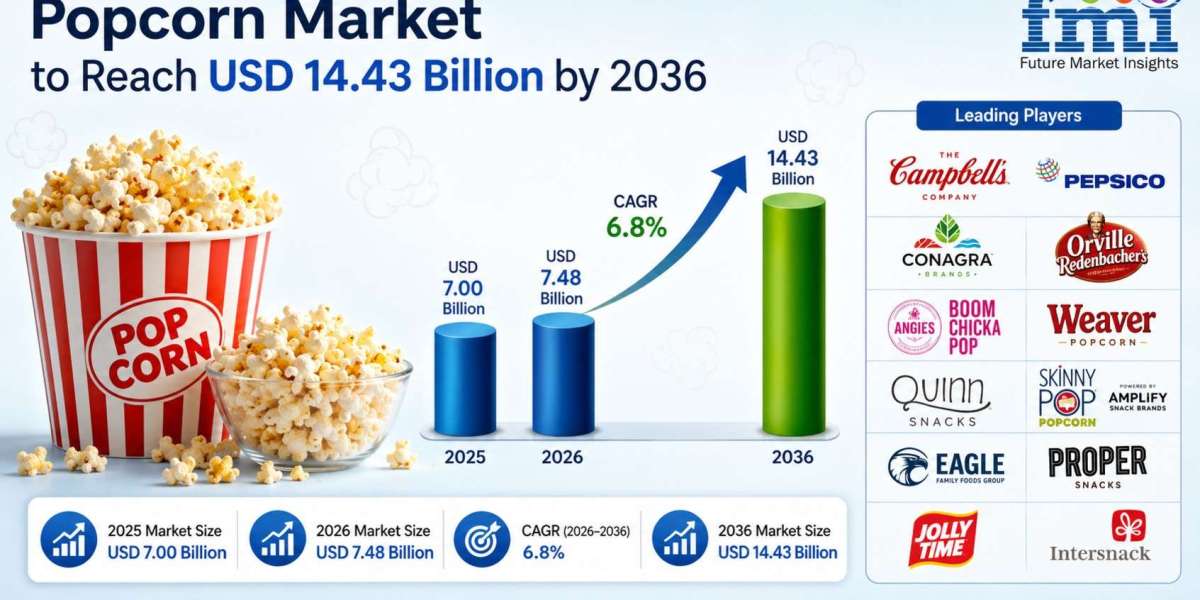
The global market, valued at USD 7.00 billion in 2025, is projected to reach USD 7.48 billion in 2026. Advancing at a Compound Annual Growth Rate (CAGR) of 6.8% over the ten-year forecast period, total market valuation is anticipated to achieve USD 14.43 billion by 2036, delivering an absolute incremental opportunity of USD 6.95 billion.
Request a Sample Report: https://www.futuremarketinsights.com/reports/sample/rep-gb-19954
Market Performance Overview (2026–2036)
To map out the key product formats, core retail distribution channels, and regional growth vectors guiding this USD 6.95 billion market expansion, key segment allocations highlight where global commercial demand is concentrated:
· Ready-to-Eat (RTE) Popcorn Segment (62.0% share): Commands product format sales in 2026, favored for immediate snacking convenience, portability, and portion-controlled packaging that requires no preparation equipment.
· Microwave Popcorn Segment (38.0% share): Retains steady baseline demand serving home entertainment occasions where consumers seek warm, freshly popped textures and aromas.
· Hypermarkets and Supermarkets Channel (45.0% share): Represents the dominant retail sales channel, placing RTE popcorn directly in salty snack aisles to capture cross-browsing traffic from traditional potato chips and pretzels.
· India & China Regional Leadership: Lead national growth rates at 9.1% CAGR and 7.8% CAGR respectively through 2036, driven by rapid modern retail expansion, urban on-the-go snacking habits, and localized flavor innovations (e.g., spiced masala blends).
Technical Drivers and Snacking Shifts
The expansion and premiumization of the popcorn market across retail and digital channels are propelled by three primary industry catalysts:
Repositioning as a Clean-Label, Whole-Grain Snack
Modern consumers increasingly avoid traditional deep-fried snacks. Because air-popped and lightly seasoned popcorn delivers natural dietary fiber and polyphenols with minimal processing, brands leverage clean-label packaging ("non-GMO," "gluten-free," "organic") to capture health-oriented daily snacking trips.
Gourmet and Artisan Flavor Innovation
Manufacturers are moving beyond basic butter and salt to premium culinary flavor profiles, such as black truffle, aged white cheddar, Himalayan pink salt, sriracha, and dark chocolate drizzle. These gourmet lines command a $2\times$ to $3\times$ price premium over commodity lines, enhancing gross margins for brand owners.
Dual-Brand Strategy: Daily Wellness vs. Indulgence
Leading snack conglomerates are operating a dual-tier portfolio strategy: marketing clean-label, low-sodium air-popped lines for daily school and workplace routines while offering indulgent, sweet-and-savory kettle corn and cheese-coated varieties for premium social and movie-night occasions.
Industrial Constraints & Supply Chain Risks
Popcorn processors and snack brand managers navigate specific operational hurdles:
· Raw Corn Feedstock Price Volatility: Sourcing specialized popcorn hybrid corn varieties (which require precise kernel moisture of 13.5–14.5% to ensure maximum popping expansion) leaves manufacturers exposed to weather-induced crop yield and price fluctuations.
· Sustainable Packaging Conversion Costs: Transitioning to recyclable, compostable, or high-barrier moisture-proof packaging to maintain crispness without synthetic barrier films requires higher packaging material capital expenditure.
Regional Growth Profile
Regional demand reflects rapid organized retail expansion across Asian emerging markets alongside premiumization in Western snack hubs:
· India (9.1% CAGR): The global growth frontrunner, driven by an expanding organized snack food market, modern grocery adoption, and high demand for localized spicy/savory flavor profiles.
· China (7.8% CAGR): Spurring rapid volume growth as busy urban demographics adopt convenient, packaged ready-to-eat Western snacks across hypermarkets and e-commerce platforms.
· United States (6.8% CAGR in North America / 5.8% mature US base): The largest global production and consumption powerhouse, where growth is sustained by organic, air-popped, and functional ingredient line extensions.
· Spain (6.4% CAGR), United Kingdom (6.2% CAGR), & Germany (5.5% CAGR): Leading European market activity, supported by private-label supermarket expansion, vegan certifications, and clean-label dietary trends.
Competitive Landscape
The global popcorn landscape features a combination of multinational food and beverage conglomerates, integrated corn agricultural processors, and agile gourmet snack startups.
Key market participants profiled in the report include Campbell Soup Company, PepsiCo Inc. (Smartfood), Conagra Brands, Inc. (Orville Redenbacher's, Angie's BOOMCHICKAPOP), Weaver Popcorn, Inc., Quinn Foods LLC, The Hershey Company (SkinnyPop / Amplify Snack Brands), Eagle Family Foods Group LLC, PROPER Snacks, JOLLY TIME, and Intersnack Group GmbH & Co. KG. Leading players compete by securing vertically integrated high-expansion corn supplies, launching sustainable barrier packaging, and expanding direct-to-consumer gourmet gifting channels.
Exclusive Discounts on Full Report: https://www.futuremarketinsights.com/reports/popcorn-market
Frequently Asked Questions
What is the projected valuation of the global popcorn market by 2036?
The global popcorn market is projected to reach USD 14.43 billion by 2036, expanding from an estimated baseline valuation of USD 7.48 billion in 2026 at a CAGR of 6.8%.
Why does Ready-to-Eat (RTE) Popcorn command a 62.0% market share?
Ready-to-eat popcorn leads the market in 2026 because pre-popped, shelf-stable packaging delivers immediate consumption convenience, portion control, and complete portability for on-the-go lifestyles without requiring heating equipment.
What distribution channel accounts for the majority of popcorn sales?
Hypermarkets and supermarkets lead with a 45.0% market share in 2026, providing the high foot traffic, broad flavor variety, and prime salty snack aisle placement necessary to drive impulse grocery purchases.
FMI Custom Research: Strategic Intelligence for Confident Decision-Making
In today's rapidly evolving business environment, leadership teams need clear, actionable intelligence tailored to their strategic objectives. FMI's Custom Research solutions are designed around specific business questions, enabling executives to evaluate growth opportunities, validate investments, assess competitive dynamics, and reduce uncertainty before making critical decisions.
Key Executive Benefits
· Decision-Ready Insights: Research tailored to your specific business challenges, growth plans, and investment priorities.
· Reduced Strategic Risk: Validate market opportunities, customer demand, and competitive positioning before committing resources.
· Market Entry Confidence: Assess opportunity size, regulatory barriers, channel dynamics, and competitive landscapes with precision.
· Competitive Advantage: Gain proprietary intelligence unavailable through syndicated reports or internal datasets.
· Faster Growth Decisions: Accelerate expansion, product development, portfolio optimization, and investment planning.
· Primary Market Validation: Access real-world customer, buyer, and stakeholder insights that support high-confidence decision-making.
Business Impact
FMI helps organizations transform market complexity into strategic clarity, enabling leadership teams to identify growth opportunities faster, optimize resource allocation, strengthen competitive positioning, and make high-stakes business decisions with confidence.
To explore how FMI Custom Research can support your strategic priorities, connect with our team at - sales@futuremarketinsights.com
About Future Market Insights (FMI)
Future Market Insights (FMI) delivers actionable, decision-focused market intelligence that goes beyond traditional research reports. The company provides:
· In-depth pricing and cost benchmarking analysis
· Demand forecasting based on real industry inputs
· Procurement and buyer behavior insights
· Supply chain and trade flow intelligence
· Technology and application trend analysis across industries
FMI follows a robust bottom-up research methodology, combining insights from industry experts, procurement leaders, manufacturers, and technical professionals to ensure accurate and practical market intelligence.