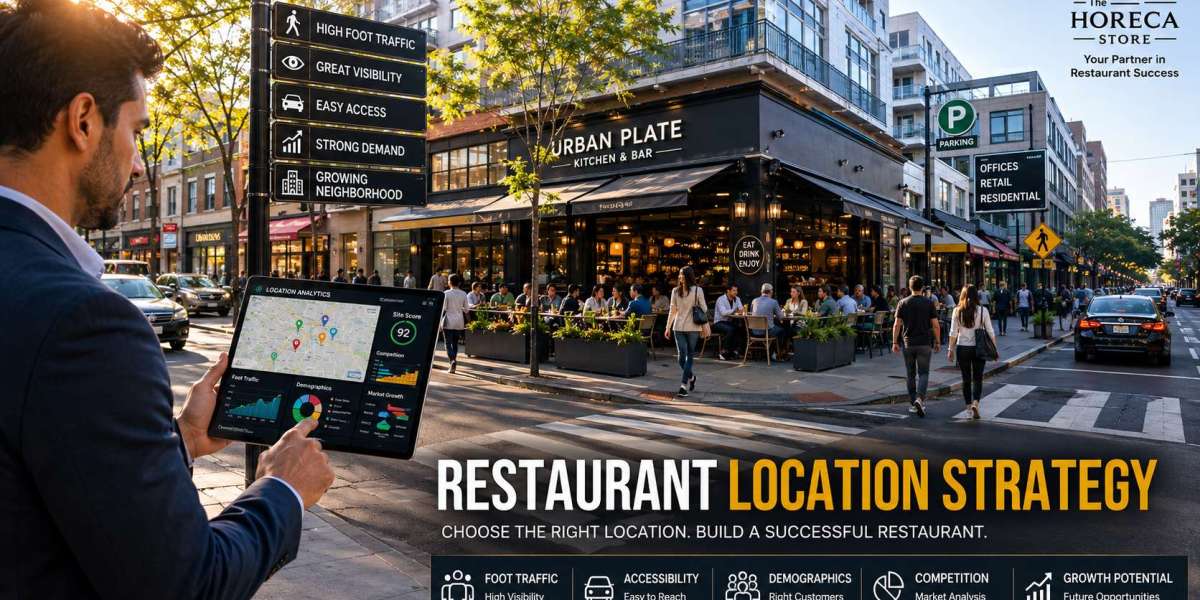

A successful restaurant depends on many factors, including food quality, service, pricing, branding, and marketing. However, one factor can influence almost every part of the business before the doors even open: location. A well-planned restaurant location strategy helps restaurant owners identify areas where their target customers are most likely to live, work, shop, travel, and dine.
Choosing a restaurant location should not be based solely on how attractive a property looks or how much foot traffic passes by. The best location is one that matches the restaurant concept, customer demographics, competition, accessibility, operating costs, and long-term business goals.
Whether you are launching a new restaurant, expanding an existing brand, or relocating an established operation, a structured approach to site selection can reduce risk and improve the potential for sustainable growth.
What Is a Restaurant Location Strategy?
A restaurant location strategy is a structured process for evaluating and selecting a location based on factors that can influence restaurant performance.
It involves analyzing elements such as:
Target customers
Demographics
Foot traffic
Vehicle traffic
Competition
Accessibility
Parking
Rent and occupancy costs
Local market demand
Delivery opportunities
Property infrastructure
Future development
Business regulations
The objective is to find a location that provides a strong balance between customer potential, operating costs, convenience, and long-term growth.
A restaurant location strategy can be especially valuable because signing a commercial lease or purchasing a property represents a significant financial commitment.
Why Restaurant Location Matters
Location affects how easily customers can discover and access a restaurant.
A restaurant near offices may benefit from weekday lunch demand. A restaurant near residential neighborhoods may attract families and local residents. A restaurant near entertainment venues may receive stronger evening and weekend traffic.
The location also influences labor availability, delivery times, supplier access, rent, visibility, and competition.
Even an excellent restaurant concept can struggle if it is positioned in an area where the target customers are difficult to reach.
That is why location should be considered part of the overall business strategy rather than simply a real estate decision.
Start With Your Restaurant Concept
The first step in creating a restaurant location strategy is defining the restaurant itself.
Consider the type of restaurant you plan to operate.
Will it be:
Fine dining?
Fast casual?
Quick service?
Family dining?
Café?
Bakery?
Bar or lounge?
Specialty cuisine?
Delivery-focused?
Takeout-focused?
Each concept has different location requirements.
A fine-dining restaurant may benefit from an affluent customer base and an attractive destination environment. A quick-service restaurant may prioritize visibility, traffic, convenience, and parking.
A small café might perform well near offices, universities, shopping districts, or pedestrian areas.
Understanding your concept helps narrow the location search.
Define Your Target Customer
A strong restaurant location strategy begins with understanding the people you want to serve.
Create a profile of your ideal customer.
Consider:
Age
Income
Occupation
Household size
Lifestyle
Dining preferences
Spending habits
Transportation
Preferred dining times
Then determine where these customers are concentrated.
For example, a premium restaurant may require an area with sufficient purchasing power, while an affordable family restaurant may benefit from a dense residential population.
Customer demographics can help restaurant owners avoid selecting locations based on assumptions.
Analyze Local Demographics
Demographic data provides valuable information about potential customer markets.
Research population size, population growth, household income, age distribution, employment, household composition, and other relevant characteristics.
But demographic analysis should go beyond simply asking whether an area has a large population.
A neighborhood may have a high population but still be unsuitable for your restaurant concept if the residents do not match your target market.
The goal is to find relevant demand, not simply a large number of people.
Study Foot and Vehicle Traffic
Traffic is an important component of restaurant site selection.
Pedestrian traffic can be valuable for cafés, bakeries, quick-service restaurants, and restaurants located in urban or shopping districts.
Vehicle traffic may be more important for suburban restaurants, drive-through concepts, and businesses where customers typically arrive by car.
However, high traffic does not automatically mean high restaurant sales.
You should determine whether the people passing through the area are likely to become customers.
Also evaluate whether customers can easily enter and exit the property.
Evaluate Accessibility
Customers should be able to reach your restaurant conveniently.
Evaluate:
Road access
Public transportation
Pedestrian routes
Parking
Intersection design
Traffic congestion
Property entrances
Sign visibility
Accessibility requirements
For restaurants serving families or groups, convenient parking can be particularly important.
Urban restaurants may depend more heavily on public transportation and pedestrian access.
The best choice depends on customer behavior and restaurant concept.
Analyze Competition
Competition is another essential part of a restaurant location strategy.
Research restaurants in the area and identify:
Cuisine types
Price levels
Customer ratings
Popular menu items
Opening hours
Customer volume
Online visibility
Service style
Competition can reveal whether there is existing demand.
A neighborhood filled with successful restaurants may indicate that customers regularly dine in the area.
However, entering an oversaturated market with an almost identical concept can create significant challenges.
Look for ways your restaurant can differentiate itself.
Identify Market Gaps
Competition analysis can help reveal opportunities.
Suppose an area has several pizza restaurants, burger restaurants, and cafés but very few healthy dining options.
That could represent a potential market gap.
Similarly, a business district may have numerous lunch restaurants but limited evening dining.
A residential neighborhood may have many family restaurants but no specialty cuisine.
Identifying unmet demand can help you develop a location strategy based on opportunity rather than simply avoiding competition.
Consider Rent and Occupancy Costs
A great location must also make financial sense.
Rent can become one of the largest fixed costs for a restaurant.
When comparing properties, look beyond the advertised base rent.
Evaluate the total occupancy expense, including applicable:
Common-area charges
Property taxes
Insurance
Maintenance
Utilities
Security deposits
Renovation expenses
Other property costs
Estimate potential revenue and determine whether the location can support its occupancy costs while leaving enough margin for food, labor, marketing, equipment, and other expenses.
A high-profile location is not necessarily the best choice if its costs make profitability difficult.
Examine the Property Infrastructure
The physical condition of a property can dramatically affect startup costs.
Evaluate:
Kitchen layout
Electrical capacity
Plumbing
Gas availability
Ventilation
HVAC
Grease management
Restrooms
Storage
Loading access
Waste disposal
A property that was previously used as a restaurant may have infrastructure that reduces renovation requirements.
However, restaurant owners should still conduct appropriate inspections and confirm that the existing infrastructure meets the needs of the new concept.
Consider Delivery and Takeout
Restaurant business models increasingly include delivery and takeout.
Even restaurants focused primarily on dine-in service may receive a significant number of online orders.
When evaluating a location, consider whether delivery drivers can access the property easily.
Look at residential density, office concentration, traffic patterns, parking availability, and delivery times.
A location that works well for dine-in customers but creates major delivery challenges may not be ideal for a restaurant that depends heavily on online orders.
Use Data to Build Your Strategy
Modern restaurant site selection can benefit significantly from data.
Rather than relying only on personal observations, restaurant owners can analyze demographics, competition, market demand, traffic, customer characteristics, and other location-related information.
Restaurant Site Finder provides resources focused on restaurant location strategy and data-driven site selection.
Using data can help restaurant owners compare multiple markets and identify locations that align with their business objectives.
Create a Location Scorecard
A location scorecard is a practical way to compare potential restaurant sites.
Assign each location a score based on important criteria.
For example:
| Factor | Importance |
|---|---|
| Target customer fit | Very High |
| Accessibility | Very High |
| Rent | Very High |
| Competition | High |
| Visibility | High |
| Parking | High |
| Foot traffic | Medium/High |
| Delivery potential | Medium/High |
| Property condition | High |
| Future growth | Medium |
You can adjust the scoring system according to your restaurant concept.
This approach allows you to compare properties using consistent criteria instead of making decisions based only on emotion.
Consider Nearby Businesses
Neighboring businesses can influence restaurant traffic.
Restaurants located near offices, hotels, shopping centers, entertainment venues, gyms, supermarkets, and other complementary businesses may benefit from nearby customers.
Think about how customers move through the area.
A restaurant near a busy office district may experience strong weekday lunch demand, while a location near entertainment venues may benefit from evening traffic.
Understanding the surrounding business ecosystem can provide valuable insight into potential customer flows.
Think About Future Development
A good restaurant location strategy should consider future changes.
Research planned developments, new housing projects, commercial construction, transportation improvements, and infrastructure changes.
An area with expected population growth may offer long-term opportunities.
However, future development also creates uncertainty.
Businesses should evaluate both current demand and realistic future potential before making a major investment.
Test the Location Before Committing
If possible, observe the location at different times.
Visit during:
Morning
Lunch
Afternoon
Evening
Weekdays
Weekends
Observe customer behavior, traffic, parking, nearby businesses, and competitor activity.
A location that appears busy at lunchtime may become quiet in the evening.
Understanding the area's daily rhythm can help determine whether it fits your restaurant's operating hours.
Common Restaurant Location Strategy Mistakes
Several mistakes can undermine site selection.
Choosing Based on Cheap Rent
Low rent is attractive, but inexpensive space may have weak demand or poor accessibility.
Assuming High Traffic Equals High Sales
Large traffic numbers are not enough. The traffic must include potential customers.
Ignoring Competition
Failing to study nearby restaurants can lead to poor differentiation and unrealistic sales expectations.
Underestimating Renovation Costs
A property may look affordable until major kitchen and infrastructure upgrades are required.
Ignoring Parking
For car-dependent customers, inadequate parking can discourage visits.
Failing to Research Regulations
Zoning, licensing, signage, alcohol, health, fire, and accessibility requirements can affect whether a property is suitable.
How Restaurant Site Selection Supports Growth
A thoughtful restaurant location strategy can help businesses establish a stronger foundation for growth.
The right location can improve visibility, customer access, operational efficiency, delivery performance, and brand exposure.
For restaurant groups, the lessons learned from existing locations can also guide expansion.
Analyze what characteristics successful locations have in common.
Then use those characteristics to evaluate future markets.
This creates a repeatable site-selection process rather than relying on intuition each time the business expands.
Why Restaurant Site Selection Should Be Data-Driven
Restaurant location decisions involve significant financial commitments.
Data can help restaurant owners evaluate opportunities more objectively.
Instead of asking, "Does this location look good?" operators can ask more specific questions:
Does the area contain our target customers?
Is there enough relevant demand?
How strong is the competition?
Can customers access the site conveniently?
Are occupancy costs sustainable?
Does the property support our operations?
Is there potential for future growth?
These questions lead to a more structured decision-making process.
Final Thoughts
A strong restaurant location strategy combines customer research, market analysis, competition evaluation, financial planning, property assessment, accessibility analysis, and future growth considerations.
The perfect restaurant location is not necessarily the busiest street or the most prestigious shopping district. It is the location that best aligns with your restaurant concept, target customers, operational requirements, financial model, and long-term goals.
Before committing to a property, research the surrounding market, analyze customer demographics, study competitors, evaluate traffic and accessibility, review occupancy costs, inspect the physical property, and consider delivery requirements.
Most importantly, use data to compare multiple options.
Restaurant Site Finder can help restaurant owners explore data-driven approaches to restaurant site selection and develop a smarter location strategy.
With careful research and a structured evaluation process, restaurant owners can make more informed location decisions and build a stronger foundation for long-term business success.