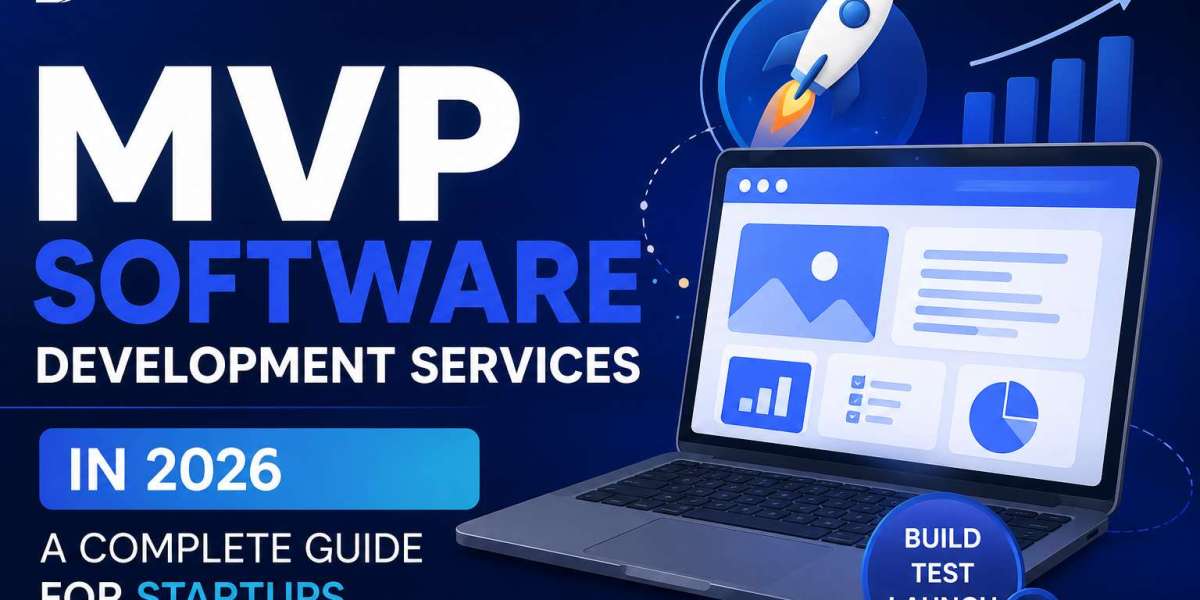

Starting a software business is exciting, but building the complete product before knowing whether customers actually need it can be expensive and risky. This is why startups increasingly use a Minimum Viable Product, or MVP, to test an idea with real users before investing heavily in a full-scale solution.
In 2026, MVP software development services are also changing with AI-assisted development, faster prototyping, better analytics, and more flexible technology options. Recent 2026 startup guides continue to emphasize focused MVP scope, real-user validation, and avoiding unnecessary features in the first release.
For founders, the goal is not simply to build software quickly. It is to build the right first version, learn from users, and use those insights to decide what should come next.
What Are MVP Software Development Services?
MVP software development services cover the process of turning a business idea into a functional minimum viable product that can be tested by real users.
Unlike a basic prototype, an MVP should provide enough functionality to solve a genuine problem. It should also allow the startup team to collect feedback and measure user behavior.
A typical MVP project may include:
Product discovery and requirement analysis
Market and competitor research
Feature prioritization
UI/UX design
Web or mobile development
Backend and API development
Database integration
Third-party integrations
Testing and quality assurance
Deployment
Analytics and monitoring
Post-launch improvements
The exact scope depends on the product, target audience, industry, and business objective.
Why Startups Need an MVP in 2026
The startup environment is becoming more competitive. New products can be developed and launched faster, but this also means founders need to be careful about where they spend their time and budget.
An MVP provides a practical way to test assumptions before committing to a large development project.
For example, suppose a founder wants to create a complete marketplace with advanced recommendations, multiple payment methods, loyalty programs, seller dashboards, AI tools, and dozens of other features.
Building everything immediately could take months.
A better approach may be to identify the core transaction that needs to be validated and build around that first. Once users interact with the product, the team can use actual feedback to determine which additional features deserve investment.
Recent 2026 MVP guidance consistently highlights this principle: define the core hypothesis, keep the first release focused, and learn from real user behavior before expanding the product.
Key Benefits of MVP Software Development
1. Faster Market Validation
An MVP gives startups an opportunity to put their idea in front of actual users instead of relying entirely on assumptions.
User behavior can reveal whether the product solves a meaningful problem and whether customers are willing to continue using it.
2. Better Budget Control
A focused MVP generally requires less development work than a complete product.
This does not mean choosing the cheapest possible development approach. It means investing first in functionality that helps answer the most important business questions.
3. Real Customer Feedback
Customer feedback can expose problems that may not be visible during planning.
Users may find certain features confusing, ignore functionality that seemed important, or request something the original product team did not consider.
This information can influence the next development cycle.
4. Reduced Product Risk
The biggest risk is not always technical failure. Sometimes the product simply does not solve a problem people care enough about.
MVP development allows startups to test important assumptions earlier.
5. Flexible Product Roadmap
An MVP creates a starting point rather than locking a startup into a complete product roadmap.
After launch, the roadmap can be adjusted according to customer needs, market response, analytics, and business priorities.
What Should You Build in an MVP?
One of the most important decisions is determining what belongs in version one.
A useful method is to divide features into three groups:
Essential features: Without these, the main product experience cannot work.
Useful features: These improve the experience but can potentially wait.
Future features: These may be valuable later but are not required to validate the initial idea.
For example, an appointment-booking MVP may need user registration, service selection, available time slots, booking confirmation, and basic notifications.
It may not need loyalty points, advanced analytics, multiple recommendation systems, or a complex referral program on the first release.
The purpose is to create a complete core user journey, not simply a collection of incomplete features.
MVP Software Development Process
A professional MVP development process usually includes several stages.
Step 1: Product Discovery
The first stage focuses on understanding the business idea, target customers, market problem, and desired outcome.
The development team should ask what the product is expected to achieve and which assumption needs to be tested first.
Step 2: Requirements and Feature Planning
Once the objective is clear, the team defines the minimum feature set.
This stage is important because uncontrolled feature additions can increase cost and delay the launch.
Step 3: UI/UX Design
A good MVP should be simple to understand and easy to navigate.
Designers create user flows, wireframes, prototypes, and visual interfaces based on the target audience and product requirements.
Step 4: Software Development
Developers then build the frontend, backend, database, APIs, authentication, integrations, and other required components.
The technology stack should match the product rather than being selected simply because it is popular.
Step 5: Testing
Testing covers functionality, usability, performance, security, compatibility, and important user flows.
An MVP can have limited features, but those features should work reliably.
Step 6: Launch
After testing, the MVP can be deployed for a controlled group of users or released to the wider market.
Analytics should be configured so the team can understand how users interact with the product.
Step 7: Measure and Improve
The development process does not end at launch.
Teams should review metrics such as user engagement, conversion, retention, feature usage, and customer feedback.
The next version should be based on what the team learns rather than simply adding more features.
How AI Is Influencing MVP Development in 2026
AI is becoming an important part of modern software development. AI-assisted tools can help developers with repetitive coding tasks, documentation, test generation, debugging, and other parts of the development workflow.
However, AI does not remove the need for experienced developers.
Recent research in 2026 highlights an important point: as AI becomes better at generating code, requirements, validation, architecture, and human oversight become even more important.
AI can also become part of the MVP itself.
Depending on the product, startups may include:
AI-powered chat
Intelligent search
Recommendation systems
Automated content generation
Document processing
Predictive analytics
Voice interfaces
Workflow automation
Personalized experiences
The key is to use AI where it creates measurable value instead of adding AI simply because it is currently popular.
Choosing the Right MVP Development Company
Choosing an experienced MVP development company can significantly influence the quality and speed of the project.
Before hiring a development partner, consider the following factors.
Technical Experience
Check whether the team has experience with the technologies your product requires, including mobile development, web applications, cloud platforms, APIs, databases, and AI integrations.
Product Understanding
A good team should understand your business objective instead of simply following a feature document.
UI/UX Expertise
A technically functional product can still fail if users find it difficult to understand.
Testing Standards
Ask how the company handles quality assurance, security testing, performance testing, and bug fixing.
Communication
Clear communication is especially important for startups because requirements can change as new information becomes available.
Post-Launch Support
An MVP is the beginning of product validation. Your development partner should ideally be able to support future iterations, improvements, integrations, and scaling.
MVP App Development Services for Mobile Startups
Mobile startups can use MVP app development services to validate an application idea before investing in a large mobile product.
The first version may include essential functionality such as account creation, onboarding, core navigation, the primary user action, notifications, and basic analytics.
Depending on the target audience, the app can be developed for Android, iOS, or both.
A mobile MVP should also consider device compatibility, app performance, security, responsive interfaces, and the expectations of mobile users.
Common MVP Development Mistakes
Startups often make avoidable mistakes during the MVP stage.
Building Too Many Features
More features do not automatically create more value. They can make development slower and the product harder to use.
Ignoring User Research
A technically impressive product can still fail if the target audience does not have a strong need for it.
Choosing Technology Without a Strategy
Technology decisions should support the product's requirements, budget, security needs, and expected growth.
Treating MVP as a Low-Quality Product
Minimum viable does not mean broken or unreliable.
Users still expect a smooth and professional experience, even when the product has limited functionality.
Not Measuring Results
Without analytics and feedback, founders may struggle to understand whether the MVP is actually succeeding.
How to Make Your MVP More Scalable
A startup should not over-engineer an MVP, but it should avoid decisions that make future growth unnecessarily difficult.
A scalable foundation may include:
Modular application architecture
Secure authentication
Well-structured databases
Documented APIs
Cloud-ready infrastructure
Automated testing
Monitoring and error tracking
Proper data management
For AI-enabled products, teams may also need to consider model monitoring, data quality, evaluation, privacy, and operational costs. AI-enabled software introduces additional lifecycle concerns because system behavior depends on data and model configurations as well as conventional code.
Final Thoughts
MVP software development services give startups a practical way to turn an idea into a real product without attempting to build the entire business platform at once.
The strongest MVP strategy is focused on one important problem, one clearly defined audience, and a small set of features that can generate meaningful learning.
In 2026, AI-assisted development is making parts of software creation faster, but successful MVPs still depend on strong product thinking, accurate requirements, good UX, reliable engineering, testing, and continuous customer feedback.
Whether you are building a SaaS platform, marketplace, mobile application, AI product, fintech solution, or custom business application, the right MVP can help you move from an idea to evidence.
Instead of spending months building features that may never be used, start with the core problem, create a useful first product, measure real behavior, and improve based on what your customers tell you.