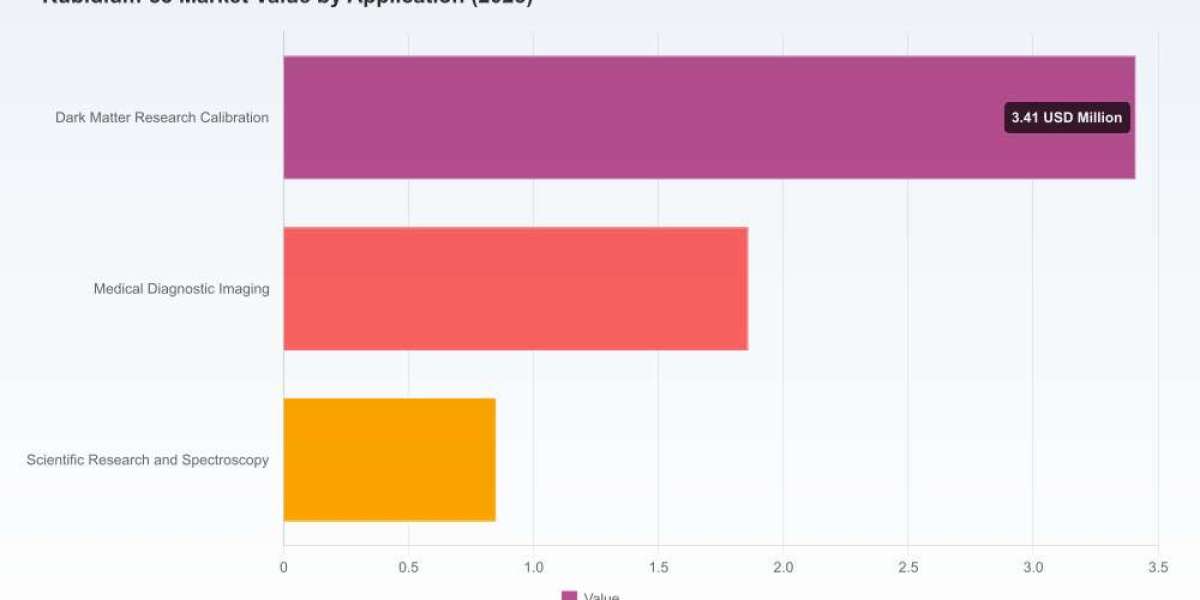

Rubidium-83 Market: Strategic Imperatives for 2026 — Executive Insights from PW Consulting
PW Consulting’s latest Rubidium-83 Market report (base year 2025; historical window 2020–2025; forecast 2026–2032) translates an often-overlooked isotope market into a practical strategic playbook for organizations making procurement, R&D, and investment decisions in 2026. Drawing on a synthesized dataset and proprietary scenario models, the study contextualizes a market that has steadily expanded from USD 4.52 million in 2020 to USD 6.12 million in 2025, and which we project to grow at a compound annual growth rate (CAGR) of 6.18% through 2032 — reaching roughly USD 9.3 million by the end of the forecast period.
Machine Tool Safety Glass Market
Why Rubidium-83 Matters to Strategic Decision-Makers in 2026
Rubidium-83, with its unique nuclear and chemical properties, plays a specialized but outsized role across scientific calibration, imaging research, and advanced materials workflows. For 2026, three converging dynamics make informed decisions around rubidium-83 supply and use more consequential than ever:
4,4'-Oxybisbenzoic Acid (OBBA) Market
- Consolidated supply structure — the market exhibits a high concentration among a few established suppliers, which creates both negotiating leverage and single-source risk.
- Accelerator-centric production and regulatory specificity — production pathways and radionuclidic purity criteria shape lead times and qualification requirements for research and medical customers.
- Downstream demand heterogeneity — growth is driven by specialized research applications and incremental deployment in diagnostic research and spectroscopy, requiring differentiated procurement strategies rather than one-size-fits-all sourcing.
What the Numbers Tell Us — High-Level Market Trajectory
Key topline findings from the report that should inform 2026 planning:
P-tert-Amylphenol (PTAP) Market
- Historical growth: The market expanded from USD 4.52 million (2020) to USD 6.12 million (2025), reflecting resilience even amid episodic price and supply dislocations.
- Near-term momentum: Our 2026 base projection positions the market to continue expanding modestly in 2026 and beyond, aligned with the 6.18% CAGR through 2032 — a steady, research-driven growth profile rather than explosive commercial adoption.
- Market structure: Concentration metrics indicate that a small number of providers account for the dominant share of supply, with implications for bargaining, service differentiation, and risk concentrations across the value chain.
Report Deliverables — What PW Consulting Provides Practically
This report is structured to be actionable for C-suite leaders, procurement teams, lab managers, and investors. Key practical components include:
- Supply chain risk matrix: identification of single points of failure (production facilities, target material sourcing, transport & customs constraints) and recommended mitigation levers (dual-sourcing templates, strategic inventory sizing, and qualification staircases).
- Regulatory and quality playbook: a step-by-step compliance checklist tailored to research-grade radionuclidic purity standards and acceptance testing protocols — aligned with the DOE/NIDC specifications for Rb-83 supply and common institutional IRB/IBC requirements.
- Procurement and contracting templates: commercial terms, warranty language, lead-time clauses, and sample SLA/KPI sets calibrated to isotope-specific realities (shelf life, activity decay scheduling, shipment frequency).
- Scenario P&L and funding models: three demand scenarios (base, accelerated research adoption, and constrained-supply) with sensitivity analyses on price volatility and capacity ramp timelines to inform budget allocation and grant applications.
- Technology and R&D roadmap guidance: prioritized opportunities for internal R&D and external partnerships, including suggested milestones for tracer development, calibration standard integration, and cross-institutional consortia to share supply risk.
Competitive Landscape — Who Matters and Why
The Rubidium-83 market is served by a mix of public-sector suppliers, specialist distributors, and material suppliers. Our competitive analysis emphasizes capabilities and strategic positioning rather than raw market share mosaics, enabling buyers and partners to align selection criteria with risk tolerance, technical requirements, and program timelines.
- National Isotope Development Center (NIDC) / DOE Isotope Program (Oak Ridge, TN): The primary U.S. government supplier, NIDC operates within stringent radionuclidic-purity frameworks and serves research customers with accelerator-produced Rb-83. Its role as a special-order provider with recognized quality assurance protocols makes it the de facto source for institutions requiring traceable provenance and tight purity specifications.
- American Elements (Los Angeles, CA): A global supplier of rubidium compounds and high-purity materials, American Elements supports research-grade requirements and can complement isotope procurement with upstream materials (high-purity salts, metals) beneficial for cross-lab standardization and materials research collaborations.
- Trace Sciences International (Ontario, Canada): Specialized in both stable and radioactive isotopes, Trace Sciences is notable for its product breadth and regulatory experience across North America, making it a practical partner for institutions seeking integrated supply and logistics for multi-isotope programs.
- AMT Ventures / AMT Isotopes (USA/global distribution): As a distributor focused on isotopes for tracer development and imaging research, AMT plays a role in connecting research groups with manufacturing partners and can accelerate adoption pathways for new imaging workflows and generator concepts.
Each of these players brings a distinct value proposition — government-backed assurance and special-order capability, integrated materials supply, regional regulatory experience, and distribution/market access — that organizations should match to their procurement strategy and technical needs.
Supply & Geo-Strategic Context
Several macro-contextual facts directly inform 2026 tactical choices:
- Source material dynamics: Rubidium is typically recovered as a byproduct of other mining operations. This means primary mining economics do not drive supply planning in the same way as for bulk commodities; instead, supply elasticity is constrained by the economics and capacity of host mineral industries and associated processing streams.
- Geopolitical footprint: Global production has historically been concentrated in a small set of countries. Import dependence in certain regions should be treated as a strategic procurement exposure — particularly for organizations evaluating inventory policies and contingency sourcing.
- Price signals and input-cost inflation: Spot-market pricing for rubidium compounds has shown step changes in recent years. Organizations should model procurement costs under moderate price escalation scenarios and consider hedging tactics (multi-year agreements, strategic stockpiles) where program continuity is critical.
- Regulatory specificity: Rb-83 supply for research is governed by radionuclidic purity constraints and supplier qualification protocols. Procurement teams must ensure downstream labs confirm acceptance criteria up front to avoid costly returns or failed experiments.
Strategic Recommendations for 2026
Based on the dataset and scenario simulations in the report, PW Consulting recommends the following high-impact actions for organizations planning in 2026:
- Adopt a layered sourcing approach: Combine primary contracts with government-backed suppliers for certified lots and vetted commercial distributors for flexibility; include contingency clauses for expedited fills.
- Formalize quality gates and shelf-life planning: Align experiment timelines with isotope activity decay profiles and mandate supplier-provided radionuclidic certificates with each shipment.
- Invest in partnership-based risk sharing: For institutions with recurring needs, explore co-funded capacity expansions or joint procurement pools to secure priority allocation and reduce per-unit logistic overhead.
- Integrate price and supply scenarios into budgeting cycles: Use the report’s sensitivity models to stress-test operating budgets and grant proposals against realistic cost and availability shocks.
- Prioritize vendor audits for critical programs: Where mission-critical research is at stake, schedule supplier audits or third-party verification to validate end-to-end chain-of-custody and handling procedures.
How to Use This Report in Your 2026 Planning Cycle
The full PW Consulting Rubidium-83 Market report functions as both a market intelligence asset and an operational toolkit. Practical applications include:
- Input to procurement RFPs and negotiation playbooks
- Baseline data for grant and capital requests tied to isotope-dependent programs
- Risk matrix and contingency planning templates for supply continuity
- Vendor selection criteria calibrated to purity, lead-time, logistics, and regulatory compliance
Importantly, the report’s appendices contain the granular datasets, supplier capability matrices, and downloadable contract language that procurement and legal teams can deploy immediately. To preserve the proprietary integrity of our segment-level analytics and supplier-specific scorecards, these materials are accessible on the report’s landing page.
Concluding Perspective — Where 2026 Fits in the Long-Term Story
Rubidium-83 occupies a niche but strategically important position within the broader isotope ecosystem. The market’s steady growth trajectory, combined with concentrated supply and specialized production processes, makes 2026 the right time to move from ad hoc purchasing toward structured sourcing, strategic partnerships, and integrated risk management. Organizations that incorporate the report’s scenario-driven P&L modeling, procurement templates, and supplier insights into their 2026 planning will be better equipped to secure reliable supply, control costs, and accelerate research outcomes.
For decision-makers ready to operationalize these insights, PW Consulting’s complete report — including segmented forecasts, supplier scorecards, and downloadable operational tools — is available on our report page. Engage with the full dataset and the executable frameworks to translate the market’s modest but persistent growth into measurable program advantage in 2026.
For detailed analysis of this topic, please visit the official page:Rubidium-83 Market
Lacy Lee
Senior Marketing Manager
sales@pmarketresearch.com
00852-95632430
PW Consulting: www.pmarketresearch.com





