
India's pharmaceutical export sector serves markets across the world, but entering international markets requires exporters to manage documentation, registrations, product-specific regulations, and trade-related compliances carefully. For businesses involved in pharmaceutical exports, registration with the relevant export promotion body can become an important part of establishing a compliant export framework.
For exporters dealing with products under the Pharmaceuticals Export Promotion Council of India, understanding Pharmexil Certification is particularly important. It is also useful to understand the relationship between Pharmexcil membership, the Registration-cum-Membership Certificate (RCMC), IEC, drug licences, and other export-related documents.
A clear understanding of these requirements can help pharmaceutical manufacturers, merchant exporters, and other eligible businesses organise their export documentation before approaching overseas buyers.
What Is Pharmexil Certification?
The term Pharmexil Certification is commonly used by businesses looking for registration or membership with the Pharmaceuticals Export Promotion Council of India (PHARMEXCIL).
PHARMEXCIL provides services including the issuance of Registration-cum-Membership Certificates (RCMC) and Certificates of Origin, along with export-related support, trade enquiries, buyer-seller meetings, and other services for the pharmaceutical industry.
The important point is that Pharmexcil registration should not automatically be treated as a standalone product approval or a universal pharmaceutical export licence. The exporter may need additional approvals depending on the products being exported and the destination market.
What Is a Pharmexil Certificate?
A Pharmexil Certificate generally refers to the registration or membership documentation associated with PHARMEXCIL, particularly the RCMC issued to eligible exporters.
An RCMC validates an exporter's registration with the relevant Export Promotion Council or authorised organisation for products falling under its jurisdiction. DGFT's RCMC guidance explains that exporters generally obtain the certificate from the council concerned with their main line of business.
For businesses exporting pharmaceutical products covered by PHARMEXCIL, the RCMC can therefore form an important part of their export documentation.
Who Can Apply for Pharmexcil Registration?
Businesses involved in eligible pharmaceutical products and services may consider registration with PHARMEXCIL according to the council's product coverage and applicable requirements.
PHARMEXCIL's listed areas include products and services such as bulk drugs and intermediates, formulations, biotechnology and biological products, diagnostics, surgical products, nutraceuticals, collaborative research, contract manufacturing, clinical trials, consultancy, and related pharmaceutical services.
Applicants may operate as manufacturer-exporters or merchant exporters, subject to the applicable requirements.
This makes it important to identify the applicant's actual business model before preparing the application.
Pharmexil Registration vs Pharmexil Certification
Although the terms are often used interchangeably, businesses should understand the basic relationship between them.
Pharmexcil registration refers to the process of applying for membership/RCMC with PHARMEXCIL.
Pharmexil certification is commonly used as a broader search term for the resulting registration or membership documentation.
The official PHARMEXCIL platform provides facilities to apply for membership/RCMC online and renew membership/RCMC online.
Therefore, businesses should identify the exact certificate or registration they require instead of relying only on informal terminology.
Is Pharmexcil a Pharmaceutical Export License?
One of the biggest areas of confusion is the phrase pharmaceutical export license.
PHARMEXCIL membership or RCMC should not simply be described as a replacement for every regulatory licence required for pharmaceutical exports.
The exporter may need an IEC and other product-specific or business-specific approvals. For example, PHARMEXCIL's own membership documentation lists the IEC and, where applicable, a drug licence among supporting documents.
Therefore, an exporter should treat PHARMEXCIL registration as one component of the overall export compliance structure rather than assuming it alone authorises every pharmaceutical product for export.
Why Do Pharmaceutical Exporters Need RCMC?
The RCMC provides formal recognition of an exporter as a member of the relevant export promotion council for products covered by that council.
PHARMEXCIL states in its FAQ that exporters of pharmaceutical products must have a valid RCMC issued by the council, referring to the applicable DGFT notification.
For a growing exporter, this registration can also provide access to council-related services and export-promotion activities.
PHARMEXCIL's services include trade delegations, buyer-seller meetings, dissemination of trade enquiries, Certificate of Origin services, and assistance concerning certain government export-promotion schemes.
Documents Required for Pharmexcil Registration
The exact documentation can depend on the applicant and the type of membership being sought. However, businesses should prepare their core export and business records in advance.
Commonly relevant documents can include:
Import Export Code (IEC)
PAN
Business constitution documents
Manufacturing or industrial registration documents, where applicable
Drug licence, where applicable
Banker's certificate
Previous export turnover details, where applicable
Product information
Business and contact details
PHARMEXCIL's published membership documentation specifically lists IEC, PAN, SSI/IA documentation, drug licence, banker's certificate, and previous-year export turnover where applicable.
The final document requirement should always be checked against the current application process.
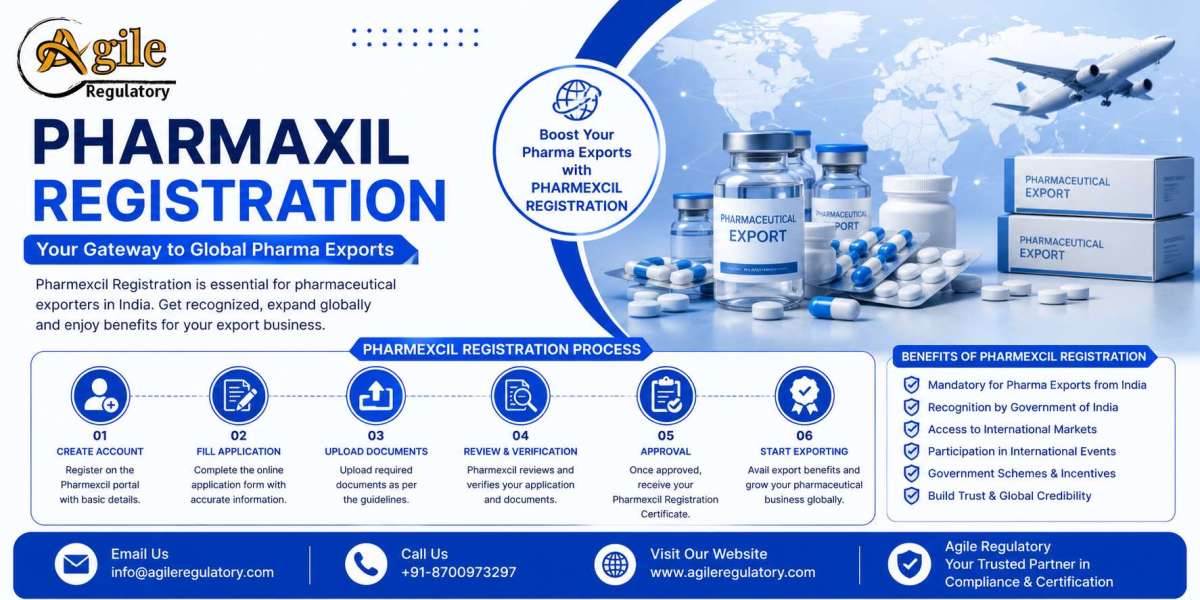
Pharmexil Registration Process
The application process should begin with determining whether the applicant's products fall within PHARMEXCIL's jurisdiction.
Step 1: Identify the Product Category
First, determine the main pharmaceutical products or services being exported and confirm that they fall within the council's scope.
Step 2: Check Business Eligibility
The applicant should establish whether it is operating as a manufacturer-exporter, merchant exporter, or another eligible category.
Step 3: Organise Documents
Prepare the IEC, PAN, business documents, applicable licences, banking information, and other supporting records.
Step 4: Submit the Application
PHARMEXCIL provides an online facility for membership and RCMC applications.
Step 5: Respond to Queries
If additional information or clarification is requested, the applicant should provide accurate supporting documents within the prescribed process.
Step 6: Obtain the RCMC
After the application is processed and accepted, the applicable registration/membership documentation can be issued.
Pharmexil Registration for Manufacturer Exporters
Manufacturer exporters should pay particular attention to their manufacturing credentials and product information.
A manufacturer-exporter may need to establish the connection between the manufacturing facility, pharmaceutical products, applicable licences, and export activities.
This is different from a merchant exporter that sources products from manufacturers and exports them under its own business structure.
The applicant's category should therefore be correctly identified during the registration process.
Pharmexil Registration for Merchant Exporters
Merchant exporters can also operate within the pharmaceutical export supply chain, subject to the applicable requirements.
A merchant exporter should maintain appropriate documentation relating to the products being exported, suppliers/manufacturers, IEC, and other applicable regulatory permissions.
The PHARMEXCIL member directory itself distinguishes between membership categories such as merchant exporters and manufacturers, demonstrating that different business models can be represented within the council's membership structure.
Is Pharmexcil Registration the Same as a Drug Licence?
No. These serve different regulatory purposes.
A drug licence is connected with the regulation of drugs and pharmaceutical activities under the applicable drug regulatory framework. Pharmexcil registration/RCMC, on the other hand, relates to export-promotion council membership and exporter registration.
A pharmaceutical exporter may therefore need both, depending on the nature of the business and products.
This distinction is important because obtaining a Pharmexcil RCMC does not eliminate other regulatory requirements applicable to the manufacture, sale, distribution, or export of medicines.
What Is a Medicine Export License?
The phrase medicine export license is frequently used by businesses searching for the approvals needed to export pharmaceutical products.
However, there may be multiple regulatory components rather than one universal document called a "medicine export licence."
Depending on the product and business model, an exporter may need:
IEC
PHARMEXCIL RCMC, where applicable
Relevant drug licence
Product-specific regulatory approvals
Certificates required by the destination country
Certificate of Origin, where applicable
Shipping and customs documentation
Additional country-specific requirements
The exact combination depends on what is being exported and where it is being exported.
Pharmexil Certificate and Certificate of Origin
PHARMEXCIL also provides Certificate of Origin services. Its official website separately identifies RCMC and Certificate of Origin verification.
A Certificate of Origin is not the same as an RCMC.
The RCMC establishes the exporter's registration/membership relationship with the relevant council, while a Certificate of Origin is used to certify the origin of goods for the relevant export transaction.
Exporters should therefore avoid treating these documents as interchangeable.
Common Mistakes During Pharmexil Registration
Pharmaceutical exporters can encounter avoidable problems when their registration information is not properly aligned.
Using Incorrect Product Information
The product category should match the exporter's actual business and the council's jurisdiction.
Treating RCMC as a Product Approval
An RCMC does not automatically mean that every medicine or pharmaceutical product is approved for every international market.
Ignoring Other Licences
Drug licences and other regulatory permissions may still be required depending on the business and product.
Inconsistent Business Details
The legal name, address, IEC details, PAN, banking information, and other records should be consistent.
Delaying Renewal
Exporters should monitor the validity of their registration and complete renewal requirements within the applicable timeframe.
How a Pharmexil Registration Consultant Can Help
The registration process involves more than filling out an online form. Businesses need to identify the correct membership category, organise supporting documents, verify product information, and understand how PHARMEXCIL registration fits into their broader export compliance structure.
A professional consultant can assist with document review, application preparation, registration coordination, clarification of procedural requirements, and follow-up during the application process.
For manufacturers and merchant exporters entering international pharmaceutical markets, professional support can also help distinguish PHARMEXCIL registration from other licences and certificates required for export operations.
Build a Stronger Pharmaceutical Export Compliance Framework
International pharmaceutical trade involves multiple layers of compliance. Exporters need to consider the Indian regulatory framework as well as the requirements of the destination country.
A properly organised Pharmexil Certification process can form part of that framework by establishing the exporter's registration and membership with the relevant export promotion council.
However, successful pharmaceutical exports require more than council registration. Businesses should review their product approvals, manufacturing or sourcing documentation, drug licences, IEC, customs requirements, destination-country regulations, and transaction-specific certificates before beginning shipments.
Agile Regulatory can assist businesses with registration and regulatory documentation, helping exporters organise the requirements involved in establishing a compliant export process.
Conclusion
Pharmexil Certification is commonly associated with registration and membership documentation issued through the Pharmaceuticals Export Promotion Council of India, particularly the RCMC relevant to pharmaceutical exporters. PHARMEXCIL provides online membership/RCMC services and supports exporters through several trade-promotion and documentation services.
Businesses should remember that Pharmexcil registration is not automatically a substitute for a drug licence, product approval, IEC, Certificate of Origin, or destination-country requirements. Understanding the difference between these documents can help pharmaceutical manufacturers and merchant exporters prepare a more complete export compliance framework.
FAQs
1. What is Pharmexil Certification?
It commonly refers to registration or membership documentation associated with PHARMEXCIL, particularly the Registration-cum-Membership Certificate issued to eligible pharmaceutical exporters.
2. Is Pharmexcil registration mandatory for pharmaceutical exporters?
PHARMEXCIL states that pharmaceutical product exporters must have a valid RCMC issued by the council under the applicable DGFT notification.
3. Is a Pharmexil Certificate the same as a pharmaceutical export licence?
Not necessarily. PHARMEXCIL registration/RCMC is an export-promotion council registration, while other licences and approvals may apply depending on the products and business activities.
4. What documents are required for Pharmexcil registration?
Documents can include IEC, PAN, business records, applicable drug licences, banking documents, and other supporting information depending on the applicant.
5. Can merchant exporters apply for Pharmexcil registration?
Yes, PHARMEXCIL's membership structure includes merchant exporters as well as manufacturer-exporters, subject to applicable eligibility and documentation requirements.
6. Does Pharmexcil issue Certificate of Origin?
Yes. Certificate of Origin is among the services provided by PHARMEXCIL, and it is separate from the RCMC.
7. Can Pharmexcil registration help with pharmaceutical exports?
It forms part of the exporter's regulatory and export-promotion framework and provides access to council services, but exporters must also comply with other applicable Indian and destination-country requirements.





