
Running a ready-mix concrete (RMC) plant means managing a lot of moving parts at once — raw material stock, batching schedules, truck dispatch, site deliveries, and billing, all happening simultaneously and all depending on each other. For years, most plants have managed this with a mix of spreadsheets, phone calls, and paper registers. It works, but it leaves owners reacting to problems instead of staying ahead of them.
That's the gap Ready Mix Concrete ERP software is built to close.
What Is Ready Mix Concrete ERP Software?
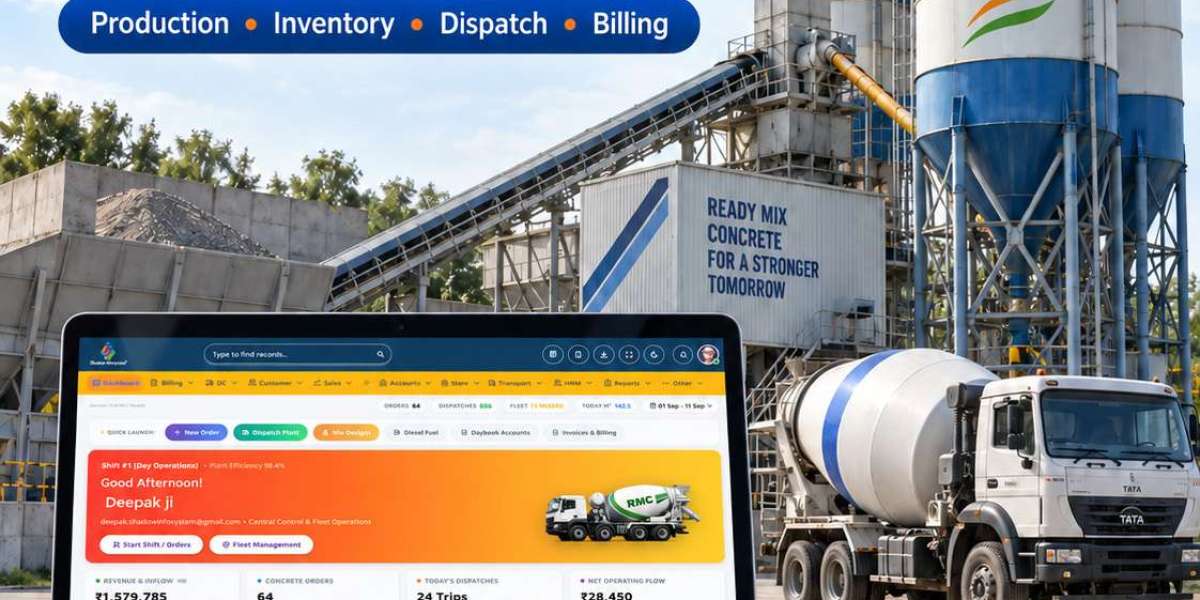
In simple terms, it's a single system that brings every part of an RMC plant's operations onto one platform — production, inventory, dispatch, fleet, and billing — instead of scattered across separate files and departments. Rather than each team working off its own version of the truth, everyone sees the same live data.
For a plant owner, that means one dashboard instead of five phone calls to find out what happened today.
What It Typically Covers
Most Ready Mix Concrete ERP platforms are built around the core stages of an RMC business:
Production and batching — planning and tracking batches as they happen, not after the fact
Inventory management — automatic stock updates as cement, aggregate, and additives are used, with alerts before anything runs low
Dispatch and fleet tracking — coordinating trucks and deliveries so the right mix reaches the right site on time
Billing and invoicing — generating invoices directly from actual delivery data, including GST-compliant billing, instead of a separate manual entry that often doesn't match what was delivered
Multi-plant visibility — for businesses running more than one plant, a single view to compare production, dispatch, and performance across locations
Why RMC Businesses Are Adopting It Now
A few things are pushing more plant owners to move away from manual systems:
Margins are tight, and small inefficiencies — wasted material, delayed trucks, billing mismatches — add up to real money over a year.
Growth makes manual tracking harder. A single plant can get by on spreadsheets; two or three plants running independently on their own sheets quickly becomes unmanageable.
Customers expect faster, more reliable service, and that's difficult to deliver when dispatch decisions are based on outdated information.
Compliance and billing accuracy matter more as GST scrutiny and customer expectations around documentation increase.
What to Look for in an RMC ERP System
Not all ERP software is built with RMC operations specifically in mind. When evaluating one, it's worth checking for:
Industry-specific workflows — batching, mix design, and aggregate tracking built for concrete production, not adapted from a generic manufacturing ERP
Real-time dispatch and vehicle tracking, so deliveries can be monitored as they happen
GST-compliant billing generated automatically from delivery data
Multi-plant support, even if you're only running one plant today
Mobile access, so site supervisors and drivers aren't tied to a desktop to update or check information
Cloud-based access, so data isn't stuck on one office computer
A Closer Look
Shadow Infosystem has built a Ready Mix Concrete ERP Software platform covering exactly this range — production, dispatch, inventory, billing, and multi-plant management in one system, designed specifically for RMC and concrete batching businesses in India: Ready Mix Concrete ERP Software.
For plant owners still relying on spreadsheets and manual coordination, the shift to a dedicated ERP system tends to pay for itself quickly — not through one big change, but through dozens of small daily inefficiencies it quietly removes.