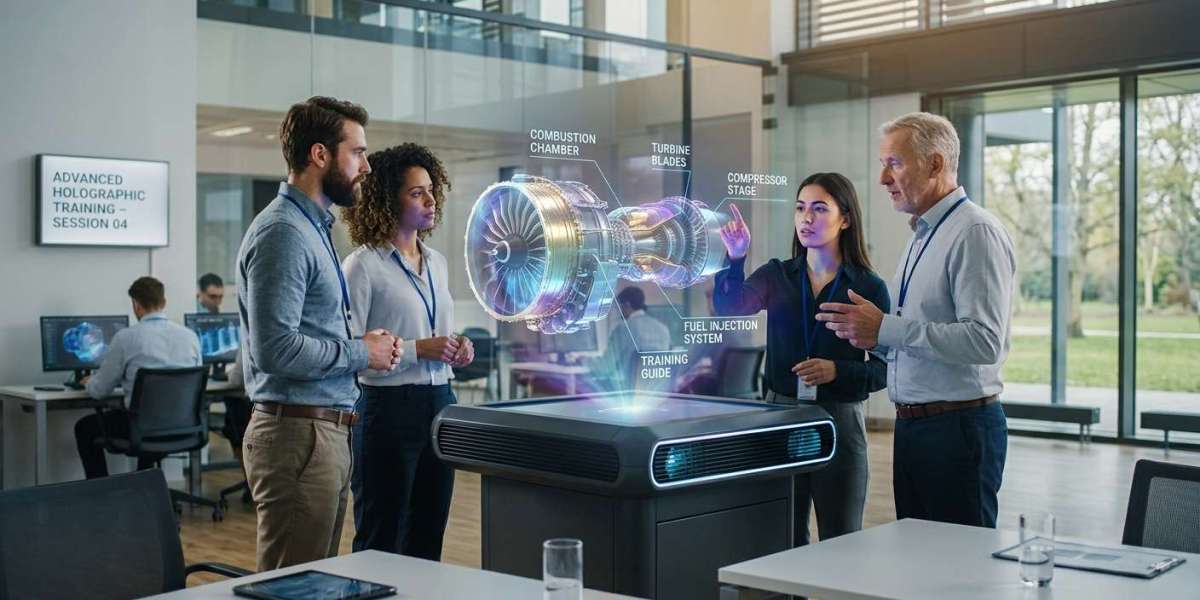

Training is evolving as firms seek better ways to teach complicated knowledge, illustrate real procedures, and engage learners. Traditional presentations, videos, manuals, and classroom sessions are still necessary, but modern technology allows for a more visual and interactive learning experience.
A hologram for training industry applications allows trainers to portray people, products, machines, processes, and instructional models in three dimensions. Holographic systems can also support remote instructors and reused training content, making them beneficial to corporations, educational institutions, technical centers, and professional training programs.
What Is Holographic Training?
Holographic training use customized screens to show three-dimensional persons, objects, animations, and instructional content. Depending on the technology, content may be pre-recorded, interactive, or delivered via a live remote link.
Holographic presentations, as opposed to traditional video projected on a flat screen, can convey a greater sensation of physical presence. Some systems can also show 3D models that students can view from various perspectives without using VR headsets or special glasses.
This makes holographic technology especially appealing for courses where viewing a process or object is more beneficial than reading about it.
Advantages Of Holograms For Training
1. Make Complex Concepts Easier To Understand
Some training topics are difficult to describe using text or traditional PowerPoint. Machines, engineering systems, medical anatomy, scientific conceptions, and technical processes can all have numerous details.
A holographic model can visually represent these topics. Trainers can display several components, demonstrate how they interact, or use animations to explain a procedure step by step.
This can help learners have a better visual reference during instruction.
2. Plan More Engaging Training Sessions
Keeping learners interested is a critical component of good training. A presentation that combines visual displays and oral explanations can enhance the classroom experience.
Holographic displays can bring a new visual dimension to training rooms, workshops, lectures, and demos. Educational applications already include 3D models, interactive courses, simulations, and remote instructors.
Technology should supplement, not replace, good teaching, but it can provide trainers with more ways to communicate material.
3. Invite Remote Experts Into Training Rooms
One intriguing application is remote expert training. Instead of requiring an instructor or specialist to come to each place, a suitable holographic system can deliver them remotely in life-size format.
This can be handy for businesses with personnel in multiple cities or countries. A specialist might deliver the same session in several places without physically visiting each one.
Holographic education systems have also been utilized to investigate live or recorded presentations by remote instructors and guest speakers.
4. Reuse Training Content
Training firms frequently deliver the same courses to diverse groups of employees or students.
Pre-recorded holographic training content may be reused across numerous sessions. A corporation might prepare a detailed demonstration once and incorporate it into subsequent training programs.
This can help to provide more uniformity when explaining routine procedures, product information, or introductory training.
Holograms Can Be Used For Training Corporate Employees
Businesses can employ holographic displays for onboarding, product knowledge, communication training, demonstrations, and presentations.
For example, a firm could construct a holographic presentation to describe its products, workplace operations, or organizational procedures.
Industrial And Technical Training
Complex machinery and processes are frequently used in industrial settings. A holographic model depicts machine components and processes in a visual style.
Trainers can utilize animations to demonstrate how equipment works, how separate parts link, and how a process should be carried out.
This is especially beneficial when physical equipment is expensive, unavailable, or difficult to transport into the classroom.
Medical And Healthcare Training
Medical education demands students to comprehend complicated structures and procedures. Three-dimensional representations can aid to teach anatomy, medical equipment, and specific procedures.
A holographic model, for example, might depict the human body and allow students to explore various anatomical systems visually.
Safety Training
Safety training is critical in construction, manufacturing, logistics, aviation, healthcare, and other industries.
Holographic simulations can show workplace scenarios and safety measures in a controlled training setting. Instead of solely relying on written instructions, trainers can use visual situations to demonstrate what employees should look for and how procedures work.
Educational And Professional Training
Schools, colleges, universities, coaching centers, and professional training organizations can all benefit from holographic learning.
Holographic courses use three-dimensional models and demonstrations to teach disciplines including biology, chemistry, physics, engineering, history, and architecture.
Important Use Cases
A hologram for training industry solution can be utilized for:
Employee onboarding
Technical demos.
Product Training
Safety Education
Medical training
Engineering Education
Remote expert sessions.
Equipment demonstrations.
Interactive Workshops
Professional Development Programs
Training options include classroom, conference, and seminar formats.
The particular use is determined by display technology, available information, training objectives, and the level of engagement necessary.
The Future Of Holographic Training
Training is becoming more visual and technologically oriented. Holographic displays provide enterprises with a new way to integrate training, demonstrations, remote knowledge, and three-dimensional visualization.
The technology is not meant to replace expert trainers or hands-on learning in all situations. Instead, it can supplement traditional approaches by making particular concepts easier to show and explore.
As holographic technology advances, corporations and educational institutions may find new applications for staff development, technical education, product displays, and immersive learning.
A hologram for training industry solution can help firms modernize their training environments by presenting information in a unique way, demonstrating complicated concepts, and creating more engaging learning experiences.