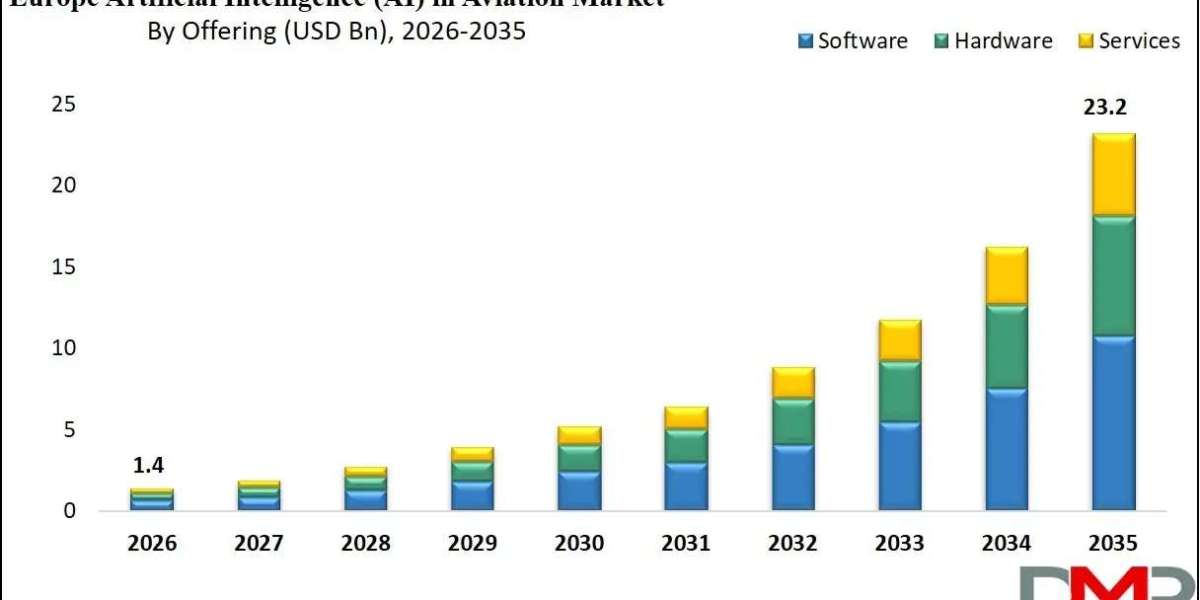

The Europe Artificial Intelligence in Aviation Market is entering a period of rapid technological transformation as airlines, aircraft manufacturers, and airport operators increasingly adopt intelligent systems to improve operational efficiency, aircraft safety, and passenger experiences. Artificial intelligence is reshaping aviation through predictive maintenance, automated manufacturing, intelligent air traffic management, and advanced data analytics.
According to Dimension Market Research, the Europe Artificial Intelligence in Aviation Market is projected to reach USD 1.4 billion in 2026 and expand to USD 23.2 billion by 2035, registering a CAGR of 36.8% during the forecast period. This expansion reflects growing investment in aviation digitalization, intelligent airport infrastructure, and technologies that improve operational reliability.
European aviation organizations are increasingly recognizing AI as a strategic capability rather than an experimental technology. Rising pressure to control operating costs, optimize fuel consumption, improve aircraft maintenance, and meet sustainability objectives is accelerating the adoption of intelligent aviation solutions.
What Is the Europe Artificial Intelligence in Aviation Market?
The Europe Artificial Intelligence in Aviation Market encompasses AI-powered software, hardware, and services designed to improve aviation activities, including aircraft manufacturing, flight operations, maintenance, passenger management, and airport operations.
These technologies use machine learning, natural language processing, computer vision, and advanced analytics to process operational information and support better decision-making.
For example, predictive maintenance platforms analyze aircraft sensor data to identify potential component failures, while intelligent air traffic management systems evaluate flight patterns, weather conditions, and airspace congestion to support more efficient operations.
Europe Artificial Intelligence in Aviation Market: Key Statistics
● 2026 Market Size: USD 1.4 Billion
● 2035 Market Forecast: USD 23.2 Billion
● Forecast CAGR: 36.8%
● Leading Offering: Software, approximately 46% share in 2026
● Leading Technology: Machine Learning, approximately 39% share in 2026
● Leading Application: Manufacturing, approximately 34% share in 2026
● Leading Equipment: Coordinate Measuring Machines, approximately 28% share in 2026
These projections highlight how AI adoption is expanding across different aviation technology and operational segments.
Why Is the Europe Artificial Intelligence in Aviation Market Growing?
Rising Demand for Operational Efficiency
Airlines and airports continuously face pressure to improve scheduling, reduce delays, manage fuel consumption, and maximize aircraft availability.
AI-powered analytics support these objectives by processing large volumes of real-time information and identifying opportunities for operational improvement.
Predictive maintenance is particularly valuable because it enables aviation operators to anticipate servicing requirements instead of relying exclusively on fixed maintenance schedules.
Government Support and Aviation Digitalization
European government initiatives and regulatory frameworks supporting digital transformation are creating opportunities for intelligent aviation infrastructure.
Investment in smart airports, sustainable aviation technologies, and advanced operational systems is encouraging collaboration among airlines, aerospace manufacturers, airport authorities, and technology providers.
The integration of AI with connected infrastructure is also supporting more automated and data-driven aviation operations.
Get a Free Sample of the Europe Artificial Intelligence in Aviation Market Report
Explore detailed market forecasts, industry segmentation, competitive intelligence, technological developments, and country-level opportunities. Access a customized sample to understand the factors influencing AI adoption across European aviation.
https://dimensionmarketresearch.com/request-sample/europe-artificial-intelligence-aviation-market/
Market Segmentation: Which Technologies and Applications Are Leading?
Software Leads the Offering Segment
Software is projected to account for approximately 46% of market revenue in 2026, supported by demand for AI platforms, analytical solutions, and automation tools.
Airlines and airport operators are prioritizing scalable software systems that integrate operational information and improve decision-making. Meanwhile, services represent a rapidly growing segment as organizations require integration, customization, and technical support.
Machine Learning Dominates Technology Adoption
Machine learning is projected to hold approximately 39% market share in 2026.
Its importance comes from its ability to analyze aircraft performance information, identify operational patterns, optimize routes, and support predictive maintenance.
Computer vision is also gaining momentum through applications in airport surveillance, passenger processing, aircraft inspection, and automated monitoring systems.
Manufacturing Leads Aviation AI Applications
Manufacturing is expected to represent approximately 34% of application revenue in 2026.
Aircraft manufacturers are increasingly integrating intelligent technologies into quality control, production planning, precision inspection, and logistics management.
Smart maintenance is identified as a particularly fast-growing application, reflecting increased demand for condition monitoring, predictive analytics, and improved fleet reliability.
Emerging Technology Trends and Market Opportunities
One of the most significant developments is the integration of artificial intelligence with Internet of Things devices and advanced analytics platforms.
Connected aircraft components and airport infrastructure generate operational data that AI systems can analyze to identify maintenance requirements and improve resource allocation.
Autonomous and semi-autonomous systems are another important development. Intelligent ground handling, flight assistance, and automated inspection technologies offer opportunities to improve precision and operational consistency.
Sustainable aviation also presents opportunities. AI-supported route optimization, fuel management, and resource utilization can contribute to reducing operational inefficiencies and environmental impact.
However, high implementation costs, legacy infrastructure integration, data privacy requirements, and safety certification challenges remain important barriers to widespread adoption.
Europe Artificial Intelligence in Aviation Market: Country Outlook
Germany, the United Kingdom, and France are among the prominent European countries adopting artificial intelligence in aviation, supported by established aerospace industries and aviation technology ecosystems.
Germany benefits from its aircraft engineering capabilities and growing adoption of intelligent airport infrastructure. France has opportunities in aerospace manufacturing, aircraft systems, and aviation innovation, while the United Kingdom is advancing digital aviation solutions and intelligent operational technologies.
Italy, Spain, the Nordic countries, and the Benelux region are also included in the market outlook, with airport modernization and aviation digitalization supporting opportunities across Europe.
Competitive Landscape and Recent Industry Developments
The European market includes prominent aviation, aerospace, and technology companies such as Airbus, Rolls-Royce Holdings, Safran, Thales, Leonardo, Siemens, SAP, and Dassault Aviation.
Competition increasingly emphasizes AI platform capabilities, advanced analytics, technical integration, research partnerships, and compliance with demanding aviation safety requirements.
In January 2026, Frankfurt Airport implemented AI-powered prohibited-item detection across its CT security screening systems. During the same month, Dassault Aviation and Harmattan AI announced a partnership focused on advancing AI-driven autonomy in combat aviation, demonstrating the expanding relevance of intelligent technologies across commercial and defense applications.
Explore the Complete Europe Artificial Intelligence in Aviation Market Analysis
Access comprehensive industry forecasts, country-level analysis, competitive profiles, technology segmentation, and emerging investment opportunities through the full Dimension Market Research report.
https://dimensionmarketresearch.com/checkout/europe-artificial-intelligence-aviation-market/
Frequently Asked Questions
1. What is the Europe Artificial Intelligence in Aviation Market size in 2026?
The market is projected to reach USD 1.4 billion in 2026.
2. What is the projected CAGR of the Europe Artificial Intelligence in Aviation Market?
The market is forecast to grow at a CAGR of 36.8% through 2035.
3. Which segment dominates the Europe Artificial Intelligence in Aviation Market?
Software leads the offering category with approximately 46% market share projected for 2026.
4. Which European countries are prominent in aviation AI adoption?
Germany, the United Kingdom, and France are among the prominent markets, supported by established aerospace ecosystems and aviation digitalization initiatives.
5. What is the future outlook for the Europe Artificial Intelligence in Aviation Market?
The market is projected to reach USD 23.2 billion by 2035, driven by intelligent aircraft systems, smart airports, advanced maintenance technologies, and aviation automation.
Conclusion
The Europe Artificial Intelligence in Aviation Market is emerging as an important component of aviation modernization. Increasing demand for operational efficiency, predictive maintenance, intelligent manufacturing, and sustainable aviation solutions is creating significant growth potential.
As AI technologies become more integrated into aircraft operations, airport infrastructure, and aerospace production, organizations investing in scalable, reliable, and safety-compliant solutions will be positioned to participate in the industry's continuing transformation.
Related Artificial Intelligence in Aviation Market Insights
Global Artificial Intelligence in Aviation Market
The global Artificial Intelligence (AI) in Aviation Market Size is projected to reach USD 52.7 billion by 2033, increasing from USD 3.0 billion in 2024 at a CAGR of 37.3%. Growing adoption of predictive maintenance, intelligent air traffic management, and automated passenger services is supporting global market expansion. North America is projected to account for 42.2% of global revenue in 2024.
Japan Artificial Intelligence in Aviation Market
The Japan Artificial Intelligence in Aviation Market Share analysis highlights growing investment in aviation automation and intelligent airport operations. Japan's market is projected to increase from USD 187.0 million in 2026 to USD 3,232.3 million by 2035, registering a CAGR of 37.3%. Software is expected to lead the offering segment, while manufacturing holds the largest application revenue share in 2026.
US Artificial Intelligence in Aviation Market
The US Artificial Intelligence in Aviation Market Growth outlook indicates substantial opportunities in intelligent maintenance, flight optimization, and airport automation. The US market is projected to reach USD 33.0 billion by 2035, rising from USD 2.1 billion in 2026 at a CAGR of 36.1%. Software leads the offering segment, while smart maintenance is expected to dominate applications in 2026.





