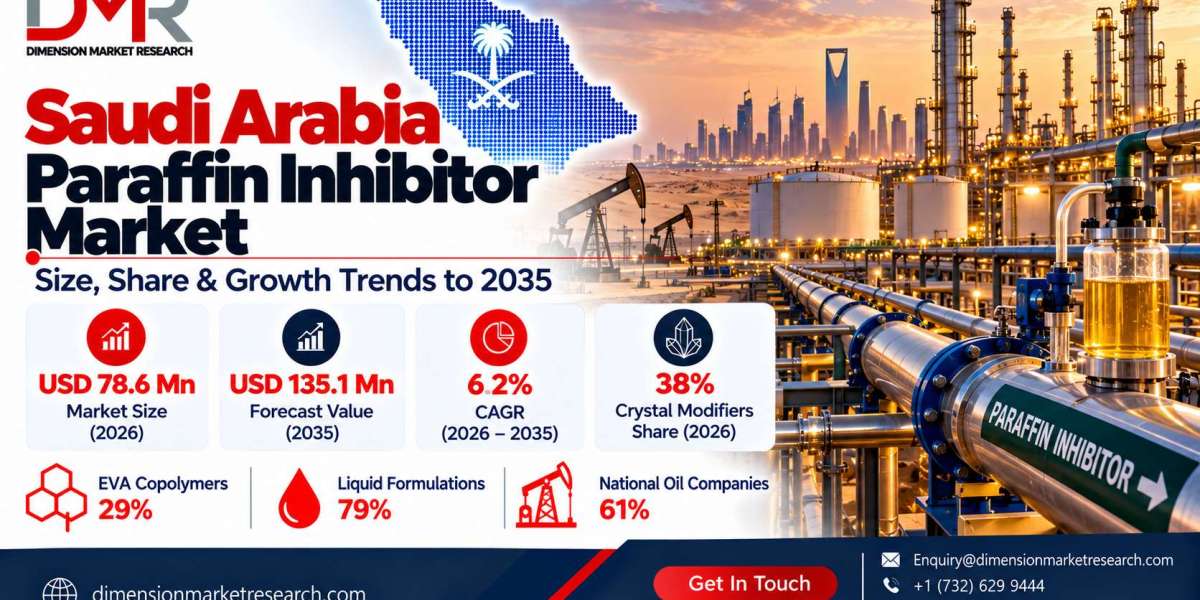

The Saudi Arabia Paraffin Inhibitor Market is expanding as oil and gas operators invest in advanced chemical solutions to maintain crude oil flow, improve pipeline reliability, and reduce production interruptions. According to Dimension Market Research, the market is projected to increase from USD 78.6 million in 2026 to USD 135.1 million by 2035, registering a CAGR of 6.2%.
Increasing demand for effective wax deposition control, improved production efficiency, and reliable hydrocarbon transportation is encouraging investment in specialized paraffin inhibitors. These chemicals help operators manage wax formation in production tubing, flowlines, pipelines, and storage facilities.
Advances in polymer chemistry, artificial intelligence, low-toxicity formulations, and localized chemical manufacturing are creating opportunities for oilfield service companies, specialty chemical manufacturers, distributors, and energy infrastructure operators.
What Is the Saudi Arabia Paraffin Inhibitor Market?
The Saudi Arabia Paraffin Inhibitor Market includes specialty chemical products used to prevent or reduce wax deposition during crude oil production, transportation, and storage.
Paraffin inhibitors modify the formation, growth, or behavior of wax crystals, helping prevent deposits that restrict fluid movement.
Major product categories include crystal modifiers, pour point depressants, paraffin dispersants, and paraffin dissolvers.
These formulations are used across oil wells, gathering systems, pipelines, terminals, and refinery feed-handling operations.
Unlike general oilfield chemicals, paraffin inhibitors specifically address wax-related flow assurance challenges.
Why Is the Saudi Arabia Paraffin Inhibitor Market Growing?
Saudi Arabia's extensive oil production infrastructure is a major market driver. Production facilities require reliable chemical treatment programs to prevent wax accumulation and maintain uninterrupted crude flow.
Temperature and pressure changes during production and transportation can encourage paraffin crystallization, particularly in wax-prone crude streams.
Increasing focus on pipeline efficiency is another important factor. Effective wax management helps operators limit pressure losses, maintain flow capacity, and reduce maintenance interventions.
Localization initiatives are encouraging domestic chemical blending, technical support, and improved product availability.
However, high formulation specificity, laboratory testing requirements, and competition from mechanical or thermal wax-removal methods remain important challenges.
Get a Free Sample of the Saudi Arabia Paraffin Inhibitor Market Report
Explore detailed market forecasts, chemical compositions, product types, applications, end-user demand, competitive developments, and Saudi Arabia's oilfield chemical opportunities.
The research supports chemical procurement, supplier benchmarking, oilfield operations planning, and specialty chemical investment strategies.
https://dimensionmarketresearch.com/request-sample/saudi-arabia-paraffin-inhibitor-market/
Saudi Arabia Paraffin Inhibitor Market Size and Key Statistics
● 2026 Market Size: USD 78.6 Million
● 2035 Forecast Revenue: USD 135.1 Million
● Forecast CAGR: 6.2%
● Leading Product Type: Crystal Modifiers, 38%
● Leading Chemical Composition: Ethylene Vinyl Acetate Copolymers, 29%
● Leading Form: Liquid Formulations, 79%
● Leading Application: Crude Oil Production, 51%
● Leading End User: National Oil Companies, 61%
● Fastest-Growing Chemistry: Bio-Based and Low-Toxicity Chemistry, 8.3% CAGR
● Pipeline Flow Assurance Growth: 7.5% CAGR
● Concentrated Blend Growth: 7.6% CAGR
All segment shares refer to 2026. Segment growth rates cover the forecast period through 2035.
Market Segmentation: Crystal Modifiers and Liquid Formulations Lead
Crystal modifiers dominate product segmentation with approximately 38% market share in 2026.
These chemicals interfere with wax crystal growth and help reduce deposition on production equipment and pipeline surfaces.
Paraffin dispersants represent another important category. They help maintain wax particles in suspension and are projected to register a 7.4% CAGR through 2035.
Ethylene vinyl acetate copolymers lead chemical composition with 29% market share, supported by their ability to modify wax crystallization behavior.
Liquid formulations account for approximately 79% of revenue, reflecting compatibility with existing chemical injection systems.
Crude oil production dominates applications with 51% share, while national oil companies account for 61% of end-user demand.
How AI Is Transforming Oilfield Wax Management
Artificial intelligence is creating opportunities to improve paraffin inhibitor selection, treatment efficiency, and pipeline monitoring.
Machine learning systems can evaluate crude oil properties, temperature changes, pressure conditions, and flow rates to identify potential wax deposition risks.
Predictive analytics can help operators adjust chemical dosage when production conditions change.
Digital monitoring platforms can support equipment maintenance planning and identify unusual pressure behavior associated with flow restrictions.
Generative AI can also assist engineers in reviewing laboratory testing results and historical chemical treatment performance.
These technologies support more informed operational decisions, although laboratory validation and field testing remain essential.
Pipeline Flow Assurance Creates New Opportunities
Pipeline flow assurance is becoming an increasingly important application for specialty chemical suppliers.
Wax deposition can reduce effective pipeline diameter, increase pressure losses, and create operational challenges.
Paraffin inhibitors help operators manage deposition risks and maintain more consistent hydrocarbon movement.
The report projects pipeline flow assurance applications to grow at a 7.5% CAGR through 2035.
This creates opportunities for suppliers offering field-tested formulations, continuous monitoring, and dosage optimization.
Integrated chemical management services may also help operators reduce unnecessary maintenance and improve infrastructure availability.
Low-Toxicity Chemicals and Local Manufacturing Support Growth
Environmental performance and chemical handling safety are influencing product development.
Bio-based and low-toxicity formulations are projected to register an 8.3% CAGR, making them the fastest-growing chemical composition category identified in the report.
Manufacturers are developing formulations that reduce selected solvent-related risks while maintaining effective wax control.
Localized chemical blending is another important opportunity.
Saudi Arabia's industrial localization initiatives encourage international suppliers to establish domestic technical capabilities, inventory, and production partnerships.
Concentrated blends are projected to grow at a 7.6% CAGR, supported by opportunities to reduce transportation and storage requirements.
Saudi Arabia's Oil and Gas Infrastructure Outlook
The market is closely connected to Saudi Arabia's crude oil production, gathering networks, pipeline systems, and export infrastructure.
Major oilfield operations require continuous attention to flow assurance, equipment reliability, and operating costs.
Saudi Aramco's local-content initiatives also influence specialty chemical procurement and supplier development.
The report highlights the importance of laboratory qualification, domestic stock availability, and responsive technical services.
Suppliers offering localized formulation development and field support may strengthen their competitive positions.
Competitive Landscape and Leading Companies
Major companies identified in the report include SLB, Halliburton, Baker Hughes, ChampionX, Clariant, BASF, Dow, Croda International, Innospec, and Dorf Ketal Chemicals.
Other participants include Nouryon, Evonik Industries, Arkema, Solvay, Lubrizol, REDA Chemicals, and regional chemical suppliers.
Competition focuses on formulation performance, treatment costs, crude-specific compatibility, laboratory testing capabilities, and local service availability.
International suppliers benefit from established chemical technologies and field experience.
Regional companies can compete through localized blending, faster delivery, inventory management, and customized technical support.
Future Outlook for the Saudi Arabia Paraffin Inhibitor Market
Through 2035, demand is expected to reflect Saudi Arabia's continued emphasis on reliable hydrocarbon production and transportation.
Pipeline flow assurance, low-toxicity chemicals, localized manufacturing, and AI-assisted chemical treatment will influence investment priorities.
Manufacturers offering effective products, competitive treatment economics, and dependable field support may benefit from evolving oilfield requirements.
Explore the Complete Saudi Arabia Paraffin Inhibitor Market Analysis
Access the comprehensive Dimension Market Research report for detailed market projections, product segmentation, chemical composition analysis, application forecasts, end-user demand, competitive benchmarking, and Saudi oilfield chemical investment opportunities.
https://dimensionmarketresearch.com/checkout/saudi-arabia-paraffin-inhibitor-market/
Frequently Asked Questions
1. What is the Saudi Arabia Paraffin Inhibitor Market size?
The market is projected to increase from USD 78.6 million in 2026 to USD 135.1 million by 2035.
2. What is the expected CAGR of the Saudi Arabia Paraffin Inhibitor Market?
The market is forecast to register a CAGR of 6.2% between 2026 and 2035.
3. Which product type dominates the Saudi Arabia Paraffin Inhibitor Market?
Crystal modifiers lead with approximately 38% market share in 2026, supported by their effectiveness in controlling wax crystal formation.
4. Which application holds the largest market share?
Crude oil production dominates with approximately 51% share in 2026, reflecting demand for wax-control chemicals in oil wells and production systems.
5. Which end users dominate the Saudi Arabia Paraffin Inhibitor Market?
National oil companies lead with approximately 61% share in 2026, supported by extensive upstream production and transportation infrastructure.
Conclusion
The Saudi Arabia Paraffin Inhibitor Market is expanding as oilfield operators prioritize flow assurance, efficient chemical treatment, and reliable crude transportation.
Crystal modifiers, EVA copolymers, liquid formulations, and crude oil production remain central to market demand.
Artificial intelligence, lower-toxicity formulations, pipeline treatment optimization, and localized chemical manufacturing will create significant opportunities through 2035.
Related Oilfield Chemicals Market Insights
The Oilfield Chemicals Market Size is projected to increase from USD 30.1 billion in 2025 to USD 40.4 billion by 2034, registering a 3.3% CAGR. Demand for corrosion inhibitors, rheology modifiers, demulsifiers, surfactants, and drilling fluid additives supports global market development. Rheology modifiers lead product segmentation with 26.5% market share in 2025, while onshore operations account for 67.2% and North America represents 43.1% of regional revenue.





