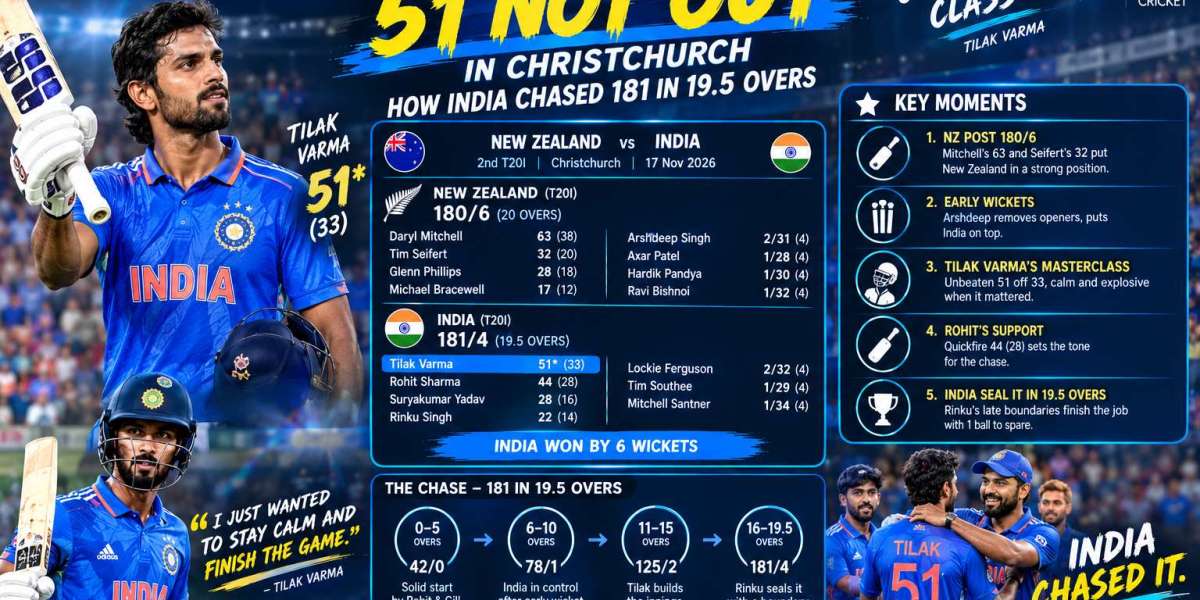

India beat New Zealand by four wickets in the second T20I at Hagley Oval, Christchurch, on 24 October 2026, chasing 181 with just one ball to spare. Tilak Varma finished unbeaten on 51 off 26 balls, sharing an unbroken 69-run stand off 30 balls with Nitish Kumar Reddy, who made 26 not out off 13. It was the kind of win that looked impossible at 70/5 — and then, suddenly, inevitable.
For fans who followed every twist live, this was not a comfortable chase. It was a test of nerve on a used, two-paced pitch, against a captain bowling beautifully and a crowd that could sense an upset. India passed it because one batter refused to leave, and another refused to panic beside him.
Match at a Glance: IND vs NZ 2nd T20I Scorecard
- Venue: Hagley Oval, Christchurch
- Match: 2nd T20I, five-match series
- New Zealand: 180/5 in 20 overs — Glenn Phillips 70, Bevon Jacobs 58
- India: 181/6 in 19.5 overs — Tilak Varma 51 not out, Naman Dhir 31, Nitish Kumar Reddy 26 not out
- Result: India won by 4 wickets, with 1 ball remaining
- Player of the Match: Tilak Varma
- Series: India lead 2-0
That scoreline hides the real story. India needed 68 runs from the last 4.5 overs. They got them.
New Zealand Set 181: Phillips and Jacobs Rescue the Innings
New Zealand did not start well. Put in to bat, they slipped to 41/3 inside the powerplay, with Arshdeep Singh striking early and India’s bowlers keeping the new ball honest. On a surface that was already holding up a little, 140 might have felt like a good score at that point.
The 116-Run Recovery
Glenn Phillips changed the maths. He played the pitch rather than fighting it, picking his moments to go over the infield and running hard when the ball went into the big Hagley outfield. Bevon Jacobs gave him exactly the partner he needed, calm at first and then increasingly fluent. Together they added 116 runs for the fourth wicket and turned a shaky start into 180/5.
It was a competitive total, not a daunting one — but on this pitch, it was more than enough to put pressure on a chase. The ball was not always coming on, the boundaries are large at Hagley Oval, and New Zealand had Mitchell Santner waiting for the middle overs.
India Collapse to 70/5: Mitchell Santner's 4/21 Turns the Game
India’s chase started steadily enough. Sanju Samson and Abhishek Sharma put on 40, but the innings never really found its rhythm. Samson fell for 14, Vaibhav Sooryavanshi, promoted to No. 3, made just 4, and then Santner took over.
Santner's Masterclass in the Middle Overs
The New Zealand captain’s 4/21 was a masterclass in T20 spin bowling. He was not just turning the ball; he was changing pace, flight and angle, and forcing batters to make a decision every ball. Abhishek Sharma fell for 27, captain Shreyas Iyer for 7, and Axar Patel soon after, and when India slipped to 70/5 in the 11th over, the chase had become a rescue job.
This is where many teams lose their shape. They either shut up shop and let the required rate climb past 14, or they swing wildly and lose three more wickets in two overs. India did neither, and that discipline is what made the rest of the night possible.
Naman Dhir's Counterattack Keeps India Alive
Naman Dhir, who had finished the first T20I for India, played the innings that kept belief alive. His 31 off 17 balls, including three sixes, was not reckless hitting. It was calculated counterattacking — taking on the bowlers he could hurt, and giving Tilak time to settle at the other end.
Dhir and Tilak added 42 together, and even when Dhir fell to Santner in the 15th over, with India on 112/6, the equation had changed in one important way. India still needed 69 off 31 balls, but they now had two set, in-form finishers at the crease, and New Zealand’s spinners had only so many overs left.
Tilak Varma's 51 Not Out: The Anatomy of a Calm Chase
Tilak came in during the 11th over, with the scoreboard reading 69/4, and his plan was strikingly simple. Before the game, head coach Gautam Gambhir and batting coach Sitanshu Kotak had told him the same thing: stay till the end, and India will win. He took that message literally.
The Message: Stay Till the End
“I was just thinking about playing till the end,” Tilak said afterwards. “If you stay till the end, then you will win the game for us. That was in my mind, and I wanted to take the game as deep as possible.”
Running Hard Against Spin, Hitting Pace Late
You could see that thinking in how he played Santner and Michael Bracewell. Instead of trying to hit every ball for six, Tilak and Nitish pushed the ball into gaps and ran hard — four or five twos against the spinners, Tilak later explained, were worth eight to ten crucial runs. Those are the runs that do not make highlight reels, but they keep a chase alive when boundaries are hard to find.
Against the fast bowlers, it was a different story. Tilak knew he could succeed there late on, and he waited for his moment. He reached his fifty off 25 balls, finishing with six fours and one six in his unbeaten 51 off 26 balls. It was not a slog. It was a chase built on patience first, power second.
The Tilak Varma Nitish Kumar Reddy Partnership: 69 Runs in 30 Balls
Great chases are rarely solo acts, and this was no exception. Nitish Kumar Reddy’s 26 not out off 13 balls was the perfect complement — calm, clean hitting, and no wasted balls. Their unbroken 69-run stand for the seventh wicket came off just 30 deliveries, a record for India in T20Is, and it completely flipped the pressure.
When a partnership works like this, you can feel the fielding side start to second-guess itself. Lengths get a fraction fuller, fields get a fraction more defensive, and suddenly the bowler who was in control two overs ago is bowling to a batter who expects to score off him. That is what happened in Christchurch, and it is why a chase like this changes every three balls for fans tracking it live on cricbet99. New Zealand did not bowl badly at the death; India batted better.
The Final Overs: How India Found 68 Runs When It Mattered Most
The 19th over was the turning point most fans will remember. Tilak took 18 runs off it, including a six off the last ball, and suddenly a chase that needed something close to 14 an over felt winnable. It is easy to say “momentum shifted” — in this case, you could actually see it in the body language on both sides.
India still needed 11 from the final over, bowled by Jacob Duffy. Nitish took a single, Tilak hit a four, ran two to bring up his fifty, and added another single. A wide left India needing two from the last two balls, and Nitish flicked the next delivery into the leg side for the two runs that sealed it. One ball to spare, four wickets in hand, and a dressing room that had gone from silent to ecstatic in the space of half an hour.
Why This Chase Matters for India Beyond the 2-0 Lead
The result itself is important: India now lead the five-match series 2-0, after also winning the first T20I at the same ground by chasing 225. But the way they won the second game may matter more.
India's Depth Was Tested — and Delivered
When your top order fails on a tricky pitch, you need Nos. 6, 7 and 8 to do more than just swing. Tilak at No. 5 and Nitish at No. 8 showed they can build an innings under pressure, not just finish one that is already won. It also confirms Tilak’s growing reputation as a chasemaster, producing his best batting when the situation is at its hardest.
A Template for Tricky Pitches
It gives the team management a template for difficult pitches. Run hard against spin, protect wickets through the middle, and back your power hitters against pace at the death. It sounds simple. Executing it at 70/5, with Santner bowling beautifully, is anything but.
What New Zealand Will Take Away From Christchurch
New Zealand will be frustrated, and rightly so. They had India exactly where they wanted them, twice — at 70/5 and again at 112/6 — and they had the form bowler in Santner delivering 4/21. What they lacked was a death-bowling plan for two batters who had already seen off their best threat.
They will also rue their fielding at times during the chase, which reprieved Indian batters when the game was still in the balance. Against a side this deep, those small margins become match-defining. To stay alive in the series, New Zealand need a win in the third match, and they need to find a way to finish games they control for 15 overs.
FAQs: Tilak Varma Christchurch Chase
Who scored 51 not out for India in Christchurch?
Tilak Varma, off 26 balls, with six fours and one six.
What was the final score in IND vs NZ 2nd T20I?
New Zealand 180/5, India 181/6 in 19.5 overs. India won by four wickets.
Who was the other hero of the chase?
Nitish Kumar Reddy, unbeaten on 26 off 13 balls, in a 69-run stand with Tilak.
Who took 4/21 for New Zealand?
Captain Mitchell Santner, whose spell left India at 70/5 and then 112/6.
Conclusion
Tilak Varma’s 51 not out in Christchurch will be remembered as a finisher’s innings, but it was really a thinker’s innings. He waited, he ran, he chose his bowlers, and he stayed till the end — exactly as his coaches had asked him to. Nitish Kumar Reddy gave him the partnership to make it count, and India walked off with a 2-0 lead that felt, for a long time on Saturday night, like it was slipping away.
One calm head, one brave partner, and 30 balls can turn 70/5 into a win with a ball to spare.