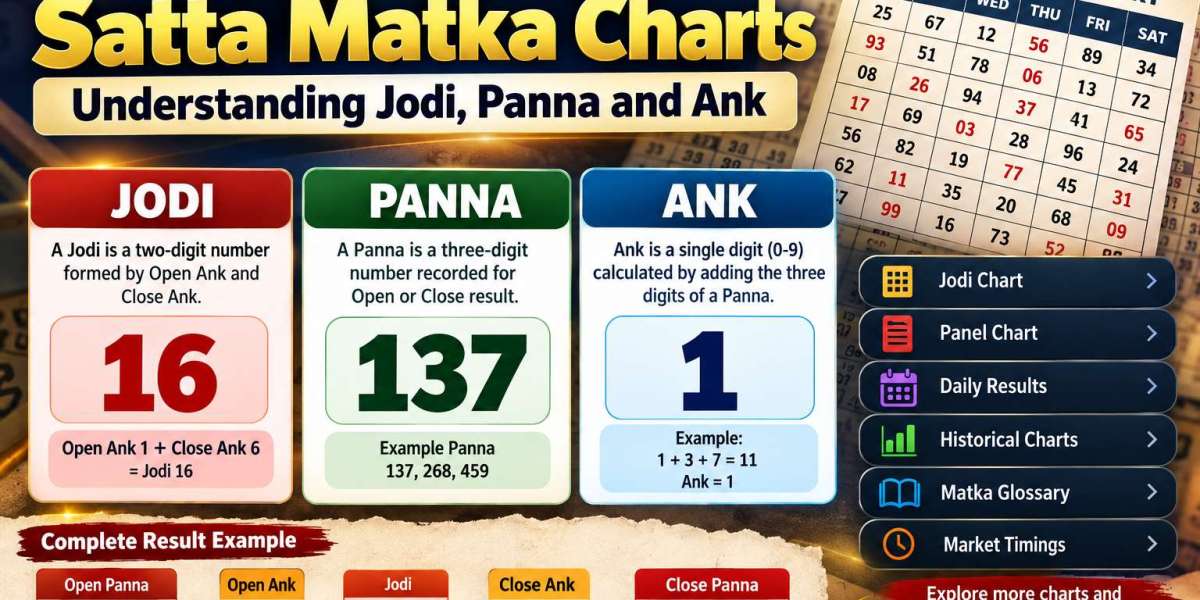

Satta Matka charts contain historical number records arranged in formats that can look confusing to first-time readers. Understanding terms such as Jodi, Panna, Ank, Open and Close makes it easier to interpret a chart, check a previously declared result and compare records from different dates.
Whether someone is exploring a historical chart or learning the terminology used on result websites, the first step is to understand how the numbers are organized. This guide explains the basic concepts, demonstrates the arithmetic with examples and shows how different chart formats serve different informational purposes.
Readers looking for chart references and historical records can explore SattaMatkaResult.live, which provides result tables, Jodi charts, Panel charts and educational resources.
What Is a Satta Matka Chart?
A Satta Matka chart is a table that organizes recorded results by date, market or week. Depending on its format, it may display two-digit Jodi values, three-digit Panna values, or a complete result line containing both.
Historical charts can help readers verify what was recorded on a particular date. They also make it easier to compare records across weeks without searching through separate result announcements.
For a broader overview of available records, visit the Satta Matka result and chart homepage.
A chart should be understood as a historical reference, not as a reliable way to forecast future results. Past outcomes do not establish which number will appear next.
Understanding Ank: The Basic Number
Ank refers to a single digit from 0 to 9. In a typical result line, the Ank is calculated by adding the three digits of a Panna and retaining the final digit of the sum.
For example, consider the Panna 137.
Add the digits: 1 + 3 + 7 = 11.
Retain the last digit of the total.
The resulting Ank is 1.
Consider another example: Panna 268.
Add the digits: 2 + 6 + 8 = 16.
Retain the last digit.
The resulting Ank is 6.
These calculations explain how the single-digit values shown in a result line relate to the three-digit figures beside them.
Readers who want to explore this terminology further can consult the Matka Glossary, which explains commonly used terms and their meanings.
What Is a Panna?
A Panna, also called a Patti, is a three-digit number recorded for an Open or Close result. Examples include 137, 268 and 459.
Pannas are an important part of a Panel Chart because they preserve the full three-digit record instead of showing only the resulting two-digit Jodi.
Pannas are commonly grouped into three broad categories:
Single Panna: All three digits are different, such as 137.
Double Panna: Two digits are the same, such as 112.
Triple Panna: All three digits are the same, such as 777.
These categories describe the arrangement of digits. They do not indicate that one category is more likely to appear in a future draw.
For a reference list organized by the Ank each Panna produces, see the Game Zone and number reference tables.
What Is a Jodi?
A Jodi is a two-digit pair formed by placing the Open Ank first and the Close Ank second.
For example, if the Open Panna is 137 and the Close Panna is 268, the calculations are:
Open Panna: 1 + 3 + 7 = 11, giving Ank 1.
Close Panna: 2 + 6 + 8 = 16, giving Ank 6.
Open Ank followed by Close Ank: 16.
Therefore, the Jodi is 16.
There are 100 possible two-digit combinations, ranging from 00 to 99. A leading zero is significant: 07 is a two-digit Jodi, not simply the number 7.
The 100 Jodi Grid is a useful reference for understanding the full range of possible pairs and seeing how Jodi values are organized.
Open, Close and the Complete Result Line
A result line combines the Open Panna, Jodi and Close Panna into one record.
Consider this illustrative example:
137 – 16 – 268
| Component | Example | Meaning |
|---|---|---|
| Open Panna | 137 | First three-digit record |
| Open Ank | 1 | Last digit of 1 + 3 + 7 = 11 |
| Jodi | 16 | Open Ank followed by Close Ank |
| Close Ank | 6 | Last digit of 2 + 6 + 8 = 16 |
| Close Panna | 268 | Second three-digit record |
This format allows readers to check whether the two-digit Jodi agrees with the Ank values calculated from the Pannas.
It is important to distinguish between a complete result and a partial result. If only the Open result has been declared, the Close portion may remain unavailable until the relevant announcement is made.
Jodi Chart vs Panel Chart: What Is the Difference?
Although both charts can cover the same historical dates, they display different levels of detail.
| Feature | Jodi Chart | Panel Chart |
|---|---|---|
| Main information | Two-digit Jodi | Open Panna, Jodi and Close Panna |
| Typical layout | One row per week | One row per week |
| Best use | Reviewing recorded Jodi values | Checking the complete result line |
| Level of detail | Compact | More comprehensive |
A Jodi Chart is easier to scan when the aim is to locate a two-digit result quickly. A Panel Chart is more useful when the reader wants to check the original three-digit records associated with that Jodi.
To understand the reading process in more detail, see the Reading Jodi and Panel Charts guide.
How to Read a Historical Chart Step by Step
Reading a chart becomes easier when the process follows a consistent order.
Step 1: Choose the correct market
Start by identifying the market whose historical record you want to examine. Avoid comparing rows from different markets as if they belonged to the same schedule.
Step 2: Locate the relevant date or week
Most historical charts group results by week. Check the date labels and year indicators before reading a particular cell.
Step 3: Decide which chart format you need
Use a Jodi Chart when you need the two-digit pair. Choose a Panel Chart when you need the full Open–Jodi–Close line.
Step 4: Check the number structure
If a complete result is available, add the digits of each Panna and retain the last digit. The Open and Close Anks should correspond to the two digits of the Jodi.
Step 5: Understand blank or pending entries
An empty cell, an off-day marker or an undeclared result should not be treated as a missing number that can be calculated from surrounding entries. Consult the relevant market schedule and record status.
Step 6: Verify the historical entry
If a result appears inconsistent, compare the date, market and full result line. A chart is most useful when the information is checked against the correct record rather than an undated screenshot.
For readers who want to compare records from a particular day, the SattaMatkaResult.live homepage provides access to its result and chart resources.
Why Historical Records and Dates Matter
Date labels are essential because the same chart may contain many weeks of records. Without dates, readers can easily confuse one week's result with another or misinterpret a record from a different market.
Historical records also help distinguish between a declared result and an unverified claim circulating elsewhere. When checking a record, confirm the market name, date and complete number line.
Some markets operate late into the night, and their sessions may finish after midnight. In such cases, understanding the market's schedule helps readers interpret which session a record belongs to.
The Popular Matka Markets guide provides additional context about market schedules and the different types of result pages.
Common Mistakes When Reading Jodi and Panna Charts
Beginners often make a few avoidable mistakes when interpreting number tables.
Confusing Panna with Jodi: A Panna contains three digits, whereas a Jodi contains two. They represent different parts of the result.
Ignoring the order of the digits: In a Jodi, the Open Ank comes first and the Close Ank comes second. Reversing the order changes the pair.
Dropping leading zeros: A value such as 07 should retain its leading zero when displayed as a two-digit Jodi.
Treating blanks as results: An undeclared entry or a no-draw day is not evidence of a particular number.
Assuming historical patterns predict future outcomes: A pair appearing frequently in an earlier period does not mean it is more likely to appear in the next draw. Historical charts describe past records; they do not guarantee future results.
For more context on common claims about number patterns and formulas, readers can consult the Matka Formulas and Fact Check guide.
Frequently Asked Questions
What is the difference between Ank and Jodi?
An Ank is a single digit from 0 to 9. A Jodi is a two-digit pair formed by placing the Open Ank before the Close Ank.
How is the Ank calculated from a Panna?
Add the three digits of the Panna and retain the final digit of the total. For example, 459 gives 4 + 5 + 9 = 18, so its Ank is 8.
Why are Jodi Charts easier to read than Panel Charts?
Jodi Charts display only the two-digit pairs, making them more compact. Panel Charts include the Open Panna and Close Panna as well, which provides more detail for verifying a complete record.
Can historical charts predict the next result?
No. Historical results can be used to understand and verify previously recorded outcomes, but they cannot reliably predict a future draw.
Where can readers find different chart formats?
Readers can explore SattaMatkaResult.live for its result board, Jodi and Panel Charts, glossary and related reference resources.
Conclusion
Understanding Satta Matka charts starts with three basic terms: Ank, Panna and Jodi. The Ank represents a single digit derived from a three-digit Panna, while the Jodi combines the Open Ank and Close Ank into a two-digit pair. A Panel Chart brings these elements together in one complete historical record.
By checking market names, dates and number structures carefully, readers can interpret chart tables more accurately and avoid confusing historical information with predictions.
For additional explanations and chart references, visit SattaMatkaResult.live and explore its related educational pages. Historical information should always be treated as a record of past outcomes, not a guarantee of future results.





