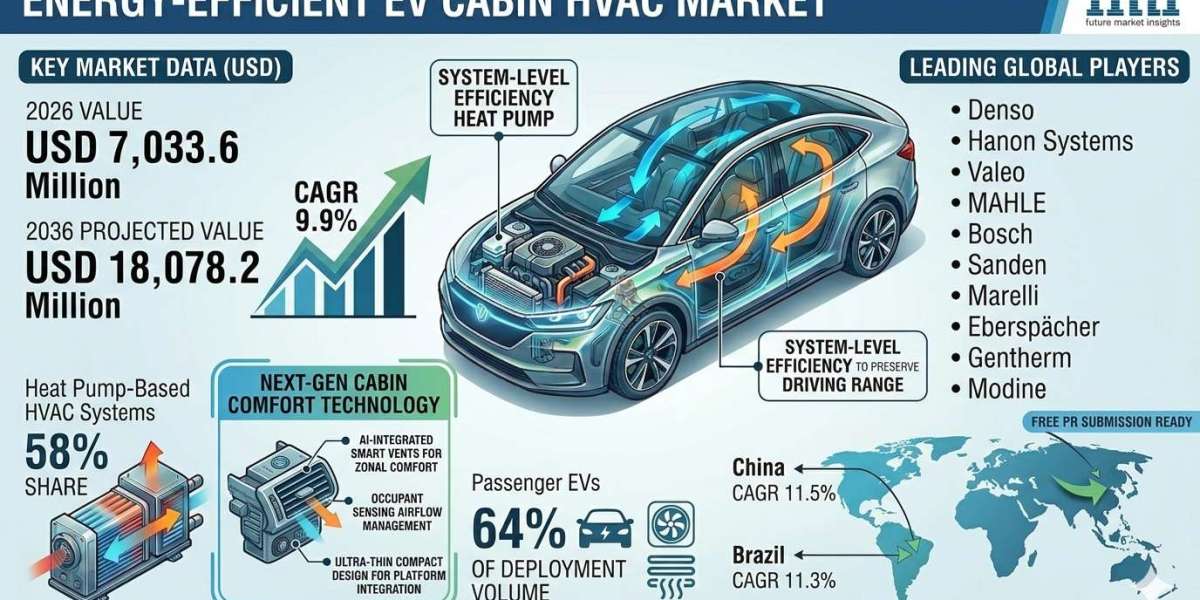

The global energy-efficient EV cabin HVAC market is set for robust expansion, driven by electrification momentum and the structural importance of thermal management in electric vehicles. Valued at USD 7,033.6 million in 2026, the market is projected to reach USD 18,078.2 million by 2036, registering a CAGR of 9.9%. As cabin HVAC remains one of the largest auxiliary energy loads in EVs, OEMs are prioritizing system-level efficiency to preserve driving range under real-world heating and cooling conditions.
Investment is increasingly focused on heat pump architectures, integrated thermal loops, and intelligent control systems embedded at the vehicle platform stage. Growth reflects not just rising EV production but deeper integration of energy-optimized HVAC systems aligned with battery and power electronics management strategies.
Key Takeaways
- Market to grow from USD 7,033.6 million (2026) to USD 18,078.2 million (2036).
- CAGR of 9.9% driven by EV adoption and range optimization needs.
- Heat pump-based HVAC systems lead with 58% share.
- Passenger EVs account for 64% of deployment volume.
- Integrated thermal management holds 46% of feature integration demand.
- China and Brazil lead global growth momentum.
Market Dynamics and Growth Prospects
Energy-efficient cabin HVAC systems are critical to balancing occupant comfort with battery range preservation. Unlike internal combustion vehicles, EVs cannot rely on waste heat, making efficient heating and cooling solutions essential. Heat pump-based systems dominate adoption because they transfer heat rather than generate it, reducing electrical load during extreme weather conditions.
OEM procurement increasingly emphasizes variable-speed compressors, inverter-driven systems, and intelligent software calibration to optimize power draw. Integration with battery and power electronics cooling loops improves overall system-level energy distribution. Real-world efficiency performance, durability across frequent duty cycles, and compliance with refrigerant regulations shape supplier selection.
However, growth is moderated by system complexity, cost sensitivity in entry-level EVs, and heat pump performance degradation in very low temperatures, often requiring supplemental resistive heating solutions.
Request a free Sample Report - https://www.futuremarketinsights.com/reports/sample/rep-gb-30745
Regional Analysis
China leads global expansion with an 11.5% CAGR, driven by large-scale EV production, urban density, and regulatory efficiency mandates. Heat pump integration is increasingly standardized across domestic EV platforms.
Brazil follows at 11.3%, where high ambient temperatures significantly elevate cooling loads. Electric bus and fleet electrification programs intensify demand for efficient HVAC systems.
The United States grows at 9.5%, supported by platform-level thermal optimization strategies and strong consumer demand for range-consistent climate control across diverse climates.
South Korea records 9.3% CAGR, driven by export-oriented EV platforms integrating coordinated battery and cabin thermal management systems.
Germany expands at 9.1%, influenced by cold-climate heating requirements and regulatory-driven efficiency targets embedded within new EV architectures.
Innovation and Emerging Technologies
Innovation centers on advanced heat pump modules, low-ambient heating optimization, and integrated thermal management systems. Hybrid heat pump architectures extend operational envelopes in extreme climates by combining multiple heat sources.
Software sophistication is increasing, incorporating predictive thermal management algorithms and connected vehicle data to pre-condition cabins while minimizing range loss. Smart vent-enabled airflow management improves localized comfort while reducing total system energy draw.
Component innovation includes lightweight compressors, low-global-warming-potential refrigerants, and inverter-integrated power electronics designed for high efficiency under transient load conditions.
Leading and Emerging Players Driving Competition
- Denso
- Hanon Systems
- Valeo
- MAHLE
- Bosch
- Sanden
- Marelli
- Eberspächer
- Gentherm
- Modine
- Report Coverage & Deliverables
- Market size and forecast (USD million) from 2026–2036
- Segmentation by HVAC architecture, vehicle segment, and feature integration
- Country-level CAGR analysis across 40+ markets
- Competitive benchmarking of leading suppliers
- Evaluation of COP efficiency, low-ambient performance, and transient response
- Analysis of integration with battery and power electronics thermal systems
- Assessment of refrigerant compliance and NVH standards
Future Outlook
By 2036, energy-efficient cabin HVAC systems will be foundational to EV platform design rather than optional upgrades. Integration depth, intelligent control software, and climate adaptability will determine value capture.
As EV penetration rises globally, OEMs will increasingly prioritize thermal architectures that protect range consistency across extreme climates. Suppliers capable of delivering scalable, heat pump-centric systems with validated real-world efficiency performance will define the next decade of competitive advantage in electric mobility.
Request Sample Report with Complete Market Breakdowns and Growth Estimates:
https://www.futuremarketinsights.com/reports/energy-efficient-ev-cabin-hvac-market
Have a specific Requirements and Need Assistant on Report Pricing or Limited Budget please contact us – sales@futuremarketinsights.com
About Future Market Insights (FMI)
Future Market Insights, Inc. (FMI) is an ESOMAR-certified, ISO 9001:2015 market research and consulting organization, trusted by Fortune 500 clients and global enterprises. With operations in the U.S., UK, India, and Dubai, FMI provides data-backed insights and strategic intelligence across 30+ industries and 1200 markets worldwide.
Why Choose FMI: https://www.futuremarketinsights.com/why-fmi