
The global construction equipment attachment market is entering a steady but strategically important growth phase, driven less by machinery expansion and more by the industry’s push toward operational flexibility, asset efficiency, and project-specific adaptability. As infrastructure pipelines expand across emerging and developed economies alike, attachments are emerging as the “hidden productivity layer” of construction fleets—enabling a single machine to perform multiple roles without proportional capital escalation.
From excavation and demolition to drilling, grading, and material handling, attachments are reshaping how contractors, rental firms, and OEMs think about equipment utilization in an increasingly cost-sensitive and time-pressured industry.
Get detailed market forecasts, competitive benchmarking, and pricing trends- https://www.factmr.com/connectus/sample?flag=S&rep_id=5134
Quick Market Snapshot
- Market size (2024): US$ 6.36 billion
- Forecast (2034): US$ 9.59 billion
- CAGR (2024–2034): 4.2%
- North America share (2024): 24.8%
- East Asia market value (2024): US$ 1.44 billion
- Fast-growing equipment type: Compact track loaders (US$ 3.09 billion projected by 2034)
- Key distribution channel: OEM segment (US$ 5.27 billion projected by 2034)
Market Overview: Why Attachments Are Moving From “Add-Ons” to Core Assets
Construction equipment attachments—once treated as supplementary tools—are now central to fleet strategy. The economic logic is straightforward: instead of purchasing multiple machines for specialized tasks, contractors increasingly rely on a single base machine fitted with interchangeable attachments.
This shift is being reinforced by three structural industry pressures:
- Rising infrastructure investment across India, Mexico, Southeast Asia, and parts of Africa
- Increasing cost of heavy equipment ownership and maintenance
- Growth of rental fleets offering diversified attachment inventories
In effect, attachments are becoming a capital efficiency mechanism, not just a functional enhancement.
Market Growth Drivers: What’s Structurally Expanding Demand
- Infrastructure-Led Construction Expansion
Large-scale infrastructure development—roads, housing, industrial corridors, and urban redevelopment—is accelerating demand for flexible equipment configurations. Emerging markets, particularly India and Mexico, are playing a disproportionate role in volume growth.
- Shift Toward Multi-Function Equipment Utilization
Contractors are increasingly prioritizing equipment that can perform multiple roles through attachments. This reduces idle time, improves ROI per machine, and minimizes fleet redundancy on job sites.
- Expansion of the Equipment Rental Economy
The global rental model is a major structural driver. Rental providers are maintaining large, diversified attachment inventories to meet short-term, project-specific requirements. This is making advanced attachments more accessible to mid-sized contractors.
- Technology Upgrades in Attachment Design
OEMs are introducing stronger materials, hydraulic optimization, and semi-intelligent systems that improve compatibility and performance. These upgrades are extending product lifecycle and improving operational reliability.
- Rising Demand for Specialized Job Functions
Use cases such as:
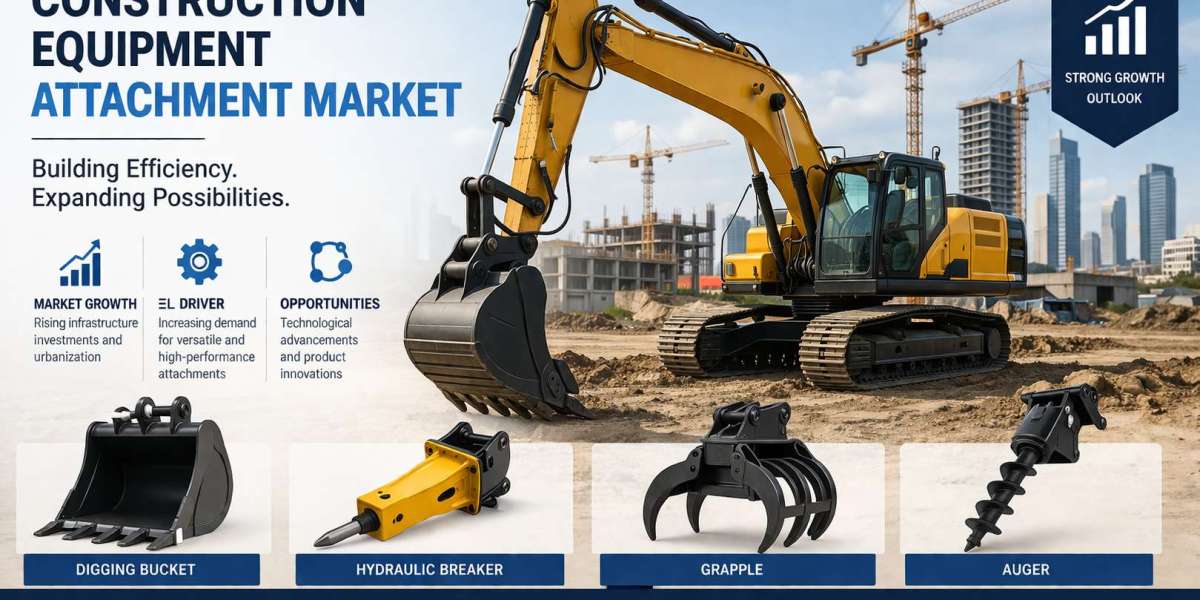
- Hydraulic breakers for demolition
- Augers for precision drilling
- Grapples for material handling
are increasing demand for task-specific attachments rather than generic tools.
Market Challenges: Where Operational Friction Still Exists
- Maintenance Dependency and Downtime Risk
Attachments require frequent maintenance to maintain performance and safety standards. For contractors, this introduces downtime risk that can delay project timelines and increase operational costs.
- Compatibility and Integration Complexity
Despite OEM dominance, mixed fleets and aftermarket systems can create compatibility gaps, particularly in rental-heavy ecosystems.
- Lifecycle Cost Pressure
While attachments reduce upfront equipment costs, cumulative maintenance, storage, and replacement cycles can erode long-term savings if not managed effectively.
- Uneven Adoption in Developing Markets
In price-sensitive regions, adoption is often constrained by limited awareness of lifecycle cost benefits versus upfront purchase costs.
Opportunity Landscape: Where Growth Is Concentrating
- Rental-Centric Expansion Model
The most significant opportunity lies in the continued expansion of rental ecosystems. Contractors increasingly prefer access over ownership, making attachments a high-turnover, high-utilization asset class.
- Electrification and Smart Attachments
Emerging designs incorporating sensors, telematics, and automated diagnostics are opening new value layers around predictive maintenance and performance tracking.
- Disaster Response and Emergency Construction
Countries like Japan demonstrate how attachments play a critical role in post-disaster recovery—supporting rapid debris removal and reconstruction workflows.
- Emerging Market Infrastructure Cycles
Rapid urbanization in Asia-Pacific, Latin America, and parts of Africa is creating long-term demand for flexible construction equipment configurations.
Segmentation Insights: How the Market Is Structuring
By Equipment Type
- Skid steer loaders: High adaptability across urban and industrial sites
- Compact track loaders: Strong traction and stability on soft terrain, increasingly preferred in uneven job conditions
- Mini excavators: Dominant in urban construction and utility work
- Telescopic handlers: Growing use in material handling and logistics-heavy projects
By End User Channel
- OEMs: Leading segment due to compatibility assurance, warranty coverage, and integrated support ecosystems
- Aftermarket providers: Important in cost-sensitive and retrofit-heavy markets
- Rental companies: Fastest operational influence on demand cycles
Regional Analysis: Uneven Growth, Clear Leadership Patterns
North America
North America remains the most mature market, accounting for nearly a quarter of global demand. The United States leads adoption, driven by strong rental penetration and infrastructure modernization. Contractors increasingly rely on attachments to optimize fleet utilization rather than expand machine count.
East Asia
East Asia represents one of the fastest-expanding regions, with significant activity in construction, mining, and industrial development. China’s large-scale infrastructure programs and Japan’s disaster-response requirements are key demand anchors.
Europe
European demand is shaped by efficiency regulations, sustainability goals, and a strong focus on equipment optimization. OEM-driven ecosystems dominate procurement behavior.
Emerging Regions
India, Southeast Asia, Latin America, and parts of the Middle East are witnessing accelerated adoption due to infrastructure expansion and rental market growth, although price sensitivity remains a moderating factor.
Competitive Landscape: OEM-Led but Increasingly Tech-Driven
The market is moderately consolidated, with global OEMs and specialized manufacturers shaping innovation standards. Key players include:
Caterpillar Inc., Komatsu Limited, Volvo Construction Equipment, CNH Industrial N.V., Doosan Corporation, Kubota Corporation, Wacker Neuson SE, Hitachi Construction Machinery Co., Ltd., and Paladin Attachments.
Competitive differentiation is increasingly defined by:
- OEM integration and compatibility assurance
- Smart attachments with telematics and tracking capabilities
- Expanded rental ecosystem partnerships
- Durability and lifecycle efficiency rather than just performance specs
Recent product and platform developments—such as telematics-enabled tracking systems and modular attachment frames—signal a broader shift toward data-integrated construction ecosystems.
Strategic Implications for Industry Leaders
For executives and procurement teams, the market signals a shift in how construction fleets are optimized:
- Capital strategy shift: From equipment ownership to modular capability acquisition
- Procurement evolution: Attachments increasingly evaluated as lifecycle assets, not accessories
- Rental expansion: Fleet operators must diversify attachment portfolios to remain competitive
- OEM advantage: Integration ecosystems are becoming more valuable than standalone equipment performance
- Operational focus: Downtime reduction and maintenance planning are now central to ROI calculations
Future Outlook: Toward Modular, Intelligent Construction Ecosystems
Over the next decade, the construction equipment attachment market is expected to evolve from a mechanical add-on ecosystem into a digitally coordinated equipment intelligence layer.
Three structural shifts are likely to define the next phase:
- Wider adoption of sensor-enabled and telematics-linked attachments
- Increased convergence between rental platforms and OEM ecosystems
- Greater emphasis on automation-ready attachments designed for semi-autonomous job sites
As construction projects become more complex and compressed in timelines, attachments will increasingly determine not just productivity—but competitiveness itself.
Executive Takeaways
- The attachment market is becoming a core efficiency driver in construction operations, not a secondary equipment category
- Growth is being fueled by infrastructure expansion and rental-driven asset strategies
- OEM dominance is strengthening due to integration, warranty assurance, and system compatibility
- Maintenance and downtime remain key friction points affecting adoption economics
- Smart attachments and telematics integration represent the next competitive frontier
- The market’s long-term value lies in enabling flexible, modular construction ecosystems
Browse Full Report - https://www.factmr.com/report/5134/construction-equipment-attachment-market
To View Related Report:
Construction Glass Market https://www.factmr.com/report/construction-glass-market
Construction Elevators Market https://www.factmr.com/report/construction-elevators-market
Construction Robot Market https://www.factmr.com/report/construction-robot-market
Construction Lasers Market https://www.factmr.com/report/construction-lasers-market