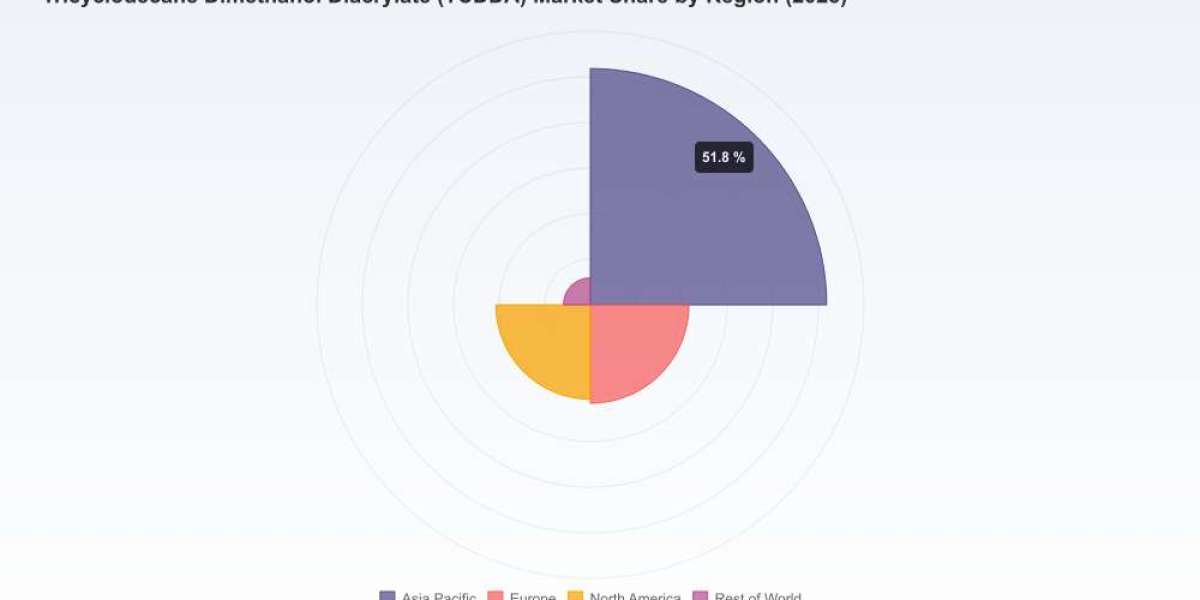

Worldwide Tricyclodecane Dimethanol Diacrylate (TCDDA) Market — Strategic Outlook for 2026 Decision-Making
PW Consulting’s latest market study on Tricyclodecane Dimethanol Diacrylate (TCDDA) synthesizes five years of historical performance (2020–2025) and a forward-looking forecast (2026–2032) into an actionable intelligence package tailored for commercial leaders, product strategists, and investors preparing for 2026. The headline: the global TCDDA market is on a sustained recovery and expansion path — rising from approximately USD 23.5 Million in 2020 to USD 32.45 Million in the 2025 base year, and projected to reach roughly USD 50.43 Million by 2032, reflecting a compound annual growth rate (CAGR) of 6.5% across the forecast horizon.
Worldwide Pet CBD Gummies Market
Why this report matters for 2026
- Timing decisions on sourcing, formulation, and capacity: our model isolates inflection points in the supply chain where input-price swings and regulatory shifts create narrow windows for locking in advantaged supply.
- Portfolio and R&D prioritization: we identify which product vectors (e.g., high-purity vs. industrial grades; UV-curable systems vs. specialty electronics applications) are structurally advantaged under alternate 2026 scenarios.
- M&A and partnership screening: concentration metrics and competitive capability mapping highlight where bolt-on acquisitions or co-development agreements deliver the fastest route to differentiated offerings.
- Regulatory readiness and product stewardship: practical compliance pathways for a substance increasingly scrutinized under modern chemical regulations.
Data-driven snapshot (high-level)
- Historical market progression: USD 23.5 Million (2020) → USD 32.45 Million (2025 base year).
- Near-term outlook: the market is modeled to grow to roughly USD 35.4 Million in 2026, with multi-year expansion to an estimated USD 50.43 Million by 2032.
- Compound growth: modeled CAGR of 6.5% across 2026–2032.
- Market concentration: the top three suppliers account for a material share of industry supply (CR3 ~64.3%), while the top five reach an even higher concentration (CR5 ~81.1%), underscoring an oligopolistic dynamic with room for specialized entrants.
Key market dynamics shaping 2026 strategies
- Input-price volatility and margin pressure — two immediate levers: recent industry data indicate acrylic acid spot prices in Northeast Asia averaged about USD 1,050/mt in Q4 2023 (up ~12% versus Q3) and dicyclopentadiene (DCPD) pricing spikes in the U.S. approached USD 1,200/mt in early 2024 amid crude-driven volatility. These shifts directly affect TCDDA feedstock economics and favor companies with integrated upstream access, long-term procurement contracts, or active hedging programs.
- Regulatory and product stewardship risk: TCDDA (CAS 42537-25-1) has been classified under EU CLP as Skin Sens. 1B and Eye Irrit. 2. This classification increases compliance costs for formulators, influences labeling and worker-protection protocols, and accelerates demand for lower-exposure formulations and safety-by-design innovation.
- End-market pull and technological substitution: radiation-curable systems (UV/EB) continue to expand across coatings, inks, adhesives, and selective electronics applications; however, heightened performance requirements (hardness, low-volatility, low-shrinkage) push customers toward differentiated grades and co-monomer design.
- Supply structure and strategic sourcing: the CR3/CR5 concentration indicates that commercial negotiations will increasingly center on multi-year commitments, quality assurance programs for high-purity grades, and tailored logistics solutions for time-sensitive electronic and optical customers.
Competitive landscape — capabilities that matter in 2026
Our competitive analysis profiles the incumbent and specialist manufacturers who shape technology, quality thresholds, and customer expectations. The report contains operational profiles and capability assessments for leading suppliers, including:
Worldwide Industrial Grade Potassium Chloride Market
- Arkema Sartomer (Colombes, France) — producers of SR 833, a difunctional alicyclic acrylate used as a reactive diluent to enhance abrasion resistance and weatherability in UV/EB-curable formulations. Strategic strength: application development and global supply footprint. (https://sartomer.arkema.com)
- BASF (Ludwigshafen, Germany) — supplies Laromer TCD 935, a low-volatility difunctional acrylate tailored for high-performance radiation-curable coatings and overprint varnishes. Strategic strength: formulation science and large-scale specialty chemical manufacturing. (https://www.basf.com)
- Eternal Materials Co., Ltd. (Taoyuan City, Taiwan) — supplier of ET597 TCDDA, positioned for UV-curable adhesives, coatings, and 3D printing resins with an emphasis on flexibility and chemical resistance. Strategic strength: regional manufacturing agility and formulation partnerships. (https://www.eternal-group.com)
- Miwon Specialty Chemical Co., Ltd. (Hwaseong-si, South Korea) — producer of Miramer M336 for radiation-curing systems in electronics coatings and optical films with low shrinkage properties. Strategic strength: electronics market orientation and quality control. (https://www.miwonsc.com)
- Shin-Nakamura Chemical Co., Ltd. (Wakayama, Japan) — provides AN-837, a TCDDA-grade difunctional acrylate for high-hardness and high-adhesion UV-curable inks and coatings on plastics. Strategic strength: specialized formulation know-how for demanding substrates. (https://www.shin-nak.com)
Each profile in the full report maps product portfolios to target applications, lists manufacturing and technology differentiators, and evaluates strategic options such as licensing, JV potential, and backward integration.
Bean Pasta Market
What’s inside the report — practical deliverables
- Granular, reproducible market model (USD Million base and forecast series; historical 2020–2025; forecast 2026–2032) with scenario toggles for input costs, regulatory shock, and end-market adoption curves.
- Segment-level demand drivers and volume dynamics by product grade and application class — presented as tables and interactive charts. Note: selective segment-level numeric detail is intentionally reserved for the full report to preserve competitive value.
- Supplier capability matrix and quality-risk framework to rank manufacturers on technical capability, scale, geographic flexibility, and compliance posture.
- Supply-chain stress tests and hedging playbooks that translate commodity-price scenarios into contract and inventory actions for procurement teams.
- Commercial playbooks for formulators and OEMs: go-to-market roadmaps for premium high-purity grades, cost-optimized industrial grades, and specialty formulations for electronics/optical customers.
- M&A screens and valuation heuristics keyed to the industry’s concentration profile and margin dynamics, plus a short list of high-opportunity acquisition archetypes.
- Regulatory compliance checklist aligned to EU and major Asia-Pacific frameworks, and templates for safety data sheet updates, worker protection training, and product substitution assessments.
Actionable recommendations for executives planning 2026 moves
- Procurement & Operations: Establish multi-supplier frameworks with capacity reservations for critical grades; adopt a rolling 12–18 month feedstock hedging policy tied to acrylic acid and DCPD price indices; create contingency plans for regional turnarounds and logistics delays.
- Product & R&D: Prioritize low-exposure, low-volatility formulations and expand pilot-scale work on high-purity monomers that command better margin resilience. Target application-specific validation cycles (e.g., optics, electronics) early in 2026 to capture accelerating demand.
- Commercial: Use the market concentration dynamic to negotiate value-add clauses (technical support, preferential allocation) rather than competing purely on price. Implement outcome-based contracts with key OEM accounts where possible.
- M&A & Corporate Strategy: Focus on tuck-ins that add specialized application capabilities or fill geographic supply gaps; be price-disciplined and use the PW Consulting valuation toolbox included in the report to stress-test offers under adverse input scenarios.
- Compliance & ESG: Update product stewardship strategies to address the EU CLP classification, reassess labelling and worker-safety processes, and communicate mitigation steps to customers to preempt procurement resistance.
Methodology & confidence
PW Consulting’s analysis combines primary interviews with supply-chain participants, company financials, customs and trade flows, patent and formulation analysis, and regulatory databases. The report’s base year is 2025 with historical coverage from 2020–2025 and a forecast window of 2026–2032. Numerical outputs are expressed in USD Million and reflect conservative-to-aggressive scenario ranges; the headline CAGR across our forecast scenarios is 6.5%.
How to use this intelligence
- Procurement leaders: incorporate our supply-stress scenarios into contract cadence planning for 2026 and extend supplier scorecards to include regulatory-readiness metrics.
- Product and application teams: use the report’s technology-readiness mapping to sequence development sprints for low-shrinkage, low-VOC UV-resins that are likely to unlock premium margins.
- Corporate strategy & investors: deploy the M&A screen to identify value-rich targets and test deal returns against raw-material price volatility mapped in the report.
Next steps
For decision-makers who need the complete segmentation tables, supplier ranking sheets, scenario-model files, and contract playbooks, PW Consulting provides the full downloadable report and bespoke briefings. The executive summary above is designed to be fully actionable while intentionally withholding detailed segment-level numerical breakouts to preserve the competitive value of the complete dataset — access to those datasets and the interactive forecast model is available through PW Consulting’s report channel.
Contact PW Consulting to schedule a tailored briefing and receive the full Worldwide TCDDA Market report and the underlying forecast model for boardroom-ready decision support in 2026.
For detailed analysis of this topic, please visit the official page:Worldwide Tricyclodecane Dimethanol Diacrylate (TCDDA) Market
Lacy Lee
Senior Marketing Manager
sales@pmarketresearch.com
00852-95632430
PW Consulting: www.pmarketresearch.com